 |
PDBsum entry 5k3h

|
|
|
|
|
|

|

|

|

|
|

|
|

|
|

|
|

|
|
|
 |

|

|
|
|
|
|
|
|
|
|
|
|
|
|
|
|
|
|
|
|
|
|
|
|
|
|
|
|
|
|
|
|
|
|
Oxidoreductase
|
PDB id
|
|
|
|
5k3h
|
|
|
|
|
|
|
|
|
|
|
|
|
|
|

|

|

|
|
|
|
|
|
|
PDB id:
|
|
|
|
| Name: |
|
Oxidoreductase
|
|
|
Title:
|
|
Crystals structure of acyl-coa oxidase-1 in caenorhabditis elegans, apo form-ii
|
|
Structure:
|
|
Acyl-coenzyme a oxidase. Chain: a, b, c, d, e, f, g, h. Engineered: yes
|
|
Source:
|
|
Caenorhabditis elegans. Organism_taxid: 6239. Gene: acox-1, cele_f08a8.1, f08a8.1. Expressed in: escherichia coli. Expression_system_taxid: 469008.
|
|
Resolution:
|
|
|
2.48Å
|
R-factor:
|
0.193
|
R-free:
|
0.232
|
|
|
Authors:
|
|
X.Zhang,K.Li,R.A.Jones,S.D.Bruner,R.A.Butcher
|
|
Key ref:
|
|
X.Zhang
et al.
(2016).
Structural characterization of acyl-CoA oxidases reveals a direct link between pheromone biosynthesis and metabolic state in Caenorhabditis elegans.
Proc Natl Acad Sci U S A,
113,
10055-10060.
PubMed id:
DOI:
|
|
|
Date:
|
|
|
19-May-16
|
Release date:
|
24-Aug-16
|
|
|
|
|
|
|
PROCHECK
|

|
|
|
|
|
Headers
|
|
|
|
References
|
|
|
|
|
|

|
|
O62140
(O62140_CAEEL) -
Acyl-coenzyme A oxidase acox-1.1 from Caenorhabditis elegans
|
|
|
|
Seq:
Struc:
|
|
|
|
674 a.a.
634 a.a.
|
|

|

|
|
|
|
|
|
|
|
|
|
|
|
Key: |
 |
PfamA domain |
|
|
 |
Secondary structure |
|
 |
CATH domain |
|
|
|
|
|
|
|
|
|
|
|
|
|
Enzyme class 2:
|
|
E.C.1.3.3.-
- ?????
|
|
|
|
|
|
|
Enzyme class 3:
|
|
E.C.1.3.3.6
- acyl-CoA oxidase.
|
|
|
|
|
|
|
Reaction:
|
|
a 2,3-saturated acyl-CoA + O2 = a (2E)-enoyl-CoA + H2O2
|
|
|
|
|
|
2,3-saturated acyl-CoA
|
+
|
 O2
O2
|
=
|
(2E)-enoyl-CoA
|
+
|
 H2O2
H2O2
|
|
|
|
|
|
|
|
|
|
Cofactor:
|
|
FAD
|
|
|
|
|
|
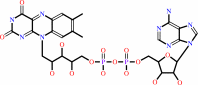 FAD
FAD
|
|
|
|
|
|
|
Note, where more than one E.C. class is given (as above), each may
correspond to a different protein domain or, in the case of polyprotein
precursors, to a different mature protein.
|
|
|
|
Molecule diagrams generated from .mol files obtained from the
KEGG ftp site
|
|
|
|
|
|
|
|
|
|
|
|
|
|
 |
|
|
|
|
|
|
| |
|
|
| |
|
DOI no:
|
Proc Natl Acad Sci U S A
113:10055-10060
(2016)
|
|
PubMed id:
|
|
|
|
|
|
| |
|
Structural characterization of acyl-CoA oxidases reveals a direct link between pheromone biosynthesis and metabolic state in Caenorhabditis elegans.
|
|
X.Zhang,
K.Li,
R.A.Jones,
S.D.Bruner,
R.A.Butcher.
|
|
|
|
|
| |
ABSTRACT
|
|
|
|
| |
|
|
Caenorhabditis elegans secretes ascarosides as pheromones to communicate with
other worms and to coordinate the development and behavior of the population.
Peroxisomal β-oxidation cycles shorten the side chains of ascaroside precursors
to produce the short-chain ascaroside pheromones. Acyl-CoA oxidases, which
catalyze the first step in these β-oxidation cycles, have different side
chain-length specificities and enable C. elegans to regulate the production of
specific ascaroside pheromones. Here, we determine the crystal structure of the
acyl-CoA oxidase 1 (ACOX-1) homodimer and the ACOX-2 homodimer bound to its
substrate. Our results provide a molecular basis for the substrate specificities
of the acyl-CoA oxidases and reveal why some of these enzymes have a very broad
substrate range, whereas others are quite specific. Our results also enable
predictions to be made for the roles of uncharacterized acyl-CoA oxidases in C.
elegans and in other nematode species. Remarkably, we show that most of the C.
elegans acyl-CoA oxidases that participate in ascaroside biosynthesis contain a
conserved ATP-binding pocket that lies at the dimer interface, and we identify
key residues in this binding pocket. ATP binding induces a structural change
that is associated with tighter binding of the FAD cofactor. Mutations that
disrupt ATP binding reduce FAD binding and reduce enzyme activity. Thus, ATP may
serve as a regulator of acyl-CoA oxidase activity, thereby directly linking
ascaroside biosynthesis to ATP concentration and metabolic state.
|
|
|
|
|
|
|
|
|
|
|
|
|
|
|
|
|
|
 |
 |
 |
|


 Links
Links


