 |
PDBsum entry 4ymj

|
|
|
|
|
|

|

|

|

|
|

|
|

|
|

|
|

|
|

|
|

|
|

|
|
|
 |

|

|
|
|
|
|
|
|
|
|
|
|
|
|
|
|
|
|
|
|
|
|
|
|
|
|
|
|
|
|
|
|
|
|
|
|
|
Transferase/transferase inhibitor
|
PDB id
|
|
|
|
4ymj
|
|
|
|
|
|
|
|
|
|
|
|
|
|
|

|

|

|
|
|
|
|
|
|
PDB id:
|
|
|
|
| Name: |
|
Transferase/transferase inhibitor
|
|
|
Title:
|
|
(R)-2-phenylpyrrolidine substitute imidazopyridazines: a new class of potent and selective pan-trk inhibitors
|
|
Structure:
|
|
Nt-3 growth factor receptor. Chain: a, b. Synonym: gp145-trkc,trk-c,neurotrophic tyrosine kinase receptor type 3,trkc tyrosine kinase. Engineered: yes. Other_details: sequence refers to ntrk3 isoform b precursor (np_002521.2)
|
|
Source:
|
|
Homo sapiens. Human. Organism_taxid: 9606. Gene: ntrk3, trkc. Expressed in: spodoptera frugiperda. Expression_system_taxid: 7108. Expression_system_cell_line: sf9.
|
|
Resolution:
|
|
|
2.00Å
|
R-factor:
|
0.166
|
R-free:
|
0.199
|
|
|
Authors:
|
|
A.Kreusch,P.Rucker,V.Molteni,J.Loren
|
|
Key ref:
|
|
H.S.Choi
et al.
(2015).
(R)-2-Phenylpyrrolidine Substituted Imidazopyridazines: A New Class of Potent and Selective Pan-TRK Inhibitors.
Acs Med Chem Lett,
6,
562-567.
PubMed id:
DOI:
|
|
|
Date:
|
|
|
06-Mar-15
|
Release date:
|
03-Jun-15
|
|
|
|
|
|
|
PROCHECK
|

|
|
|
|
|
Headers
|
|
|
|
References
|
|
|
|
|
|

|
|
Q16288
(NTRK3_HUMAN) -
NT-3 growth factor receptor from Homo sapiens
|
|
|
|
Seq:
Struc:
|
|
|
|
839 a.a.
271 a.a.*
|
|

|

|

|
|
|
|
|
|
|
|
|
|
|
Key: |
 |
PfamA domain |
|
|
 |
Secondary structure |
|
 |
CATH domain |
|
|
*
PDB and UniProt seqs differ
at 3 residue positions (black
crosses)
|
|
|
|
|
|
|
|
|
|
|
|
|
Enzyme class:
|
|
E.C.2.7.10.1
- receptor protein-tyrosine kinase.
|
|
|
|
|
|
|
Reaction:
|
|
L-tyrosyl-[protein] + ATP = O-phospho-L-tyrosyl-[protein] + ADP + H+
|
|
|
|
|
|
L-tyrosyl-[protein]
|
+
|
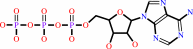 ATP
ATP
|
=
|
O-phospho-L-tyrosyl-[protein]
|
+
|
 ADP
ADP
|
+
|
H(+)
|
|
|
|
|
|
|
|
|
|
|
|
|
Molecule diagrams generated from .mol files obtained from the
KEGG ftp site
|
|
|
|
|
|
|
|
|
|
|
|
|
|
 |
|
|
|
|
|
|
| |
|
|
| |
|
DOI no:
|
Acs Med Chem Lett
6:562-567
(2015)
|
|
PubMed id:
|
|
|
|
|
|
| |
|
(R)-2-Phenylpyrrolidine Substituted Imidazopyridazines: A New Class of Potent and Selective Pan-TRK Inhibitors.
|
|
H.S.Choi,
P.V.Rucker,
Z.Wang,
Y.Fan,
P.Albaugh,
G.Chopiuk,
F.Gessier,
F.Sun,
F.Adrian,
G.Liu,
T.Hood,
N.Li,
Y.Jia,
J.Che,
S.McCormack,
A.Li,
J.Li,
A.Steffy,
A.Culazzo,
C.Tompkins,
V.Phung,
A.Kreusch,
M.Lu,
B.Hu,
A.Chaudhary,
M.Prashad,
T.Tuntland,
B.Liu,
J.Harris,
H.M.Seidel,
J.Loren,
V.Molteni.
|
|
|
|
|
| |
ABSTRACT
|
|
|
|
| |
|
|
Deregulated kinase activities of tropomyosin receptor kinase (TRK) family
members have been shown to be associated with tumorigenesis and poor prognosis
in a variety of cancer types. In particular, several chromosomal rearrangements
involving TRKA have been reported in colorectal, papillary thyroid,
glioblastoma, melanoma, and lung tissue that are believed to be the key
oncogenic driver in these tumors. By screening the Novartis compound collection,
a novel imidazopyridazine TRK inhibitor was identified that served as a
launching point for drug optimization. Structure guided drug design led to the
identification of (R)-2-phenylpyrrolidine substituted imidazopyridazines as a
series of potent, selective, orally bioavailable pan-TRK inhibitors achieving
tumor regression in rats bearing KM12 xenografts. From this work the
(R)-2-phenylpyrrolidine has emerged as an ideal moiety to incorporate in
bicyclic TRK inhibitors by virtue of its shape complementarity to the
hydrophobic pocket of TRKs.
|
|
|
|
|
|
|
|
|
|
|
|
|
|
|
|
|
|
 |
 |
 |
|


 Links
Links


