 |
PDBsum entry 4y9a
|
|

|
|
PDB id:
|
|
|
|
| Name: |
|
Isomerase
|
|
|
Title:
|
|
Crystal structure of triosephosphate isomerase from streptomyces coelicolor
|
|
Structure:
|
|
Triosephosphate isomerase. Chain: a, b, c, d. Synonym: tim,triose-phosphate isomerase. Engineered: yes. Other_details: expression tag: gsh
|
|
Source:
|
|
Streptomyces coelicolor. Organism_taxid: 100226. Strain: a3(2) / m145. Gene: tpia, tpi, sco1945, scc54.05c. Expressed in: escherichia coli. Expression_system_taxid: 469008.
|
|
Resolution:
|
|
|
2.29Å
|
R-factor:
|
0.232
|
R-free:
|
0.282
|
|
|
Authors:
|
|
S.Romero-Romero,A.Rodriguez-Romero,D.A.Fernandez-Velasco
|
|
Key ref:
|
|
S.Romero-Romero
et al.
(2015).
Reversibility and two state behaviour in the thermal unfolding of oligomeric TIM barrel proteins.
Phys Chem Chem Phys,
17,
20699-20714.
PubMed id:
DOI:
|
|
|
Date:
|
|
|
17-Feb-15
|
Release date:
|
15-Jul-15
|
|
|
|
|
|
|
PROCHECK
|

|
|
|
|
|
Headers
|
|
|
|
References
|
|
|
|
|
|

|
|
Q9Z520
(TPIS_STRCO) -
Triosephosphate isomerase from Streptomyces coelicolor (strain ATCC BAA-471 / A3(2) / M145)
|
|
|
|
Seq:
Struc:
|
|
|
|
258 a.a.
254 a.a.
|
|

|

|
|
|
|
|
|
|
|
|
|
|
|
Key: |
 |
PfamA domain |
|
|
 |
Secondary structure |
|
 |
CATH domain |
|
|
|
|
|
|
|
|
|
|
|
|
|
Enzyme class:
|
|
E.C.5.3.1.1
- triose-phosphate isomerase.
|
|
|
|
|
|
|
Reaction:
|
|
D-glyceraldehyde 3-phosphate = dihydroxyacetone phosphate
|
|
|
|
|
|
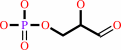 D-glyceraldehyde 3-phosphate
|
=
|
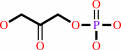 dihydroxyacetone phosphate
|
|
|
|
|
|
|
|
|
|
|
|
|
Molecule diagrams generated from .mol files obtained from the
KEGG ftp site
|
|
|
|
|
|
|
|
|
|
|
|
|
|
 |
|
|
|
|
|
|
| |
|
|
| |
|
DOI no:
|
Phys Chem Chem Phys
17:20699-20714
(2015)
|
|
PubMed id:
|
|
|
|
|
|
| |
|
Reversibility and two state behaviour in the thermal unfolding of oligomeric TIM barrel proteins.
|
|
S.Romero-Romero,
M.Costas,
A.Rodríguez-Romero,
D.Alejandro Fernández-Velasco.
|
|
|
|
|
| |
ABSTRACT
|
|
|
|
| |
|
|
Temperature is one of the main variables that modulate protein function and
stability. Thermodynamic studies of oligomeric proteins, the dominant protein
natural form, have been often hampered because irreversible aggregation and/or
slow reactions are common. There are no reports on the reversible equilibrium
thermal unfolding of proteins composed of (β/α)8 barrel subunits, albeit this
"TIM barrel" topology is one of the most abundant and versatile in
nature. We studied the eponymous TIM barrel, triosephosphate isomerase (TIM),
belonging to five species of different bacterial taxa. All of them were found to
be catalytically efficient dimers. The three-dimensional structure of four
enzymes was solved at high/medium resolution. Irreversibility and kinetic
control were observed in the thermal unfolding of two TIMs, while for the other
three the thermal unfolding was found to follow a two-state equilibrium
reversible process. Shifts in the global stability curves of these three
proteins are related to the organismal temperature range of optimal growth and
modulated by variations in maximum stability temperature and in the enthalpy
change at that temperature. Reversibility appears to correlate with the low
isoelectric point, the absence of a residual structure in the unfolded state,
small cavity volume in the native state, low conformational stability and a low
melting temperature. Furthermore, the strong coupling between dimer dissociation
and monomer unfolding may reduce aggregation and favour reversibility. It is
therefore very thought-provoking to find that a common topological ensemble,
such as the TIM barrel, can unfold/refold in the Anfinsen way, i.e. without the
help of the cellular machinery.
|
|
|
|
|
|
|
|
|
|
|
|
|
|
|
|
|
|
 |
 |
 |
|


 Links
Links


