 |
PDBsum entry 3kl4

|
|
|
|
|
 |
Contents |
 |
|
|
|
|
|
|
|
|
* Residue conservation analysis
|
|
|
|
|
|
|
|
|
|
Enzyme class 1:
|
|
Chain A:
E.C.3.6.5.4
- signal-recognition-particle GTPase.
|
|
|
|
|
|
|
Reaction:
|
|
GTP + H2O = GDP + phosphate + H+
|
|
|
|
|
|
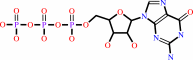 GTP
GTP
|
+
|
H2O
|
=
|
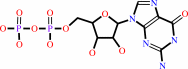 GDP
GDP
|
+
|
 phosphate
|
+
|
H(+)
|
|
|
|
|
|
|
|
|
|
Enzyme class 2:
|
|
Chain B:
E.C.3.4.14.-
- ?????
|
|
|
|
|
|
|
|
|
|
Note, where more than one E.C. class is given (as above), each may
correspond to a different protein domain or, in the case of polyprotein
precursors, to a different mature protein.
|
|
|
|
Molecule diagrams generated from .mol files obtained from the
KEGG ftp site
|
|
|
|
|
|
|
|
|
|
|
|
|
|
 |
|
|
|
|
|
|
| |
|
|
| |
|
|
Nature
465:507-510
(2010)
|
|
PubMed id:
|
|
|
|
|
|
| |
|
Recognition of a signal peptide by the signal recognition particle.
|
|
C.Y.Janda,
J.Li,
C.Oubridge,
H.Hernández,
C.V.Robinson,
K.Nagai.
|
|
|
|
|
| |
ABSTRACT
|
|
|
|
| |
|
|
Targeting of proteins to appropriate subcellular compartments is a crucial
process in all living cells. Secretory and membrane proteins usually contain an
amino-terminal signal peptide, which is recognized by the signal recognition
particle (SRP) when nascent polypeptide chains emerge from the ribosome. The
SRP-ribosome nascent chain complex is then targeted through its GTP-dependent
interaction with SRP receptor to the protein-conducting channel on endoplasmic
reticulum membrane in eukaryotes or plasma membrane in bacteria. A universally
conserved component of SRP (refs 1, 2), SRP54 or its bacterial homologue,
fifty-four homologue (Ffh), binds the signal peptides, which have a highly
divergent sequence divisible into a positively charged n-region, an h-region
commonly containing 8-20 hydrophobic residues and a polar c-region. No structure
has been reported that exemplifies SRP54 binding of any signal sequence. Here we
have produced a fusion protein between Sulfolobus solfataricus SRP54 (Ffh) and a
signal peptide connected via a flexible linker. This fusion protein oligomerizes
in solution through interaction between the SRP54 and signal peptide moieties
belonging to different chains, and it is functional, as demonstrated by its
ability to bind SRP RNA and SRP receptor FtsY. We present the crystal structure
at 3.5 A resolution of an SRP54-signal peptide complex in the dimer, which
reveals how a signal sequence is recognized by SRP54.
|
|
|
|
|
|
|
|
|
|
|
|
|
|
|
|
|
|
 |
 |
 |
|
Literature references that cite this PDB file's key reference
|
|
|
| |
PubMed id
|
|
Reference
|
|
|
|
|
|
K.Shen,
S.Arslan,
D.Akopian,
T.Ha,
and
S.O.Shan
(2012).
Activated GTPase movement on an RNA scaffold drives co-translational protein targeting.
|
| |
Nature,
492,
271-275.
|
|
|
|
|
|
|
W.Holtkamp,
S.Lee,
T.Bornemann,
T.Senyushkina,
M.V.Rodnina,
and
W.Wintermeyer
(2012).
Dynamic switch of the signal recognition particle from scanning to targeting.
|
| |
Nat Struct Mol Biol,
19,
1332-1337.
|
|
|
|
|
|
|
I.Saraogi,
and
S.O.Shan
(2011).
Molecular mechanism of co-translational protein targeting by the signal recognition particle.
|
| |
Traffic,
12,
535-542.
|
|
|
|
|
|
|
P.Varilly,
A.J.Patel,
and
D.Chandler
(2011).
An improved coarse-grained model of solvation and the hydrophobic effect.
|
| |
J Chem Phys,
134,
074109.
|
|
|
|
|
|
|
R.S.Hegde,
and
R.J.Keenan
(2011).
Tail-anchored membrane protein insertion into the endoplasmic reticulum.
|
| |
Nat Rev Mol Cell Biol,
12,
787-798.
|
|
|
|
|
|
|
S.F.Ataide,
N.Schmitz,
K.Shen,
A.Ke,
S.O.Shan,
J.A.Doudna,
and
N.Ban
(2011).
The crystal structure of the signal recognition particle in complex with its receptor.
|
| |
Science,
331,
881-886.
|
|
|
PDB code:
|
|
|
|
|
|
|
|
T.Hainzl,
S.Huang,
G.Meriläinen,
K.Brännström,
and
A.E.Sauer-Eriksson
(2011).
Structural basis of signal-sequence recognition by the signal recognition particle.
|
| |
Nat Struct Mol Biol,
18,
389-391.
|
|
|
PDB code:
|
|
|
|
|
|
|
|
C.Zwieb,
and
S.Bhuiyan
(2010).
Archaea signal recognition particle shows the way.
|
| |
Archaea,
2010,
485051.
|
|
|
|
|
|
|
F.Wang,
E.C.Brown,
G.Mak,
J.Zhuang,
and
V.Denic
(2010).
A chaperone cascade sorts proteins for posttranslational membrane insertion into the endoplasmic reticulum.
|
| |
Mol Cell,
40,
159-171.
|
|
|
|
|
|
The most recent references are shown first.
Citation data come partly from CiteXplore and partly
from an automated harvesting procedure. Note that this is likely to be
only a partial list as not all journals are covered by
either method. However, we are continually building up the citation data
so more and more references will be included with time.
Where a reference describes a PDB structure, the PDB
code is
shown on the right.
|
|
|


 Links
Links


