 |
PDBsum entry 3k5k

|
|
|
|
|
 |
Contents |
 |
|
|
|
|
|
|
|
|
|
|
|
|
|
|
* Residue conservation analysis
|
|
|
|
|
|
PDB id:
|
|
|
|
| Name: |
|
Transferase
|
|
|
Title:
|
|
Discovery of a 2,4-diamino-7-aminoalkoxy-quinazoline as a potent inhibitor of histone lysine methyltransferase, g9a
|
|
Structure:
|
|
Histone-lysine n-methyltransferase, h3 lysine-9 specific 3. Chain: a, b. Fragment: unp residues 913-1193, set domain. Synonym: protein g9a, histone h3-k9 methyltransferase 3, h3-k9-hmtase 3, euchromatic histone-lysine n-methyltransferase 2, hla-b-associated transcript 8, lysine n-methyltransferase 1c. Engineered: yes
|
|
Source:
|
|
Homo sapiens. Human. Organism_taxid: 9606. Gene: ehmt2, bat8, c6orf30, g9a, kmt1c, ng36. Expressed in: escherichia coli. Expression_system_taxid: 562.
|
|
Resolution:
|
|
|
1.70Å
|
R-factor:
|
0.211
|
R-free:
|
0.264
|
|
|
Authors:
|
|
A.Dong,G.A.Wasney,F.Liu,X.Chen,A.Allali-Hassani,G.Senisterra,I.Chau, C.Bountra,J.Weigelt,A.M.Edwards,C.H.Arrowsmith,S.V.Frye,A.Bochkarev, P.J.Brown,J.Jin,M.Vedadi,Structural Genomics Consortium (Sgc)
|
|
Key ref:
|
|
F.Liu
et al.
(2009).
Discovery of a 2,4-diamino-7-aminoalkoxyquinazoline as a potent and selective inhibitor of histone lysine methyltransferase G9a.
J Med Chem,
52,
7950-7953.
PubMed id:
|
|
|
Date:
|
|
|
07-Oct-09
|
Release date:
|
10-Nov-09
|
|
|
|
|
|
|
PROCHECK
|

|
|
|
|
|
Headers
|
|
|
|
References
|
|
|
|
|
|

|
|
Q96KQ7
(EHMT2_HUMAN) -
Histone-lysine N-methyltransferase EHMT2 from Homo sapiens
|
|
|
|
Seq:
Struc:
|
|
|
|
1210 a.a.
272 a.a.
|
|

|

|
|
|
|
|
|
|
|
|
|
|
|
Key: |
 |
PfamA domain |
|
|
 |
Secondary structure |
|
 |
CATH domain |
|
|
|
|
|
|
|
|
|
|
|
|
|
Enzyme class 2:
|
|
E.C.2.1.1.-
- ?????
|
|
|
|
|
|
|
Enzyme class 3:
|
|
E.C.2.1.1.367
- [histone H3]-lysine(9) N-methyltransferase.
|
|
|
|
|
|
|
Reaction:
|
|
L-lysyl9-[histone H3] + S-adenosyl-L-methionine = N6-methyl-L- lysyl9-[histone H3] + S-adenosyl-L-homocysteine + H+
|
|
|
|
|
|
L-lysyl(9)-[histone H3]
|
+
|
 S-adenosyl-L-methionine
|
=
|
N(6)-methyl-L- lysyl(9)-[histone H3]
|
+
|
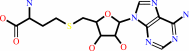 S-adenosyl-L-homocysteine
|
+
|
H(+)
Bound ligand (Het Group name = )
corresponds exactly
|
|
|
|
|
|
|
|
|
|
|
|
|
Note, where more than one E.C. class is given (as above), each may
correspond to a different protein domain or, in the case of polyprotein
precursors, to a different mature protein.
|
|
|
|
Molecule diagrams generated from .mol files obtained from the
KEGG ftp site
|
|
|
|
|
|
|
|
|
|
|
|
|
|
 |
|
|
|
|
|
|
| |
|
|
| |
|
|
J Med Chem
52:7950-7953
(2009)
|
|
PubMed id:
|
|
|
|
|
|
| |
|
Discovery of a 2,4-diamino-7-aminoalkoxyquinazoline as a potent and selective inhibitor of histone lysine methyltransferase G9a.
|
|
F.Liu,
X.Chen,
A.Allali-Hassani,
A.M.Quinn,
G.A.Wasney,
A.Dong,
D.Barsyte,
I.Kozieradzki,
G.Senisterra,
I.Chau,
A.Siarheyeva,
D.B.Kireev,
A.Jadhav,
J.M.Herold,
S.V.Frye,
C.H.Arrowsmith,
P.J.Brown,
A.Simeonov,
M.Vedadi,
J.Jin.
|
|
|
|
|
| |
ABSTRACT
|
|
|
|
| |
|
|
SAR exploration of the 2,4-diamino-6,7-dimethoxyquinazoline template led to the
discovery of 8 (UNC0224) as a potent and selective G9a inhibitor. A high
resolution X-ray crystal structure of the G9a-8 complex, the first cocrystal
structure of G9a with a small molecule inhibitor, was obtained. The cocrystal
structure validated our binding hypothesis and will enable structure-based
design of novel inhibitors. 8 is a useful tool for investigating the biology of
G9a and its roles in chromatin remodeling.
|
|
|
|
|
|
|
|
|
|
|
|
|
|
|
|
|
|
 |
 |
 |
|
Literature references that cite this PDB file's key reference
|
|
|
| |
PubMed id
|
|
Reference
|
|
|
|
|
|
A.K.Upadhyay,
and
X.Cheng
(2011).
Dynamics of histone lysine methylation: structures of methyl writers and erasers.
|
| |
Prog Drug Res,
67,
107-124.
|
|
|
|
|
|
|
S.Krishnan,
S.Horowitz,
and
R.C.Trievel
(2011).
Structure and function of histone H3 lysine 9 methyltransferases and demethylases.
|
| |
Chembiochem,
12,
254-263.
|
|
|
|
|
|
|
T.D.Heightman
(2011).
Therapeutic prospects for epigenetic modulation.
|
| |
Expert Opin Ther Targets,
15,
729-740.
|
|
|
|
|
|
|
M.Wang,
M.W.Mok,
H.Harper,
W.H.Lee,
J.Min,
S.Knapp,
U.Oppermann,
B.Marsden,
and
M.Schapira
(2010).
Structural genomics of histone tail recognition.
|
| |
Bioinformatics,
26,
2629-2630.
|
|
|
|
|
|
|
T.J.Wigle,
L.M.Provencher,
J.L.Norris,
J.Jin,
P.J.Brown,
S.V.Frye,
and
W.P.Janzen
(2010).
Accessing protein methyltransferase and demethylase enzymology using microfluidic capillary electrophoresis.
|
| |
Chem Biol,
17,
695-704.
|
|
|
|
|
|
|
W.P.Janzen,
T.J.Wigle,
J.Jin,
and
S.V.Frye
(2010).
Epigenetics: Tools and Technologies.
|
| |
Drug Discov Today Technol,
7,
e59-e65.
|
|
|
|
|
|
|
X.Cheng,
and
R.M.Blumenthal
(2010).
Coordinated chromatin control: structural and functional linkage of DNA and histone methylation.
|
| |
Biochemistry,
49,
2999-3008.
|
|
|
|
|
|
The most recent references are shown first.
Citation data come partly from CiteXplore and partly
from an automated harvesting procedure. Note that this is likely to be
only a partial list as not all journals are covered by
either method. However, we are continually building up the citation data
so more and more references will be included with time.
|
|


 Links
Links


