 |
PDBsum entry 3ez5

|
|
|
|
|
|

|

|

|

|
|

|
|

|
|

|
|

|
|

|
|

|
|

|
|

|
|
|
 |

|

|
|
|
|
|
|
|
|
|
|
|
|
|
|
|
|
|
|
|
|
|
|
|
|
|
|
|
|
|
|
|
|
|
|
|
|
|
Transferase/DNA
|
PDB id
|
|
|
|
3ez5
|
|
|
|
|
|
|
|
|
|
|
|
|
|
|

|

|

|
|
|
|
|
|
|
|
 |
Contents |
 |
|
|
|
|
|
|
|
|
|
|
|
|
|
|
|
|
* Residue conservation analysis
|
|
|
|
|
|
PDB id:
|
|
|
|
| Name: |
|
Transferase/DNA
|
|
|
Title:
|
|
Cocrystal structure of bacillus fragment DNA polymerase i with duplex DNA , dctp, and zinc (closed form).
|
|
Structure:
|
|
DNA polymerase i. Chain: a, d. Engineered: yes. Mutation: yes. 5'-d( Dcp Dcp Dtp Dgp Dap Dcp Dtp Dcp Dg)-3'. Chain: b, e. Engineered: yes. Other_details: DNA primer strand. 5'-d( Dap Dtp Dtp Dcp Dgp Dap Dgp Dtp Dcp Dap Dgp Dg)-3'.
|
|
Source:
|
|
Bacillus stearothermophilus. Gene: pola. Expressed in: escherichia coli. Expression_system_taxid: 562. Synthetic: yes. Synthetic: yes
|
|
Resolution:
|
|
|
1.90Å
|
R-factor:
|
0.212
|
R-free:
|
0.244
|
|
|
Authors:
|
|
J.J.Warren,E.Y.Wu,A.A.Golosov,M.Karplus,L.S.Beese
|
|
Key ref:
|
|
A.A.Golosov
et al.
(2010).
The mechanism of the translocation step in DNA replication by DNA polymerase I: a computer simulation analysis.
Structure,
18,
83-93.
PubMed id:
|
|
|
Date:
|
|
|
22-Oct-08
|
Release date:
|
10-Nov-09
|
|
|
|
|
|
|
PROCHECK
|

|
|
|
|
|
Headers
|
|
|
|
References
|
|
|
|
|
|

|
|
P52026
(DPO1_GEOSE) -
DNA polymerase I from Geobacillus stearothermophilus
|
|
|
|
Seq:
Struc:
|
|
|
|
876 a.a.
580 a.a.*
|
|

|

|

|
|
|
|
|
|
|
|
|
|
|
Key: |
 |
PfamA domain |
|
|
 |
Secondary structure |
|
 |
CATH domain |
|
|
*
PDB and UniProt seqs differ
at 69 residue positions (black
crosses)
|
|
|
|
|
|
|
|

|
|
|
|
C-C-T-G-A-C-T-C-G
9 bases
|
|
|
|
A-T-T-C-G-A-G-T-C-A-G-G
12 bases
|
|
|
|
C-C-T-G-A-C-T-C-G
9 bases
|
|
|
|
A-T-T-C-G-A-G-T-C-A-G-G
12 bases
|
|
|
|
|
|
|
|
|
|
|
|
|
|
Enzyme class:
|
|
E.C.2.7.7.7
- DNA-directed Dna polymerase.
|
|
|
|
|
|
|
Reaction:
|
|
DNA(n) + a 2'-deoxyribonucleoside 5'-triphosphate = DNA(n+1) + diphosphate
|
|
|
|
|
|
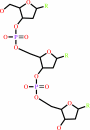 DNA(n)
|
+
|
2'-deoxyribonucleoside 5'-triphosphate
|
=
|
DNA(n+1)
|
+
|
 diphosphate
|
|
|
|
|
|
|
|
|
|
|
|
|
Molecule diagrams generated from .mol files obtained from the
KEGG ftp site
|
|
|
|
|
|
|
|
|
|
|
|
|
|
 |
|
|
|
|
|
|
| |
|
|
| |
|
|
Structure
18:83-93
(2010)
|
|
PubMed id:
|
|
|
|
|
|
| |
|
The mechanism of the translocation step in DNA replication by DNA polymerase I: a computer simulation analysis.
|
|
A.A.Golosov,
J.J.Warren,
L.S.Beese,
M.Karplus.
|
|
|
|
|
| |
ABSTRACT
|
|
|
|
| |
|
|
High-fidelity DNA polymerases copy DNA rapidly and accurately by adding correct
deoxynucleotide triphosphates to a growing primer strand of DNA. Following
nucleotide incorporation, a series of conformational changes translocate the DNA
substrate by one base pair step, readying the polymerase for the next round of
incorporation. Molecular dynamics simulations indicate that the translocation
consists globally of a polymerase fingers-opening transition, followed by the
DNA displacement and the insertion of the template base into the preinsertion
site. They also show that the pyrophosphate release facilitates the opening
transition and that the universally conserved Y714 plays a key role in coupling
polymerase opening to DNA translocation. The transition involves several
metastable intermediates in one of which the O helix is bent in the vicinity of
G711. Completion of the translocation appears to require a gating motion of the
O1 helix, perhaps facilitated by the presence of G715. These roles are
consistent with the high level of conservation of Y714 and the two glycine
residues at these positions. It is likely that a corresponding mechanism is
applicable to other polymerases.
|
|
|
|
|
|
|
|
|
|
|
|
|
|
|
|
|
|
 |
 |
 |
|
Literature references that cite this PDB file's key reference
|
|
|
| |
PubMed id
|
|
Reference
|
|
|
|
|
|
T.Schlick,
R.Collepardo-Guevara,
L.A.Halvorsen,
S.Jung,
and
X.Xiao
(2011).
Biomolecularmodeling and simulation: a field coming of age.
|
| |
Q Rev Biophys,
44,
191-228.
|
|
|
|
|
|
|
J.D.Pata,
and
J.Jaeger
(2010).
Molecular machines and targeted molecular dynamics: DNA in motion.
|
| |
Structure,
18,
4-6.
|
|
|
|
|
|
The most recent references are shown first.
Citation data come partly from CiteXplore and partly
from an automated harvesting procedure. Note that this is likely to be
only a partial list as not all journals are covered by
either method. However, we are continually building up the citation data
so more and more references will be included with time.
|
|


 Links
Links


