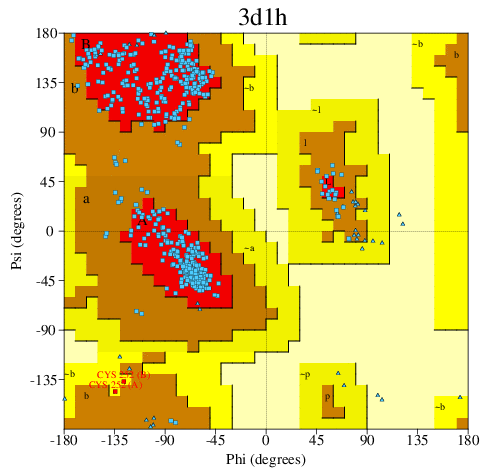
|
PDBsum entry 3d1h
|
|
|
|
References listed in PDB file
|
 |
|
Key reference
|
|
|
Title
|
|
Effect of ionic strength and oxidation on the p-Loop conformation of the protein tyrosine phosphatase-Like phytase, Phyasr.
|
|
|
Authors
|
|
R.J.Gruninger,
L.B.Selinger,
S.C.Mosimann.
|
|
|
Ref.
|
|
Febs J, 2008,
275,
3783-3792.
|
|
|
PubMed id
|
|
|
|
|
|
Abstract
|
|
|
The protein tyrosine phosphatase (PTP)-like phytase, PhyAsr, from Selenomonas
ruminantium is a novel member of the PTP superfamily, and the only described
member that hydrolyzes myo-inositol-1,2,3,4,5,6-hexakisphosphate. In addition to
the unique substrate specificity of PhyAsr, the phosphate-binding loop (P-loop)
has been reported to undergo a conformational change from an open (inactive) to
a closed (active) conformation upon ligand binding at low ionic strength. At
high ionic strengths, the P-loop was observed in the closed, active conformation
in both the presence and absence of ligand. To test whether the P-loop movement
can be induced by changes in ionic strength, we examined the effect that ionic
strength has on the catalytic efficiency of PhyAsr, and determined the structure
of the enzyme at several ionic strengths. The catalytic efficiency of PhyAsr is
highly sensitive to ionic strength, with a seven-fold increase in k(cat)/K(m)
and a ninefold decrease in K(m) when the ionic strength is increased from 100 to
500 mm. Surprisingly, the P-loop is observed in the catalytically competent
conformation at all ionic strengths, despite the absence of a ligand. Here we
provide structural evidence that the ionic strength dependence of PhyAsr and the
conformational change in the P-loop are not linked. Furthermore, we demonstrate
that the previously reported P-loop conformational change is a result of
irreversible oxidation of the active site thiolate. Finally, we rationalize the
observed P-loop conformational changes observed in all oxidized PTP structures.
|
|
|
|
|
|
|