 |
PDBsum entry 2p33

|
|
|
|
|
 |
Contents |
 |
|
|
|
|
|
|
|
|
|
|
|
|
* Residue conservation analysis
|
|
|
|
|
|
PDB id:
|
|
|
|
| Name: |
|
Transferase
|
|
|
Title:
|
|
Synthesis and sar of aminopyrimidines as novel c-jun n-terminal kinase (jnk) inhibitors
|
|
Structure:
|
|
C-jun n-terminal kinase 3. Chain: a. Fragment: protein kinase domain, residues 40-402. Synonym: mitogen-activated protein kinase 10, stress-activated protein kinase jnk3, map kinase p49 3f12. Engineered: yes
|
|
Source:
|
|
Homo sapiens. Human. Organism_taxid: 9606. Gene: mapk10, jnk3, jnk3a, prkm10. Expressed in: escherichia coli. Expression_system_taxid: 562
|
|
Resolution:
|
|
|
2.40Å
|
R-factor:
|
0.253
|
R-free:
|
0.304
|
|
|
Authors:
|
|
T.A.Ceska,A.Platt,M.Fortunato,K.M.Dickson,A.Sharpe
|
|
Key ref:
|
|
M.Alam
et al.
(2007).
Synthesis and SAR of aminopyrimidines as novel c-Jun N-terminal kinase (JNK) inhibitors.
Bioorg Med Chem Lett,
17,
3463-3467.
PubMed id:
DOI:
|
|
|
Date:
|
|
|
08-Mar-07
|
Release date:
|
19-Jun-07
|
|
|
|
|
|
|
PROCHECK
|

|
|
|
|
|
Headers
|
|
|
|
References
|
|
|
|
|
|

|
|
P53779
(MK10_HUMAN) -
Mitogen-activated protein kinase 10 from Homo sapiens
|
|
|
|
Seq:
Struc:
|
|
|
|
464 a.a.
332 a.a.
|
|

|

|

|
|
|
|
|
|
|
|
|
|
|
Key: |
 |
PfamA domain |
|
|
 |
Secondary structure |
|
 |
CATH domain |
|
|
|
|
|
|
|
|
|
|
|
|
|
Enzyme class:
|
|
E.C.2.7.11.24
- mitogen-activated protein kinase.
|
|
|
|
|
|
|
Reaction:
|
|
|
1.
|
L-seryl-[protein] + ATP = O-phospho-L-seryl-[protein] + ADP + H+
|
|
2.
|
L-threonyl-[protein] + ATP = O-phospho-L-threonyl-[protein] + ADP + H+
|
|
|
|
|
|
|
L-seryl-[protein]
|
+
|
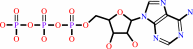 ATP
ATP
|
=
|
O-phospho-L-seryl-[protein]
|
+
|
 ADP
ADP
|
+
|
H(+)
|
|
|
|
|
|
|
L-threonyl-[protein]
|
+
|
ATP
|
=
|
O-phospho-L-threonyl-[protein]
|
+
|
ADP
|
+
|
H(+)
|
|
|
|
|
|
|
|
|
|
|
|
|
Molecule diagrams generated from .mol files obtained from the
KEGG ftp site
|
|
|
|
|
|
|
|
|
|
|
|
|
|
 |
|
|
|
|
|
|
| |
|
|
| |
|
DOI no:
|
Bioorg Med Chem Lett
17:3463-3467
(2007)
|
|
PubMed id:
|
|
|
|
|
|
| |
|
Synthesis and SAR of aminopyrimidines as novel c-Jun N-terminal kinase (JNK) inhibitors.
|
|
M.Alam,
R.E.Beevers,
T.Ceska,
R.J.Davenport,
K.M.Dickson,
M.Fortunato,
L.Gowers,
A.F.Haughan,
L.A.James,
M.W.Jones,
N.Kinsella,
C.Lowe,
J.W.Meissner,
A.L.Nicolas,
B.G.Perry,
D.J.Phillips,
W.R.Pitt,
A.Platt,
A.J.Ratcliffe,
A.Sharpe,
L.J.Tait.
|
|
|
|
|
| |
ABSTRACT
|
|
|
|
| |
|
|
The development of a series of novel aminopyrimidines as inhibitors of c-Jun
N-terminal kinases is described. The synthesis, in vitro inhibitory values for
JNK1, JNK2 and CDK2, and the in vitro inhibitory value for a c-Jun cellular
assay are discussed.
|
|
|
|
|
|
|
|
|
|
|
|
|
|
|
|
|
|
 |
 |
 |
|
Literature references that cite this PDB file's key reference
|
|
|
| |
PubMed id
|
|
Reference
|
|
|
|
|
|
R.Noël,
Y.Shin,
X.Song,
Y.He,
M.Koenig,
W.Chen,
Y.Y.Ling,
L.Lin,
C.H.Ruiz,
P.LoGrasso,
M.D.Cameron,
D.R.Duckett,
and
T.M.Kamenecka
(2011).
Synthesis and SAR of 4-(pyrazol-3-yl)-pyridines as novel c-jun N-terminal kinase inhibitors.
|
| |
Bioorg Med Chem Lett,
21,
2732-2735.
|
|
|
|
|
|
|
T.Kamenecka,
R.Jiang,
X.Song,
D.Duckett,
W.Chen,
Y.Y.Ling,
J.Habel,
J.D.Laughlin,
J.Chambers,
M.Figuera-Losada,
M.D.Cameron,
L.Lin,
C.H.Ruiz,
and
P.V.LoGrasso
(2010).
Synthesis, biological evaluation, X-ray structure, and pharmacokinetics of aminopyrimidine c-jun-N-terminal kinase (JNK) inhibitors.
|
| |
J Med Chem,
53,
419-431.
|
|
|
PDB code:
|
|
|
|
|
|
|
|
W.Zhou,
D.Ercan,
L.Chen,
C.H.Yun,
D.Li,
M.Capelletti,
A.B.Cortot,
L.Chirieac,
R.E.Iacob,
R.Padera,
J.R.Engen,
K.K.Wong,
M.J.Eck,
N.S.Gray,
and
P.A.Jänne
(2009).
Novel mutant-selective EGFR kinase inhibitors against EGFR T790M.
|
| |
Nature,
462,
1070-1074.
|
|
|
PDB code:
|
|
|
|
|
|
|
The most recent references are shown first.
Citation data come partly from CiteXplore and partly
from an automated harvesting procedure. Note that this is likely to be
only a partial list as not all journals are covered by
either method. However, we are continually building up the citation data
so more and more references will be included with time.
Where a reference describes a PDB structure, the PDB
code is
shown on the right.
|
|


 Links
Links


