 |
PDBsum entry 2mxd

|
|
|
|
|
|

|

|

|

|
|

|
|

|
|
|
 |

|

|
|
|
|
|
|
|
|
|
|
|
|
|
|
|
|
|
|
|
|
|
|
|
|
|
|
|
|
|
|
|
Viral protein
|
PDB id
|
|
|
|
2mxd
|
|
|
|
|
|
|
|
|
|
|
|
|
|
|

|

|

|
|
|
|
|
|
|
|
|
Enzyme class 2:
|
|
E.C.2.7.7.48
- RNA-directed Rna polymerase.
|
|
|
|
|
|
|
Reaction:
|
|
RNA(n) + a ribonucleoside 5'-triphosphate = RNA(n+1) + diphosphate
|
|
|
|
|
|
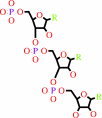 RNA(n)
|
+
|
ribonucleoside 5'-triphosphate
|
=
|
RNA(n+1)
|
+
|
 diphosphate
|
|
|
|
|
|
|
|
|
|
Enzyme class 3:
|
|
E.C.3.4.22.66
- calicivirin.
|
|
|
|
|
|
|
Enzyme class 4:
|
|
E.C.3.6.1.15
- nucleoside-triphosphate phosphatase.
|
|
|
|
|
|
|
Reaction:
|
|
a ribonucleoside 5'-triphosphate + H2O = a ribonucleoside 5'-diphosphate + phosphate + H+
|
|
|
|
|
|
ribonucleoside 5'-triphosphate
|
+
|
H2O
|
=
|
ribonucleoside 5'-diphosphate
|
+
|
 phosphate
|
+
|
H(+)
|
|
|
|
|
|
|
|
|
|
|
|
|
Note, where more than one E.C. class is given (as above), each may
correspond to a different protein domain or, in the case of polyprotein
precursors, to a different mature protein.
|
|
|
|
Molecule diagrams generated from .mol files obtained from the
KEGG ftp site
|
|
|
|
|
|
|
|
|
|
|
|
|
|
 |
|
|
|
|
|
|
| |
|
|
| |
|
DOI no:
|
Biochem Biophys Res Commun
459:610-616
(2015)
|
|
PubMed id:
|
|
|
|
|
|
| |
|
Solution structure of the porcine sapovirus VPg core reveals a stable three-helical bundle with a conserved surface patch.
|
|
H.J.Hwang,
H.J.Min,
H.Yun,
J.G.Pelton,
D.E.Wemmer,
K.O.Cho,
J.S.Kim,
C.W.Lee.
|
|
|
|
|
| |
ABSTRACT
|
|
|
|
| |
|
|
Viral protein genome-linked (VPg) proteins play a critical role in the life
cycle of vertebrate and plant positive-sense RNA viruses by acting as a protein
primer for genome replication and as a protein cap for translation initiation.
Here we report the solution structure of the porcine sapovirus VPg core (VPg(C))
determined by multi-dimensional NMR spectroscopy. The structure of VPg(C) is
composed of three α-helices stabilized by several conserved hydrophobic
residues that form a helical bundle core similar to that of feline calicivirus
VPg. The putative nucleotide acceptor Tyr956 within the first helix of the core
is completely exposed to solvent accessible surface to facilitate
nucleotidylation by viral RNA polymerase. Comparison of VPg structures suggests
that the surface for nucleotidylation site is highly conserved among the
Caliciviridae family, whereas the backbone core structures are different. These
structural features suggest that caliciviruses share common mechanisms of
VPg-dependent viral replication and translation.
|
|
|
|
|
|
|
|
|
|
|
|
|
|
|
|
|
|
 |
 |
 |
|


 Links
Links


