
|
|
|
|
|
 |
Contents |
 |
|
|
|
|
|
|
|
|
|
|
|


 (+ 0 more)
165 a.a.
(+ 0 more)
165 a.a.
|
|
|
|
|
|
|
|
|
|
|


 (+ 0 more)
113 a.a.
(+ 0 more)
113 a.a.
|
|
|
|
|
|
|
|
|
|
|
|
|
* Residue conservation analysis
|
|
|
|
|
|
PDB id:
|
|
|
|
| Name: |
|
Hydrolase
|
|
|
Title:
|
|
Crystal structure of the arf1:arhgap21-arfbd complex
|
|
Structure:
|
|
Adp-ribosylation factor 1. Chain: a, b, c, d, e, f. Fragment: delta 17-arf1, residues 17-180. Synonym: arf1. Engineered: yes. Mutation: yes. Rho-gtpase activating protein 10. Chain: m, n, o, p, q, r. Fragment: arf-binding domain, residues 929-1096.
|
|
Source:
|
|
Mus musculus. Mouse. Organism_taxid: 10090. Expressed in: escherichia coli. Expression_system_taxid: 562. Homo sapiens. Human. Organism_taxid: 9606. Expression_system_taxid: 562
|
|
Resolution:
|
|
|
2.10Å
|
R-factor:
|
0.209
|
R-free:
|
0.243
|
|
|
Authors:
|
|
J.Menetrey,M.Perderiset,J.Cicolari,T.Dubois,N.El Khatib,F.El Khadali, M.Franco,P.Chavrier,A.Houdusse
|
Key ref:

|
|
J.Ménétrey
et al.
(2007).
Structural basis for ARF1-mediated recruitment of ARHGAP21 to Golgi membranes.
EMBO J,
26,
1953-1962.
PubMed id:
DOI:

|
|
|
Date:
|
|
|
13-Sep-06
|
Release date:
|
20-Feb-07
|
|
|
|
|
|
|
PROCHECK
|

|
|
|
|
|
Headers
|
|
|
|
References
|
|
|
|
|
|
|
|
|
|
|
|
Enzyme class:
|
|
Chains A, B, C, D, E, F:
E.C.3.6.5.2
- small monomeric GTPase.
|
|
|
|
|
|
|
Reaction:
|
|
GTP + H2O = GDP + phosphate + H+
|
|
|
|
|
|
GTP
Bound ligand (Het Group name = )
corresponds exactly
|
+
|
H2O
|
=
|
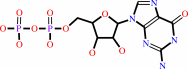 GDP
GDP
|
+
|
 phosphate
|
+
|
H(+)
|
|
|
|
|
|
|
|
|
|
|
|
|
Molecule diagrams generated from .mol files obtained from the
KEGG ftp site
|
|
|
|
|
|
|
|
|
|
|
|
|
|
 |
|
|
|
|
|
|
| |
|
|
| |
|
DOI no:
|
EMBO J
26:1953-1962
(2007)
|
|
PubMed id:
|
|
|
|
|
|
| |
|
Structural basis for ARF1-mediated recruitment of ARHGAP21 to Golgi membranes.
|
|
J.Ménétrey,
M.Perderiset,
J.Cicolari,
T.Dubois,
N.Elkhatib,
F.El Khadali,
M.Franco,
P.Chavrier,
A.Houdusse.
|
|
|
|
|
| |
ABSTRACT
|
|
|
|
| |
|
|
ARHGAP21 is a Rho family GTPase-activating protein (RhoGAP) that controls the
Arp2/3 complex and F-actin dynamics at the Golgi complex by regulating the
activity of the small GTPase Cdc42. ARHGAP21 is recruited to the Golgi by
binding to another small GTPase, ARF1. Here, we present the crystal structure of
the activated GTP-bound form of ARF1 in a complex with the Arf-binding domain
(ArfBD) of ARHGAP21 at 2.1 A resolution. We show that ArfBD comprises a PH
domain adjoining a C-terminal alpha helix, and that ARF1 interacts with both of
these structural motifs through its switch regions and triggers structural
rearrangement of the PH domain. We used site-directed mutagenesis to confirm
that both the PH domain and the helical motif are essential for the binding of
ArfBD to ARF1 and for its recruitment to the Golgi. Our data demonstrate that
two well-known small GTPase-binding motifs, the PH domain and the alpha helical
motif, can combine to create a novel mode of binding to Arfs.
|
|
|
|
|
|
| |
Selected figure(s)
|
|
|
|
| |
|
|

|
|

|
|
Figure 1.
Figure 1 Structure of the ARF1:ArfBD complex. (A) A cartoon
diagram of the ARF1:ArfBD complex is shown in two distinct
orientations. ARF1 is shown in grey with the  1
helix and switch I region in light and dark blue, respectively,
the interswitch region in green and the switch II region in red.
The Mg.GTP ligand is shown as a grey stick model. ArfBD is shown
in white with its 1
helix and switch I region in light and dark blue, respectively,
the interswitch region in green and the switch II region in red.
The Mg.GTP ligand is shown as a grey stick model. ArfBD is shown
in white with its  5'
region ( 5'
strand plus 5'–
6'
loop) in pink, the 1'
helix in orange and the Cter
helix in yellow. Tyr999 and Ile1053 of ArfBD are shown as stick
models. The two adjacent contact areas of the ARF1:ArfBD complex
interface are delineated by black boxes on the right-hand view.
(B) Detailed view of the interface between the Cter
helix and the PH domain of ArfBD. (C–F) Detailed views of the
ARF1:ArfBD interface. The secondary structures are shown as
ribbons and the residues as sticks. Hydrogen bonds are indicated
by dashed lines. (C) The 5'
region of ArfBD (pink) lies between the interswitch (green) and
switch I (blue) regions of ARF1 centred on Tyr999. (D) The
network of water-mediated interactions made between Asp996 of
the 5'
region (in pink) of ArfBD and ARF1. (E) The switch I (blue)
region of ARF1 interacts with the 5'
region (pink) and the 1'
helix (orange) of ArfBD. (F) The Cter
helix (yellow) of ArfBD is grasped between the switch II (red)
and the interswitch/switch I (green/blue) regions of ARF1. 5'
region ( 5'
strand plus 5'–
6'
loop) in pink, the 1'
helix in orange and the Cter
helix in yellow. Tyr999 and Ile1053 of ArfBD are shown as stick
models. The two adjacent contact areas of the ARF1:ArfBD complex
interface are delineated by black boxes on the right-hand view.
(B) Detailed view of the interface between the Cter
helix and the PH domain of ArfBD. (C–F) Detailed views of the
ARF1:ArfBD interface. The secondary structures are shown as
ribbons and the residues as sticks. Hydrogen bonds are indicated
by dashed lines. (C) The 5'
region of ArfBD (pink) lies between the interswitch (green) and
switch I (blue) regions of ARF1 centred on Tyr999. (D) The
network of water-mediated interactions made between Asp996 of
the 5'
region (in pink) of ArfBD and ARF1. (E) The switch I (blue)
region of ARF1 interacts with the 5'
region (pink) and the 1'
helix (orange) of ArfBD. (F) The Cter
helix (yellow) of ArfBD is grasped between the switch II (red)
and the interswitch/switch I (green/blue) regions of ARF1.
|
|
Figure 2.
Figure 2 The hydrophobic pocket and triad patch of Arf proteins.
(A) Front-view of the ARF1 hydrophobic pocket (transparent grey
area) and the hydrophobic triad patch (transparent purple area)
with the hydrophobic residue side chains shown as stick models.
(B) Sequence alignment of the Arf proteins (nomenclature from
Kahn et al, 2006) with residues of the hydrophobic pocket
indicated with grey shading and those of the triad patch
indicated in purple. Residues conserved with ARF1 are shown in
bold.
|
|
|
|
|
|
| |
The above figures are
reprinted
by permission from Macmillan Publishers Ltd:
EMBO J
(2007,
26,
1953-1962)
copyright 2007.
|
|
| |
Figures were
selected
by the author.
|
|
|
|
|
|
|
|
|
|
|
|
|
|
|
|
 |
 |
 |
|
Literature references that cite this PDB file's key reference
|
|
|
| |
PubMed id
|
|
Reference
|
|
|
|
|
|
G.Montagnac,
H.de Forges,
E.Smythe,
C.Gueudry,
M.Romao,
J.Salamero,
and
P.Chavrier
(2011).
Decoupling of activation and effector binding underlies ARF6 priming of fast endocytic recycling.
|
| |
Curr Biol,
21,
574-579.
|
|
|
|
|
|
|
E.W.Lamb,
C.D.Walls,
J.T.Pesce,
D.K.Riner,
S.K.Maynard,
E.T.Crow,
T.A.Wynn,
B.C.Schaefer,
and
S.J.Davies
(2010).
Blood fluke exploitation of non-cognate CD4+ T cell help to facilitate parasite development.
|
| |
PLoS Pathog,
6,
e1000892.
|
|
|
|
|
|
|
H.Hehnly,
W.Xu,
J.L.Chen,
and
M.Stamnes
(2010).
Cdc42 regulates microtubule-dependent Golgi positioning.
|
| |
Traffic,
11,
1067-1078.
|
|
|
|
|
|
|
J.Janin
(2010).
Protein-protein docking tested in blind predictions: the CAPRI experiment.
|
| |
Mol Biosyst,
6,
2351-2362.
|
|
|
|
|
|
|
M.F.Lensink,
and
S.J.Wodak
(2010).
Blind predictions of protein interfaces by docking calculations in CAPRI.
|
| |
Proteins,
78,
3085-3095.
|
|
|
|
|
|
|
P.Chavrier,
and
J.Ménétrey
(2010).
Toward a structural understanding of arf family:effector specificity.
|
| |
Structure,
18,
1552-1558.
|
|
|
|
|
|
|
S.J.Fleishman,
J.E.Corn,
E.M.Strauch,
T.A.Whitehead,
I.Andre,
J.Thompson,
J.J.Havranek,
R.Das,
P.Bradley,
and
D.Baker
(2010).
Rosetta in CAPRI rounds 13-19.
|
| |
Proteins,
78,
3212-3218.
|
|
|
|
|
|
|
Y.Liu,
R.A.Kahn,
and
J.H.Prestegard
(2010).
Dynamic structure of membrane-anchored Arf*GTP.
|
| |
Nat Struct Mol Biol,
17,
876-881.
|
|
|
PDB code:
|
|
|
|
|
|
|
|
H.Hehnly,
K.M.Longhini,
J.L.Chen,
and
M.Stamnes
(2009).
Retrograde Shiga toxin trafficking is regulated by ARHGAP21 and Cdc42.
|
| |
Mol Biol Cell,
20,
4303-4312.
|
|
|
|
|
|
|
N.Kowalsman,
and
M.Eisenstein
(2009).
Combining interface core and whole interface descriptors in postscan processing of protein-protein docking models.
|
| |
Proteins,
77,
297-318.
|
|
|
|
|
|
|
T.Isabet,
G.Montagnac,
K.Regazzoni,
B.Raynal,
F.El Khadali,
P.England,
M.Franco,
P.Chavrier,
A.Houdusse,
and
J.Ménétrey
(2009).
The structural basis of Arf effector specificity: the crystal structure of ARF6 in a complex with JIP4.
|
| |
EMBO J,
28,
2835-2845.
|
|
|
PDB code:
|
|
|
|
|
|
|
|
L.M.Craveiro,
D.Hakkoum,
O.Weinmann,
L.Montani,
L.Stoppini,
and
M.E.Schwab
(2008).
Neutralization of the membrane protein Nogo-A enhances growth and reactive sprouting in established organotypic hippocampal slice cultures.
|
| |
Eur J Neurosci,
28,
1808-1824.
|
|
|
|
|
|
|
A.Heifetz,
S.Pal,
and
G.R.Smith
(2007).
Protein-protein docking: progress in CAPRI rounds 6-12 using a combination of methods: the introduction of steered solvated molecular dynamics.
|
| |
Proteins,
69,
816-822.
|
|
|
|
|
|
|
A.K.Gillingham,
and
S.Munro
(2007).
The small G proteins of the Arf family and their regulators.
|
| |
Annu Rev Cell Dev Biol,
23,
579-611.
|
|
|
|
|
|
|
A.May,
and
M.Zacharias
(2007).
Protein-protein docking in CAPRI using ATTRACT to account for global and local flexibility.
|
| |
Proteins,
69,
774-780.
|
|
|
|
|
|
|
C.Wang,
O.Schueler-Furman,
I.Andre,
N.London,
S.J.Fleishman,
P.Bradley,
B.Qian,
and
D.Baker
(2007).
RosettaDock in CAPRI rounds 6-12.
|
| |
Proteins,
69,
758-763.
|
|
|
|
|
|
|
G.Terashi,
M.Takeda-Shitaka,
K.Kanou,
M.Iwadate,
D.Takaya,
and
H.Umeyama
(2007).
The SKE-DOCK server and human teams based on a combined method of shape complementarity and free energy estimation.
|
| |
Proteins,
69,
866-872.
|
|
|
|
|
|
|
J.Heuvingh,
M.Franco,
P.Chavrier,
and
C.Sykes
(2007).
ARF1-mediated actin polymerization produces movement of artificial vesicles.
|
| |
Proc Natl Acad Sci U S A,
104,
16928-16933.
|
|
|
|
|
|
|
J.Janin
(2007).
The targets of CAPRI rounds 6-12.
|
| |
Proteins,
69,
699-703.
|
|
|
|
|
|
|
J.P.DiNitto,
A.Delprato,
M.T.Gabe Lee,
T.C.Cronin,
S.Huang,
A.Guilherme,
M.P.Czech,
and
D.G.Lambright
(2007).
Structural basis and mechanism of autoregulation in 3-phosphoinositide-dependent Grp1 family Arf GTPase exchange factors.
|
| |
Mol Cell,
28,
569-583.
|
|
|
PDB codes:
|
|
|
|
|
|
|
|
K.Wiehe,
B.Pierce,
W.W.Tong,
H.Hwang,
J.Mintseris,
and
Z.Weng
(2007).
The performance of ZDOCK and ZRANK in rounds 6-11 of CAPRI.
|
| |
Proteins,
69,
719-725.
|
|
|
|
|
|
|
M.Bueno,
and
C.J.Camacho
(2007).
Acidic groups docked to well defined wetted pockets at the core of the binding interface: a tale of scoring and missing protein interactions in CAPRI.
|
| |
Proteins,
69,
786-792.
|
|
|
|
|
|
|
M.F.Lensink,
R.Méndez,
and
S.J.Wodak
(2007).
Docking and scoring protein complexes: CAPRI 3rd Edition.
|
| |
Proteins,
69,
704-718.
|
|
|
|
|
|
|
M.Król,
R.A.Chaleil,
A.L.Tournier,
and
P.A.Bates
(2007).
Implicit flexibility in protein docking: cross-docking and local refinement.
|
| |
Proteins,
69,
750-757.
|
|
|
|
|
|
|
N.Li,
Z.Sun,
and
F.Jiang
(2007).
SOFTDOCK application to protein-protein interaction benchmark and CAPRI.
|
| |
Proteins,
69,
801-808.
|
|
|
|
|
|
|
N.London,
and
O.Schueler-Furman
(2007).
Assessing the energy landscape of CAPRI targets by FunHunt.
|
| |
Proteins,
69,
809-815.
|
|
|
|
|
|
|
S.Grosdidier,
C.Pons,
A.Solernou,
and
J.Fernández-Recio
(2007).
Prediction and scoring of docking poses with pyDock.
|
| |
Proteins,
69,
852-858.
|
|
|
|
|
|
|
S.J.de Vries,
A.D.van Dijk,
M.Krzeminski,
M.van Dijk,
A.Thureau,
V.Hsu,
T.Wassenaar,
and
A.M.Bonvin
(2007).
HADDOCK versus HADDOCK: new features and performance of HADDOCK2.0 on the CAPRI targets.
|
| |
Proteins,
69,
726-733.
|
|
|
|
|
|
|
S.R.Comeau,
D.Kozakov,
R.Brenke,
Y.Shen,
D.Beglov,
and
S.Vajda
(2007).
ClusPro: performance in CAPRI rounds 6-11 and the new server.
|
| |
Proteins,
69,
781-785.
|
|
|
|
|
|
|
X.Q.Gong,
S.Chang,
Q.H.Zhang,
C.H.Li,
L.Z.Shen,
X.H.Ma,
M.H.Wang,
B.Liu,
H.Q.He,
W.Z.Chen,
and
C.X.Wang
(2007).
A filter enhanced sampling and combinatorial scoring study for protein docking in CAPRI.
|
| |
Proteins,
69,
859-865.
|
|
|
|
|
|
|
Y.Shen,
R.Brenke,
D.Kozakov,
S.R.Comeau,
D.Beglov,
and
S.Vajda
(2007).
Docking with PIPER and refinement with SDU in rounds 6-11 of CAPRI.
|
| |
Proteins,
69,
734-742.
|
|
|
|
|
|
The most recent references are shown first.
Citation data come partly from CiteXplore and partly
from an automated harvesting procedure. Note that this is likely to be
only a partial list as not all journals are covered by
either method. However, we are continually building up the citation data
so more and more references will be included with time.
Where a reference describes a PDB structure, the PDB
code is
shown on the right.
|
 |


 Links
Links


