
|
|
|
|
|
 |
Contents |
 |
|
|
|
|
|
|
|
|
|
|
|
|
* Residue conservation analysis
|
|
|
|
|
|
|
|
|
|
Enzyme class:
|
|
Chain B:
E.C.3.6.5.5
- dynamin GTPase.
|
|
|
|
|
|
|
Reaction:
|
|
GTP + H2O = GDP + phosphate + H+
|
|
|
|
|
|
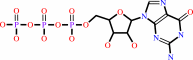 GTP
GTP
|
+
|
H2O
|
=
|
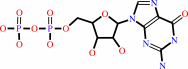 GDP
GDP
|
+
|
 phosphate
|
+
|
H(+)
|
|
|
|
|
|
|
|
|
|
|
|
|
Molecule diagrams generated from .mol files obtained from the
KEGG ftp site
|
|
|
|
|
|
|
|
|
|
|
|
|
|
 |
|
|
|
|
|
|
| |
|
|
| |
|
DOI no:
|
Proc Natl Acad Sci U S A
102:13093-13098
(2005)
|
|
PubMed id:
|
|
|
|
|
|
| |
|
Crystal structure of the GTPase domain of rat dynamin 1.
|
|
T.F.Reubold,
S.Eschenburg,
A.Becker,
M.Leonard,
S.L.Schmid,
R.B.Vallee,
F.J.Kull,
D.J.Manstein.
|
|
|
|
|
| |
ABSTRACT
|
|
|
|
| |
|
|
Here, we present the 1.9-A crystal structure of the nucleotide-free GTPase
domain of dynamin 1 from Rattus norvegicus. The structure corresponds to an
extended form of the canonical GTPase fold observed in Ras proteins. Both
nucleotide-binding switch motifs are well resolved, adopting conformations that
closely resemble a GTP-bound state not previously observed for nucleotide-free
GTPases. Two highly conserved arginines, Arg-66 and Arg-67, greatly restrict the
mobility of switch I and are ideally positioned to relay information about the
nucleotide state to other parts of the protein. Our results support a model in
which switch I residue Arg-59 gates GTP binding in an assembly-dependent manner
and the GTPase effector domain functions as an assembly-dependent GTPase
activating protein in the fashion of RGS-type GAPs.
|
|
|
|
|
|
| |
Selected figure(s)
|
|
|
|
| |
|
|

|
|

|
|
Figure 3.
Fig. 3. Stabilization of the switch motifs (stereo view).
P-loop and switch elements are colored as in Fig. 2, and  B and B and
 2A
are shown in light gray. Side chains and carbonyl groups are
shown as stick models, and main-chain nitrogens are shown as
blue spheres. Polar and ionic interactions are drawn as dotted
lines. 2A
are shown in light gray. Side chains and carbonyl groups are
shown as stick models, and main-chain nitrogens are shown as
blue spheres. Polar and ionic interactions are drawn as dotted
lines.
|
|
Figure 5.
Fig. 5. Docking of the C-terminal myosin helix into the
hydrophobic groove of dynamin. (A) The structure of the dynamin
1-myosin fusion as solid cartoon with the dynamin 1 GTPase
domain drawn in dark gray, the groove helices A and
5
in yellow and orange, respectively, and the myosin motor domain
in blue. The structure of the dynamin A fusion is superimposed
in transparent gray. Although the dynamin domains align well,
the myosin motor domains adopt different conformations in the
dynamin 1 and dynamin A fusion structures. (B) Schematic
representation of the hydrophobic interactions (solid lines
between the respective amino acid partners) between helices A
(yellow box) and 5 (orange box) and the
C-terminal myosin helix (blue box).
|
|
|
|
| |
Figures were
selected
by an automated process.
|
|
|
|
|
|
|
|
|
|
|
|
|
|
|
|
 |
 |
 |
|
Literature references that cite this PDB file's key reference
|
|
|
| |
PubMed id
|
|
Reference
|
|
|
|
|
|
R.Ramachandran
(2011).
Vesicle scission: dynamin.
|
| |
Semin Cell Dev Biol,
22,
10-17.
|
|
|
|
|
|
|
J.S.Chappie,
S.Acharya,
M.Leonard,
S.L.Schmid,
and
F.Dyda
(2010).
G domain dimerization controls dynamin's assembly-stimulated GTPase activity.
|
| |
Nature,
465,
435-440.
|
|
|
PDB codes:
|
|
|
|
|
|
|
|
S.Gao,
A.von der Malsburg,
S.Paeschke,
J.Behlke,
O.Haller,
G.Kochs,
and
O.Daumke
(2010).
Structural basis of oligomerization in the stalk region of dynamin-like MxA.
|
| |
Nature,
465,
502-506.
|
|
|
PDB code:
|
|
|
|
|
|
|
|
H.H.Low,
C.Sachse,
L.A.Amos,
and
J.Löwe
(2009).
Structure of a bacterial dynamin-like protein lipid tube provides a mechanism for assembly and membrane curving.
|
| |
Cell,
139,
1342-1352.
|
|
|
PDB code:
|
|
|
|
|
|
|
|
J.A.Heymann,
and
J.E.Hinshaw
(2009).
Dynamins at a glance.
|
| |
J Cell Sci,
122,
3427-3431.
|
|
|
|
|
|
|
J.S.Chappie,
S.Acharya,
Y.W.Liu,
M.Leonard,
T.J.Pucadyil,
and
S.L.Schmid
(2009).
An intramolecular signaling element that modulates dynamin function in vitro and in vivo.
|
| |
Mol Biol Cell,
20,
3561-3571.
|
|
|
|
|
|
|
L.R.Odell,
N.Chau,
A.Mariana,
M.E.Graham,
P.J.Robinson,
and
A.McCluskey
(2009).
Azido and diazarinyl analogues of bis-tyrphostin as asymmetrical inhibitors of dynamin GTPase.
|
| |
ChemMedChem,
4,
1182-1188.
|
|
|
|
|
|
|
R.Gasper,
S.Meyer,
K.Gotthardt,
M.Sirajuddin,
and
A.Wittinghofer
(2009).
It takes two to tango: regulation of G proteins by dimerization.
|
| |
Nat Rev Mol Cell Biol,
10,
423-429.
|
|
|
|
|
|
|
S.O.Shan,
S.L.Schmid,
and
X.Zhang
(2009).
Signal recognition particle (SRP) and SRP receptor: a new paradigm for multistate regulatory GTPases.
|
| |
Biochemistry,
48,
6696-6704.
|
|
|
|
|
|
|
J.M.Kinchen,
K.Doukoumetzidis,
J.Almendinger,
L.Stergiou,
A.Tosello-Trampont,
C.D.Sifri,
M.O.Hengartner,
and
K.S.Ravichandran
(2008).
A pathway for phagosome maturation during engulfment of apoptotic cells.
|
| |
Nat Cell Biol,
10,
556-566.
|
|
|
|
|
|
|
M.Cecchini,
A.Houdusse,
and
M.Karplus
(2008).
Allosteric communication in myosin V: from small conformational changes to large directed movements.
|
| |
PLoS Comput Biol,
4,
e1000129.
|
|
|
|
|
|
|
T.Kanazawa,
M.D.Zappaterra,
A.Hasegawa,
A.P.Wright,
E.D.Newman-Smith,
K.F.Buttle,
K.McDonald,
C.A.Mannella,
and
A.M.van der Bliek
(2008).
The C. elegans Opa1 homologue EAT-3 is essential for resistance to free radicals.
|
| |
PLoS Genet,
4,
e1000022.
|
|
|
|
|
|
|
J.A.Mears,
P.Ray,
and
J.E.Hinshaw
(2007).
A corkscrew model for dynamin constriction.
|
| |
Structure,
15,
1190-1202.
|
|
|
|
|
|
|
O.Daumke,
R.Lundmark,
Y.Vallis,
S.Martens,
P.J.Butler,
and
H.T.McMahon
(2007).
Architectural and mechanistic insights into an EHD ATPase involved in membrane remodelling.
|
| |
Nature,
449,
923-927.
|
|
|
PDB code:
|
|
|
|
|
|
|
|
S.Hoppins,
L.Lackner,
and
J.Nunnari
(2007).
The machines that divide and fuse mitochondria.
|
| |
Annu Rev Biochem,
76,
751-780.
|
|
|
|
|
|
|
S.Tang,
J.C.Liao,
A.R.Dunn,
R.B.Altman,
J.A.Spudich,
and
J.P.Schmidt
(2007).
Predicting allosteric communication in myosin via a pathway of conserved residues.
|
| |
J Mol Biol,
373,
1361-1373.
|
|
|
|
|
|
|
H.H.Low,
and
J.Löwe
(2006).
A bacterial dynamin-like protein.
|
| |
Nature,
444,
766-769.
|
|
|
PDB codes:
|
|
|
|
|
|
|
The most recent references are shown first.
Citation data come partly from CiteXplore and partly
from an automated harvesting procedure. Note that this is likely to be
only a partial list as not all journals are covered by
either method. However, we are continually building up the citation data
so more and more references will be included with time.
Where a reference describes a PDB structure, the PDB
codes are
shown on the right.
|
 |


 Links
Links


