 |
PDBsum entry 2aj1

|
|
|
|
|
 |
Contents |
 |
|
|
|
|
|
|
|
|
* Residue conservation analysis
|
|
|
|
|
|
PDB id:
|
|
|
|
| Name: |
|
Hydrolase
|
|
|
Title:
|
|
Solution structure of apocada
|
|
Structure:
|
|
Probable cadmium-transporting atpase. Chain: a. Fragment: n-terminal domain. Synonym: cada p-type atpase, cadmium efflux atpase. Engineered: yes. Mutation: yes
|
|
Source:
|
|
Listeria monocytogenes. Organism_taxid: 1639. Gene: cada. Expressed in: escherichia coli. Expression_system_taxid: 562.
|
|
NMR struc:
|
|
1 models
|
|
|
Authors:
|
|
L.Banci,I.Bertini,S.Ciofi-Baffoni,X.-C.Su,R.Miras,N.Bal,E.Mintz, P.Catty,J.E.Shokes,R.A.Scott
|
Key ref:

|
|
L.Banci
et al.
(2006).
Structural basis for metal binding specificity: the N-terminal cadmium binding domain of the P1-type ATPase CadA.
J Mol Biol,
356,
638-650.
PubMed id:
DOI:

|
|
|
Date:
|
|
|
01-Aug-05
|
Release date:
|
02-May-06
|
|
|
|
|
|
|
PROCHECK
|

|
|
|
|
|
Headers
|
|
|
|
References
|
|
|
|
|
|

|
|
Q60048
(CADA_LISMN) -
Probable cadmium-transporting ATPase from Listeria monocytogenes
|
|
|
|
Seq:
Struc:
|
|
|
|
711 a.a.
71 a.a.*
|
|

|

|
|
|
|
|
|
|
|
|
|
|
|
Key: |
 |
PfamA domain |
|
|
 |
Secondary structure |
|
 |
CATH domain |
|
|
*
PDB and UniProt seqs differ
at 1 residue position (black
cross)
|
|
|
|
|
|
|
|
|
|
|
|
|
Enzyme class:
|
|
E.C.7.2.2.21
- Cd(2+)-exporting ATPase.
|
|
|
|
|
|
|
Reaction:
|
|
Cd2+(in) + ATP + H2O = Cd2+(out) + ADP + phosphate + H+
|
|
|
|
|
|
Cd(2+)(in)
|
+
|
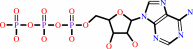 ATP
ATP
|
+
|
H2O
|
=
|
Cd(2+)(out)
|
+
|
 ADP
ADP
|
+
|
 phosphate
|
+
|
H(+)
|
|
|
|
|
|
|
|
|
|
|
|
|
Molecule diagrams generated from .mol files obtained from the
KEGG ftp site
|
|
|
|
|
|
|
|
|
|
|
|
|
|
 |
|
|
|
|
|
|
| |
|
|
| |
|
DOI no:
|
J Mol Biol
356:638-650
(2006)
|
|
PubMed id:
|
|
|
|
|
|
| |
|
Structural basis for metal binding specificity: the N-terminal cadmium binding domain of the P1-type ATPase CadA.
|
|
L.Banci,
I.Bertini,
S.Ciofi-Baffoni,
X.C.Su,
R.Miras,
N.Bal,
E.Mintz,
P.Catty,
J.E.Shokes,
R.A.Scott.
|
|
|
|
|
| |
ABSTRACT
|
|
|
|
| |
|
|
In bacteria, P1-type ATPases are responsible for resistance to di- and
monovalent toxic heavy metals by taking them out of the cell. These ATPases have
a cytoplasmic N terminus comprising metal binding domains defined by a
betaalphabetabetaalphabeta fold and a CXXC metal binding motif. To check how the
structural properties of the metal binding site in the N terminus can influence
the metal specificity of the ATPase, the first structure of a Cd(II)-ATPase N
terminus was determined by NMR and its coordination sphere was investigated by
X-ray absorption spectroscopy. A novel metal binding environment was found,
comprising the two conserved Cys residues of the metal binding motif and a Glu
in loop 5. A bioinformatic search identifies an ensemble of highly homologous
sequences presumably with the same function. Another group of highly homologous
sequences is found which can be referred to as zinc-detoxifying P1-type ATPases
with the metal binding pattern DCXXC in the N terminus. Because no carboxylate
groups participate in Cu(I) or Ag(I) binding sites, we suggest that the acidic
residue plays a key role in the coordination properties of divalent cations,
hence conferring a function to the N terminus in the metal specificity of the
ATPase.
|
|
|
|
|
|
| |
Selected figure(s)
|
|
|
|
| |
|
|

|
|

|
|
Figure 5.
Figure 5. (a) Cd K edge spectra and (b) Fourier transforms
(k3 weighting, k=2-13 Å -1) for CadA NTKII (continuous)
and CadA NTKII+TCEP (broken). k3-weighted EXAFS data are
presented in the inset to (b).
|
|
Figure 7.
Figure 7. Solution structures of N-terminal metal-binding
domains of L. monocytogenes CadA, E. coli ZntA (1MWY) and B.
subtilis CopA (1JWW). Apo forms of the proteins, marked with an
asterisk in Figure 3, are compared here. van der Waals contacts
involving some hydrophobic residues are shown in blue, the metal
ligands are shown in yellow and some highly conserved residues
are in red. The Gly residues, shaded in cyan in Figure 3, are
mapped in cyan on the backbone of the structures.
|
|
|
|
|
|
| |
The above figures are
reprinted
by permission from Elsevier:
J Mol Biol
(2006,
356,
638-650)
copyright 2006.
|
|
| |
Figures were
selected
by an automated process.
|
|
|
|
|
|
|
|
|
|
|
|
|
|
|
|
 |
 |
 |
|
Literature references that cite this PDB file's key reference
|
|
|
| |
PubMed id
|
|
Reference
|
|
|
|
|
|
A.Schmidt,
M.Hagen,
E.Schütze,
A.Schmidt,
and
E.Kothe
(2010).
In silico prediction of potential metallothioneins and metallohistins in actinobacteria.
|
| |
J Basic Microbiol,
50,
562-569.
|
|
|
|
|
|
|
L.Banci,
I.Bertini,
S.Ciofi-Baffoni,
L.Poggi,
M.Vanarotti,
S.Tottey,
K.J.Waldron,
and
N.J.Robinson
(2010).
NMR structural analysis of the soluble domain of ZiaA-ATPase and the basis of selective interactions with copper metallochaperone Atx1.
|
| |
J Biol Inorg Chem,
15,
87-98.
|
|
|
PDB codes:
|
|
|
|
|
|
|
|
C.K.Wong,
R.S.Jarvis,
S.M.Sherson,
and
C.S.Cobbett
(2009).
Functional analysis of the heavy metal binding domains of the Zn/Cd-transporting ATPase, HMA2, in Arabidopsis thaliana.
|
| |
New Phytol,
181,
79-88.
|
|
|
|
|
|
|
C.Völlmecke,
C.Kötting,
K.Gerwert,
and
M.Lübben
(2009).
Spectroscopic investigation of the reaction mechanism of CopB-B, the catalytic fragment from an archaeal thermophilic ATP-driven heavy metal transporter.
|
| |
FEBS J,
276,
6172-6186.
|
|
|
|
|
|
|
L.Banci,
I.Bertini,
and
S.Ciofi-Baffoni
(2009).
Copper trafficking in biology: an NMR approach.
|
| |
HFSP J,
3,
165-175.
|
|
|
|
|
|
|
Z.Ma,
F.E.Jacobsen,
and
D.P.Giedroc
(2009).
Coordination chemistry of bacterial metal transport and sensing.
|
| |
Chem Rev,
109,
4644-4681.
|
|
|
|
|
|
|
I.Bertini,
and
G.Cavallaro
(2008).
Metals in the "omics" world: copper homeostasis and cytochrome c oxidase assembly in a new light.
|
| |
J Biol Inorg Chem,
13,
3.
|
|
|
|
|
|
|
M.A.Kihlken,
C.Singleton,
and
N.E.Le Brun
(2008).
Distinct characteristics of Ag+ and Cd2+ binding to CopZ from Bacillus subtilis.
|
| |
J Biol Inorg Chem,
13,
1011-1023.
|
|
|
|
|
|
|
T.Nagata,
S.Iizumi,
K.Satoh,
and
S.Kikuchi
(2008).
Comparative molecular biological analysis of membrane transport genes in organisms.
|
| |
Plant Mol Biol,
66,
565-585.
|
|
|
|
|
|
|
N.Mizobuchi,
J.Hoseki,
H.Kubota,
S.Toyokuni,
J.Nozaki,
M.Naitoh,
A.Koizumi,
and
K.Nagata
(2007).
ARMET is a soluble ER protein induced by the unfolded protein response via ERSE-II element.
|
| |
Cell Struct Funct,
32,
41-50.
|
|
|
|
|
|
|
S.Watanabe,
R.Matsumi,
T.Arai,
H.Atomi,
T.Imanaka,
and
K.Miki
(2007).
Crystal structures of [NiFe] hydrogenase maturation proteins HypC, HypD, and HypE: insights into cyanation reaction by thiol redox signaling.
|
| |
Mol Cell,
27,
29-40.
|
|
|
PDB codes:
|
|
|
|
|
|
|
|
C.C.Wu,
A.Gardarin,
A.Martel,
E.Mintz,
F.Guillain,
and
P.Catty
(2006).
The cadmium transport sites of CadA, the Cd2+-ATPase from Listeria monocytogenes.
|
| |
J Biol Chem,
281,
29533-29541.
|
|
|
|
|
|
The most recent references are shown first.
Citation data come partly from CiteXplore and partly
from an automated harvesting procedure. Note that this is likely to be
only a partial list as not all journals are covered by
either method. However, we are continually building up the citation data
so more and more references will be included with time.
Where a reference describes a PDB structure, the PDB
codes are
shown on the right.
|
|


 Links
Links


