 |
PDBsum entry 2ofh

|
|
|
|
|
|

|

|

|

|
|

|
|

|
|
|
 |

|

|
|
|
|
|
|
|
|
|
|
|
|
|
|
|
|
|
|
|
|
|
|
|
|
|
|
|
|
|
|
|
Hydrolase, membrane protein
|
PDB id
|
|
|
|
2ofh
|
|
|
|
|
|
|
|
|
|
|
|
|
|
|

|

|

|
|
|
|
|
|
|
|
 |
Contents |
 |
|
|
|
|
|
|
|
|
* Residue conservation analysis
|
|
|
|
|
|
|
|
|
|
|
Enzyme class:
|
|
E.C.7.2.2.12
- P-type Zn(2+) transporter.
|
|
|
|
|
|
|
Reaction:
|
|
Zn2+(in) + ATP + H2O = Zn2+(out) + ADP + phosphate + H+
|
|
|
|
|
|
Zn(2+)(in)
|
+
|
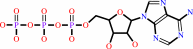 ATP
ATP
|
+
|
H2O
|
=
|
Zn(2+)(out)
|
+
|
 ADP
ADP
|
+
|
 phosphate
|
+
|
H(+)
|
|
|
|
|
|
|
|
|
|
Cofactor:
|
|
Mg(2+)
|
|
|
|
|
|
|
|
|
Molecule diagrams generated from .mol files obtained from the
KEGG ftp site
|
|
|
|
|
|
|
|
|
|
|
|
|
|
 |
|
|
|
|
|
|
| |
|
|
| |
|
|
J Biol Inorg Chem
15:87-98
(2010)
|
|
PubMed id:
|
|
|
|
|
|
| |
|
NMR structural analysis of the soluble domain of ZiaA-ATPase and the basis of selective interactions with copper metallochaperone Atx1.
|
|
L.Banci,
I.Bertini,
S.Ciofi-Baffoni,
L.Poggi,
M.Vanarotti,
S.Tottey,
K.J.Waldron,
N.J.Robinson.
|
|
|
|
|
| |
ABSTRACT
|
|
|
|
| |
|
|
A Cu(I) metallochaperone, Atx1, interacts with the amino-terminal domain of a
Cu(I)-transporting ATPase, PacS(N), but not with a domain of related
Zn-transporting ATPase, ZiaA(N) in Synechocystis PCC 6803. This is thought to
prevent ZiaA(N) from acquiring Cu(I), which it binds more tightly than Zn.
Solution structures of Atx1, PacS(N), and the heterodimer were previously
described. Here we report solution structural studies of the ZiaA(N) soluble
domain. Apo-ZiaA(N) has a typical ferredoxin-like fold followed by an atypical
34 residues of unstructured polypeptide containing a His(7) motif. ZiaA(N)
competes with the metallochromic indicator 4-(2-pyridylazo)resorcinol for 1
equiv of Zn, which can be displaced by thiol-modifying p-mercuriphenylsulfonic
acid, establishing that a high-affinity site involves thiols of the CXXC motif
within the ferredoxin-like fold. A single equivalent of Zn affects nuclear
magnetic resonance signals arising from the CXXC motif as well as all seven His
residues. The presence of NMR-line broadening in both sites implies that
Zn(1)-ZiaA(N) undergoes exchange phenomena, consistent with CXXC-bound Zn
coincidentally sampling various His ligands. These Zn-dependent dynamic changes
could either aid metal transfer or alter intramolecular interactions. No
formation of Atx1-Cu(I)-ZiaA(N) heterodimers was observed, and in the presence
of equimolar ZiaA(N) and PacS(N), only Atx1-Cu(I)-PacS(N) complexes were
detected. Residues flanking the CXXC motif of PacS(N) (R(13)-ASS(20)) differ in
charge and bulk from those of ZiaA(N) (D(18)-KLK(25)) and make contacts in the
Atx1-Cu(I)-PacS(N) complex. Crucially, swapping these residues flanking the CXXC
motifs of ZiaA(N) and PacS(N) reciprocally swaps partner choice by Atx1. These
few residues of the two ATPases have diverged during evolution to bias Atx1
interactions in favor of PacS(N) rather than ZiaA(N.).
|
|
|
|
|
|
|
|
|
|
|
|
|
|
|
|
|
|
 |
 |
 |
|
Literature references that cite this PDB file's key reference
|
|
|
| |
PubMed id
|
|
Reference
|
|
|
|
|
|
L.Banci,
I.Bertini,
F.Cantini,
and
S.Ciofi-Baffoni
(2010).
Cellular copper distribution: a mechanistic systems biology approach.
|
| |
Cell Mol Life Sci,
67,
2563-2589.
|
|
|
|
|
|
|
L.Banci,
I.Bertini,
K.S.McGreevy,
and
A.Rosato
(2010).
Molecular recognition in copper trafficking.
|
| |
Nat Prod Rep,
27,
695-710.
|
|
|
|
|
|
|
N.J.Robinson,
and
D.R.Winge
(2010).
Copper metallochaperones.
|
| |
Annu Rev Biochem,
79,
537-562.
|
|
|
|
|
|
The most recent references are shown first.
Citation data come partly from CiteXplore and partly
from an automated harvesting procedure. Note that this is likely to be
only a partial list as not all journals are covered by
either method. However, we are continually building up the citation data
so more and more references will be included with time.
|
|


 Links
Links


