 |
PDBsum entry 2mml

|
|
|
|
|
|

|

|

|

|
|

|
|

|
|

|
|
|
 |

|

|
|
|
|
|
|
|
|
|
|
|
|
|
|
|
|
|
|
|
|
|
|
|
|
|
|
|
|
|
|
|
|
Viral protein
|
PDB id
|
|
|
|
2mml
|
|
|
|
|
|
|
|
|
|
|
|
|
|
|

|

|

|
|
|
|
|
|
|
|
|
Enzyme class 1:
|
|
E.C.2.7.7.48
- RNA-directed Rna polymerase.
|
|
|
|
|
|
|
Reaction:
|
|
RNA(n) + a ribonucleoside 5'-triphosphate = RNA(n+1) + diphosphate
|
|
|
|
|
|
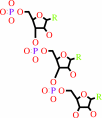 RNA(n)
|
+
|
ribonucleoside 5'-triphosphate
|
=
|
RNA(n+1)
|
+
|
 diphosphate
|
|
|
|
|
|
|
|
|
|
Enzyme class 2:
|
|
E.C.3.4.22.28
- picornain 3C.
|
|
|
|
|
|
|
Reaction:
|
|
Selective cleavage of Gln-|-Gly bond in the poliovirus polyprotein. In other picornavirus reactions Glu may be substituted for Gln, and Ser or Thr for Gly.
|
|
|
|
|
|
Enzyme class 3:
|
|
E.C.3.6.4.13
- Rna helicase.
|
|
|
|
|
|
|
Reaction:
|
|
ATP + H2O = ADP + phosphate + H+
|
|
|
|
|
|
 ATP
ATP
|
+
|
H2O
|
=
|
 ADP
ADP
|
+
|
 phosphate
|
+
|
H(+)
|
|
|
|
|
|
|
|
|
|
|
|
|
Note, where more than one E.C. class is given (as above), each may
correspond to a different protein domain or, in the case of polyprotein
precursors, to a different mature protein.
|
|
|
|
Molecule diagrams generated from .mol files obtained from the
KEGG ftp site
|
|
|
|
|
|
|
|
|
|
|
|
|
|
 |
|
|
|
|
|
|
| |
|
|
| |
|
DOI no:
|
Proc Natl Acad Sci U S A
111:15792-15797
(2014)
|
|
PubMed id:
|
|
|
|
|
|
| |
|
Solution structures of Mengovirus Leader protein, its phosphorylated derivatives, and in complex with nuclear transport regulatory protein, RanGTPase.
|
|
V.R.Bacot-Davis,
J.J.Ciomperlik,
H.A.Basta,
C.C.Cornilescu,
A.C.Palmenberg.
|
|
|
|
|
| |
ABSTRACT
|
|
|
|
| |
|
|
Cardiovirus Leader (L) proteins induce potent antihost inhibition of active
cellular nucleocytoplasmic trafficking by triggering aberrant
hyperphosphorylation of nuclear pore proteins (Nup). To achieve this, L binds
protein RanGTPase (Ran), a key trafficking regulator, and diverts it into
tertiary or quaternary complexes with required kinases. The activity of L is
regulated by two phosphorylation events not required for Ran binding. Matched
NMR studies on the unphosphorylated, singly, and doubly phosphorylated variants
of Mengovirus L (LM) show both modifications act together to partially stabilize
a short internal α-helix comprising LM residues 43-46. This motif implies that
ionic and Van der Waals forces contributed by phosphorylation help organize
downstream residues 48-67 into a new interface. The full structure of LM as
bound to Ran (unlabeled) and Ran (216 aa) as bound by LM (unlabeled) places LM
into the BP1 binding site of Ran, wrapped by the conformational flexible COOH
tail. The arrangement explains the tight KD for this complex and places the LM
zinc finger and phosphorylation interface as surface exposed and available for
subsequent reactions. The core structure of Ran, outside the COOH tail, is not
altered by LM binding and remains accessible for canonical RanGTP partner
interactions. Pull-down assays identify at least one putative Ran:LM partner as
an exportin, Crm1, or CAS. A model of Ran:LM:Crm1, based on the new structures
suggests LM phosphorylation status may mediate Ran's selection of exportin(s)
and cargo(s), perverting these native trafficking elements into the lethal
antihost Nup phosphorylation pathways.
|
|
|
|
|
|
|
|
|
|
|
|
|
|
|
|
|
|
 |
 |
 |
|


 Links
Links


