
|
|
|
|
|
 |
Contents |
 |
|
|
|
|
|
|
|
|
|
|
|
|
|
|
* Residue conservation analysis
|
|
|
|
|
|
PDB id:
|
|
|
|
| Name: |
|
Transferase
|
|
|
Title:
|
|
Structure of the e. Coli pol iii epsilon-hot proofreading complex
|
|
Structure:
|
|
DNA polymerase iii epsilon subunit. Chain: a, c. Fragment: exonuclease domain. Engineered: yes. Hot protein. Chain: b, d. Engineered: yes
|
|
Source:
|
|
Escherichia coli. Organism_taxid: 562. Gene: dnaq, mutd. Expressed in: escherichia coli bl21(de3). Expression_system_taxid: 469008. Enterobacteria phage. Organism_taxid: 10678. Strain: p1. Gene: hot.
|
|
Biol. unit:
|
|
 Dimer (from
)
Dimer (from
)
|
|
Resolution:
|
|
|
2.10Å
|
R-factor:
|
0.206
|
R-free:
|
0.244
|
|
|
Authors:
|
|
T.W.Kirby,S.Harvey,E.F.Derose,S.Chalov,A.K.Chikova,F.W.Perrino, R.M.Schaaper,R.E.London,L.C.Pedersen
|
Key ref:

|
|
T.W.Kirby
et al.
(2006).
Structure of the Escherichia coli DNA polymerase III epsilon-HOT proofreading complex.
J Biol Chem,
281,
38466-38471.
PubMed id:
DOI:

|
|
|
Date:
|
|
|
15-Sep-06
|
Release date:
|
14-Nov-06
|
|
|
|
|
|
|
PROCHECK
|

|
|
|
|
|
Headers
|
|
|
|
References
|
|
|
|
|
|
|
|
|
|
|
|
Enzyme class:
|
|
Chains A, C:
E.C.2.7.7.7
- DNA-directed Dna polymerase.
|
|
|
|
|
|
|
Reaction:
|
|
DNA(n) + a 2'-deoxyribonucleoside 5'-triphosphate = DNA(n+1) + diphosphate
|
|
|
|
|
|
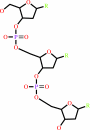 DNA(n)
|
+
|
2'-deoxyribonucleoside 5'-triphosphate
|
=
|
DNA(n+1)
|
+
|
 diphosphate
|
|
|
|
|
|
|
|
|
|
|
|
|
Molecule diagrams generated from .mol files obtained from the
KEGG ftp site
|
|
|
|
|
|
|
|
|
|
|
|
|
|
 |
|
|
|
|
|
|
| |
|
|
| |
|
DOI no:
|
J Biol Chem
281:38466-38471
(2006)
|
|
PubMed id:
|
|
|
|
|
|
| |
|
Structure of the Escherichia coli DNA polymerase III epsilon-HOT proofreading complex.
|
|
T.W.Kirby,
S.Harvey,
E.F.DeRose,
S.Chalov,
A.K.Chikova,
F.W.Perrino,
R.M.Schaaper,
R.E.London,
L.C.Pedersen.
|
|
|
|
|
| |
ABSTRACT
|
|
|
|
| |
|
|
The epsilon subunit of Escherichia coli DNA polymerase III possesses
3'-exonucleolytic proofreading activity. Within the Pol III core, epsilon is
tightly bound between the alpha subunit (DNA polymerase) and subunit. Here, we
present the crystal structure of epsilon in complex with HOT, the bacteriophage
P1-encoded homolog of , at 2.1 A resolution. The epsilon-HOT interface is
defined by two areas of contact: an interaction of the previously unstructured N
terminus of HOT with an edge of the epsilon central beta-sheet as well as
interactions between HOT and the catalytically important helix alpha1-loop-helix
alpha2 motif of epsilon. This structure provides insight into how HOT and, by
implication, may stabilize the epsilon subunit, thus promoting efficient
proofreading during chromosomal replication.
|
|
|
|
|
|
| |
Selected figure(s)
|
|
|
|
| |
|
|

|
|

|
|
Figure 2.
FIGURE 2. Variation in  186 crystallographic
structures. A, superposition of the crystal structures of the
two molecules of 186 in the asymmetric
unit of the 186-HOT complex,
molecule A (blue) and molecule C (red). B, superposition of the
previously determined 186 (green) (Protein
Data Bank code 1J54) with 186 molecule C (red) of
the 186-HOT complex. 186 crystallographic
structures. A, superposition of the crystal structures of the
two molecules of 186 in the asymmetric
unit of the 186-HOT complex,
molecule A (blue) and molecule C (red). B, superposition of the
previously determined 186 (green) (Protein
Data Bank code 1J54) with 186 molecule C (red) of
the 186-HOT complex.
|
|
Figure 6.
FIGURE 6. Stereo view of mutator residues. Amino acids of
that
lead to a mutator phenotype when specifically substituted are
shown in red on the structure of the 186-HOT complex. HOT is
in orange, and 186 is in blue. Known
mutator residues are Asp^12 (a), Glu^14 (b), Thr^15 (c), Thr^16
(d), Gly^17 (e), Arg^56 (f), His^66 (g), Val^96 (h), Asp^103
(i), His^162 (j), Ala^161 (k), Asp^167 (m), Leu^171 (n), and
Gly^180 (o).
|
|
|
|
|
|
| |
The above figures are
reprinted
by permission from the ASBMB:
J Biol Chem
(2006,
281,
38466-38471)
copyright 2006.
|
|
| |
Figures were
selected
by an automated process.
|
|
|
|
|
|
|
|
|
|
|
|
|
|
|
|
 |
 |
 |
|
Literature references that cite this PDB file's key reference
|
|
|
| |
PubMed id
|
|
Reference
|
|
|
|
|
|
G.A.Cisneros,
L.Perera,
R.M.Schaaper,
L.C.Pedersen,
R.E.London,
L.G.Pedersen,
and
T.A.Darden
(2009).
Reaction mechanism of the epsilon subunit of E. coli DNA polymerase III: insights into active site metal coordination and catalytically significant residues.
|
| |
J Am Chem Soc,
131,
1550-1556.
|
|
|
|
|
|
|
J.Batra,
K.Xu,
S.Qin,
and
H.X.Zhou
(2009).
Effect of macromolecular crowding on protein binding stability: modest stabilization and significant biological consequences.
|
| |
Biophys J,
97,
906-911.
|
|
|
|
|
|
|
R.Koike,
A.Kidera,
and
M.Ota
(2009).
Alteration of oligomeric state and domain architecture is essential for functional transformation between transferase and hydrolase with the same scaffold.
|
| |
Protein Sci,
18,
2060-2066.
|
|
|
|
|
|
|
C.Schmitz,
M.J.Stanton-Cook,
X.C.Su,
G.Otting,
and
T.Huber
(2008).
Numbat: an interactive software tool for fitting Deltachi-tensors to molecular coordinates using pseudocontact shifts.
|
| |
J Biomol NMR,
41,
179-189.
|
|
|
|
|
|
|
D.Gawel,
P.T.Pham,
I.J.Fijalkowska,
P.Jonczyk,
and
R.M.Schaaper
(2008).
Role of accessory DNA polymerases in DNA replication in Escherichia coli: analysis of the dnaX36 mutator mutant.
|
| |
J Bacteriol,
190,
1730-1742.
|
|
|
|
|
|
|
K.Ozawa,
S.Jergic,
A.Y.Park,
N.E.Dixon,
and
G.Otting
(2008).
The proofreading exonuclease subunit epsilon of Escherichia coli DNA polymerase III is tethered to the polymerase subunit alpha via a flexible linker.
|
| |
Nucleic Acids Res,
36,
5074-5082.
|
|
|
|
|
|
|
A.K.Chikova,
and
R.M.Schaaper
(2007).
The bacteriophage P1 hot gene, encoding a homolog of the E. coli DNA polymerase III theta subunit, is expressed during both lysogenic and lytic growth stages.
|
| |
Mutat Res,
624,
1-8.
|
|
|
|
|
|
The most recent references are shown first.
Citation data come partly from CiteXplore and partly
from an automated harvesting procedure. Note that this is likely to be
only a partial list as not all journals are covered by
either method. However, we are continually building up the citation data
so more and more references will be included with time.
|
 |


 Links
Links


