 |
PDBsum entry 1x9x

|
|
|
|
|
 |
Contents |
 |
|
|
|
|
|
|
|
|
* Residue conservation analysis
|
|
|
|
|
|
|
|
|
|
|
Enzyme class:
|
|
E.C.2.7.11.25
- mitogen-activated protein kinase kinase kinase.
|
|
|
|
|
|
|
Reaction:
|
|
|
1.
|
L-seryl-[protein] + ATP = O-phospho-L-seryl-[protein] + ADP + H+
|
|
2.
|
L-threonyl-[protein] + ATP = O-phospho-L-threonyl-[protein] + ADP + H+
|
|
|
|
|
|
|
L-seryl-[protein]
|
+
|
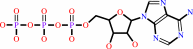 ATP
ATP
|
=
|
O-phospho-L-seryl-[protein]
|
+
|
 ADP
ADP
|
+
|
H(+)
|
|
|
|
|
|
|
L-threonyl-[protein]
|
+
|
ATP
|
=
|
O-phospho-L-threonyl-[protein]
|
+
|
ADP
|
+
|
H(+)
|
|
|
|
|
|
|
|
|
|
|
|
|
Molecule diagrams generated from .mol files obtained from the
KEGG ftp site
|
|
|
|
|
|
|
|
|
|
|
|
|
|
 |
|
|
|
|
|
|
| |
|
|
| |
|
DOI no:
|
J Mol Biol
344:1071-1087
(2004)
|
|
PubMed id:
|
|
|
|
|
|
| |
|
Solution structure of the dimeric SAM domain of MAPKKK Ste11 and its interactions with the adaptor protein Ste50 from the budding yeast: implications for Ste11 activation and signal transmission through the Ste50-Ste11 complex.
|
|
S.Bhattacharjya,
P.Xu,
R.Gingras,
R.Shaykhutdinov,
C.Wu,
M.Whiteway,
F.Ni.
|
|
|
|
|
| |
ABSTRACT
|
|
|
|
| |
|
|
Ste11, a homologue of mammalian MAPKKKs, together with its binding partner Ste50
works in a number of MAPK signaling pathways of Saccharomyces cerevisiae.
Ste11/Ste50 binding is mediated by their sterile alpha motifs or SAM domains, of
which homologues are also found in many other intracellular signaling and
regulatory proteins. Here, we present the solution structure of the SAM domain
or residues D37-R104 of Ste11 and its interactions with the cognate SAM
domain-containing region of Ste50, residues M27-Q131. NMR pulse-field-gradient
(PFG) and rotational correlation time measurements (tauc) establish that the
Ste11 SAM domain exists predominantly as a symmetric dimer in solution. The
solution structure of the dimeric Ste11 SAM domain consists of five well-defined
helices per monomer packed into a compact globular structure. The dimeric
structure of the SAM domain is maintained by a novel dimer interface involving
interactions between a number of hydrophobic residues situated on helix 4 and at
the beginning of the C-terminal long helix (helix 5). The dimer structure may
also be stabilized by potential salt bridge interactions across the interface.
NMR H/2H exchange experiments showed that binding of the Ste50 SAM to the Ste11
SAM very likely involves the positively charged extreme C-terminal region as
well as exposed hydrophobic patches of the dimeric Ste11 SAM domain. The dimeric
structure of the Ste11 SAM and its interactions with the Ste50 SAM may have
important roles in the regulation and activation of the Ste11 kinase and signal
transmission and amplifications through the Ste50-Ste11 complex.
|
|
|
|
|
|
| |
Selected figure(s)
|
|
|
|
| |
|
|

|
|

|
|
Figure 2.
Figure 2. 15N NMR relaxation data of the 15N-labeled Ste11
SAM domain in the dimeric state. (a) 15N longitudinal relaxation
rates (R[1]=1/T[1]); (b) 15N transverse relaxation rates
(R[2]=1/T[2]); and (c) heteronuclear Overhauser effects (HNOE)
between proton and the 15N nuclei of the amide 15NH group.
|
|
Figure 6.
Figure 6. Space-filling representation of the hydrophobic
core (a) and a stick diagram of salt-bridges (b) at the dimeric
interface of the Ste11 SAM domain. The helices are represented
by ribbons. (c) Stick diagram of the dimeric structure of the
Ste11 SAM domain showing surface-exposed hydrophobic residues.
(d) Electrostatic potential surface of the Ste11 SAM dimer. The
asymmetric charge distribution of the dimer of each face is
shown. Colored in red is negatively charged, blue positively
charged and white neutral. This Figure was made with the GRASP
program.54
|
|
|
|
|
|
| |
The above figures are
reprinted
by permission from Elsevier:
J Mol Biol
(2004,
344,
1071-1087)
copyright 2004.
|
|
| |
Figures were
selected
by an automated process.
|
|
|
|
|
|
|
|
|
|
|
|
|
|
|
|
 |
 |
 |
|
Literature references that cite this PDB file's key reference
|
|
|
| |
PubMed id
|
|
Reference
|
|
|
|
|
|
A.Bhunia,
P.N.Domadia,
H.Mohanram,
and
S.Bhattacharjya
(2009).
NMR structural studies of the Ste11 SAM domain in the dodecyl phosphocholine micelle.
|
| |
Proteins,
74,
328-343.
|
|
|
|
|
|
|
M.Leone,
J.Cellitti,
and
M.Pellecchia
(2009).
The Sam domain of the lipid phosphatase Ship2 adopts a common model to interact with Arap3-Sam and EphA2-Sam.
|
| |
BMC Struct Biol,
9,
59.
|
|
|
PDB code:
|
|
|
|
|
|
|
|
B.D.Slaughter,
J.M.Huff,
W.Wiegraebe,
J.W.Schwartz,
and
R.Li
(2008).
SAM domain-based protein oligomerization observed by live-cell fluorescence fluctuation spectroscopy.
|
| |
PLoS ONE,
3,
e1931.
|
|
|
|
|
|
|
G.W.Buchko,
B.J.Tarasevich,
J.Bekhazi,
M.L.Snead,
and
W.J.Shaw
(2008).
A solution NMR investigation into the early events of amelogenin nanosphere self-assembly initiated with sodium chloride or calcium chloride.
|
| |
Biochemistry,
47,
13215-13222.
|
|
|
|
|
|
|
M.Leone,
J.Cellitti,
and
M.Pellecchia
(2008).
NMR studies of a heterotypic Sam-Sam domain association: the interaction between the lipid phosphatase Ship2 and the EphA2 receptor.
|
| |
Biochemistry,
47,
12721-12728.
|
|
|
PDB code:
|
|
|
|
|
|
|
|
N.Hao,
Y.Zeng,
T.C.Elston,
and
H.G.Dohlman
(2008).
Control of MAPK specificity by feedback phosphorylation of shared adaptor protein ste50.
|
| |
J Biol Chem,
283,
33798-33802.
|
|
|
|
|
|
|
H.Li,
K.L.Fung,
D.Y.Jin,
S.S.Chung,
Y.P.Ching,
I.O.Ng,
K.H.Sze,
B.C.Ko,
and
H.Sun
(2007).
Solution structures, dynamics, and lipid-binding of the sterile alpha-motif domain of the deleted in liver cancer 2.
|
| |
Proteins,
67,
1154-1166.
|
|
|
PDB code:
|
|
|
|
|
|
|
|
C.C.Wang,
J.H.Chen,
S.H.Yin,
and
W.J.Chuang
(2006).
Predicting the redox state and secondary structure of cysteine residues in proteins using NMR chemical shifts.
|
| |
Proteins,
63,
219-226.
|
|
|
|
|
|
|
C.Wu,
G.Jansen,
J.Zhang,
D.Y.Thomas,
and
M.Whiteway
(2006).
Adaptor protein Ste50p links the Ste11p MEKK to the HOG pathway through plasma membrane association.
|
| |
Genes Dev,
20,
734-746.
|
|
|
|
|
|
|
D.M.Truckses,
J.E.Bloomekatz,
and
J.Thorner
(2006).
The RA domain of Ste50 adaptor protein is required for delivery of Ste11 to the plasma membrane in the filamentous growth signaling pathway of the yeast Saccharomyces cerevisiae.
|
| |
Mol Cell Biol,
26,
912-928.
|
|
|
|
|
|
|
S.Bhattacharjya,
P.Xu,
M.Chakrapani,
L.Johnston,
and
F.Ni
(2005).
Polymerization of the SAM domain of MAPKKK Ste11 from the budding yeast: implications for efficient signaling through the MAPK cascades.
|
| |
Protein Sci,
14,
828-835.
|
|
|
|
|
|
The most recent references are shown first.
Citation data come partly from CiteXplore and partly
from an automated harvesting procedure. Note that this is likely to be
only a partial list as not all journals are covered by
either method. However, we are continually building up the citation data
so more and more references will be included with time.
Where a reference describes a PDB structure, the PDB
code is
shown on the right.
|
|


 Links
Links


