 |
PDBsum entry 1wa2

|
|
|
|
|
 |
Contents |
 |
|
|
|
|
|
|
|
|
|
|
|
|
|
|
* Residue conservation analysis
|
|
|
|
|
|
PDB id:
|
|
|
|
| Name: |
|
Reductase
|
|
|
Title:
|
|
Crystal structure of h313q mutant of alcaligenes xylosoxidans nitrite reductase with nitrite bound
|
|
Structure:
|
|
Dissimilatory copper-containing nitrite reductase,. Chain: x. Synonym: nitrite reductase, nir. Engineered: yes. Mutation: yes
|
|
Source:
|
|
Alcaligenes xylosoxidans. Organism_taxid: 85698. Variant: xylosoxidans. Expressed in: escherichia coli. Expression_system_taxid: 469008.
|
|
Biol. unit:
|
|
 Trimer (from PDB file)
|
|
Resolution:
|
|
|
1.72Å
|
R-factor:
|
0.182
|
R-free:
|
0.210
|
|
|
Authors:
|
|
M.L.Barrett,R.L.Harris,S.V.Antonyuk,R.W.Strange,M.A.Hough,R.R.Eady, G.Sawers,S.S.Hasnain
|
Key ref:

|
|
M.L.Barrett
et al.
(2004).
Insights into redox partner interactions and substrate binding in nitrite reductase from Alcaligenes xylosoxidans: crystal structures of the Trp138His and His313Gln mutants.
Biochemistry,
43,
16311-16319.
PubMed id:
DOI:
|
|
|
Date:
|
|
|
22-Oct-04
|
Release date:
|
04-Jan-05
|
|
|
|
|
|
|
PROCHECK
|

|
|
|
|
|
Headers
|
|
|
|
References
|
|
|
|
|
|

|
|
O68601
(O68601_ALCXX) -
Copper-containing nitrite reductase from Alcaligenes xylosoxydans xylosoxydans
|
|
|
|
Seq:
Struc:
|
|
|
|
360 a.a.
334 a.a.*
|
|

|

|

|
|
|
|
|
|
|
|
|
|
|
Key: |
|
 |
Secondary structure |
|
 |
CATH domain |
|
|
*
PDB and UniProt seqs differ
at 1 residue position (black
cross)
|
|
|
|
|
|
|
|
|
|
|
|
|
Enzyme class:
|
|
E.C.1.7.2.1
- nitrite reductase (NO-forming).
|
|
|
|
|
|
|
Reaction:
|
|
nitric oxide + Fe(III)-[cytochrome c] + H2O = Fe(II)-[cytochrome c] + nitrite + 2 H+
|
|
|
|
|
|
 nitric oxide
|
+
|
Fe(III)-[cytochrome c]
|
+
|
H2O
|
=
|
Fe(II)-[cytochrome c]
|
+
|
 nitrite
|
+
|
2
×
H(+)
Bound ligand (Het Group name = )
corresponds exactly
|
|
|
|
|
|
|
|
|
|
Cofactor:
|
|
Cu cation or Fe cation; FAD
|
|
|
|
|
|
Cu cation
|
or
|
Fe cation
|
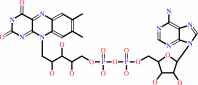 FAD
FAD
|
|
|
|
|
|
|
Molecule diagrams generated from .mol files obtained from the
KEGG ftp site
|
|
|
|
|
|
|
|
|
|
|
|
|
|
 |
|
|
|
|
|
|
| |
|
|
| |
|
DOI no:
|
Biochemistry
43:16311-16319
(2004)
|
|
PubMed id:
|
|
|
|
|
|
| |
|
Insights into redox partner interactions and substrate binding in nitrite reductase from Alcaligenes xylosoxidans: crystal structures of the Trp138His and His313Gln mutants.
|
|
M.L.Barrett,
R.L.Harris,
S.Antonyuk,
M.A.Hough,
M.J.Ellis,
G.Sawers,
R.R.Eady,
S.S.Hasnain.
|
|
|
|
|
| |
ABSTRACT
|
|
|
|
| |
|
|
Dissimilatory nitrite reductase catalyses the reduction of nitrite to nitric
oxide within the key biological process of denitrification. We present
biochemical and structural results on two key mutants, one postulated to be
important for the interaction with the partner protein and the other for
substrate entry. Trp138, adjacent to one of the type-1 Cu ligands, is one of the
residues surrounding a small depression speculated to be important in complex
formation with the physiological redox partners, azurin I and II. Our data
reveal that the Trp138His mutant is fully active using methyl viologen as an
artificial electron donor, but there is a large decrease in activity using
azurin I. These observations together with its crystal structure at a high
resolution of 1.6 A confirm the importance of Trp138 in electron transfer and
thus in productive interaction with azurin. A "hydrophobic pocket" on the
protein surface has been identified as the channel through which nitrite may be
guided to the catalytic type-2 Cu site. Glu133 and His313 at the opening of the
pocket are conserved among most blue and green copper nitrite reductases
(CuNiRs). The failure to soak the substrate into our high-resolution crystal
form of native and mutant CuNiRs has been linked to the observation of an
extraneous poly(ethylene glycol) (PEG) molecule interacting with His313. We
present the crystal structure of His313Gln and the substrate-bound mutant at
high resolutions of 1.65 and 1.72 A, respectively. The observation of the
substrate-bound structure for the His313Gln mutant and inhibitory studies with
PEG establishes the role of the hydrophobic pocket as the port of substrate
entry.
|
|
|
|
|
|
|
|
|
|
|
|
|
|
|
|
|
|
 |
 |
 |
|
Literature references that cite this PDB file's key reference
|
|
|
| |
PubMed id
|
|
Reference
|
|
|
|
|
|
J.Yi,
J.Heinecke,
H.Tan,
P.C.Ford,
and
G.B.Richter-Addo
(2009).
The distal pocket histidine residue in horse heart myoglobin directs the O-binding mode of nitrite to the heme iron.
|
| |
J Am Chem Soc,
131,
18119-18128.
|
|
|
PDB codes:
|
|
|
|
|
|
|
|
F.Jacobson,
A.Pistorius,
D.Farkas,
W.De Grip,
O.Hansson,
L.Sjölin,
and
R.Neutze
(2007).
pH dependence of copper geometry, reduction potential, and nitrite affinity in nitrite reductase.
|
| |
J Biol Chem,
282,
6347-6355.
|
|
|
PDB codes:
|
|
|
|
|
|
|
|
K.Paraskevopoulos,
M.A.Hough,
R.G.Sawers,
R.R.Eady,
and
S.S.Hasnain
(2007).
The structure of the Met144Leu mutant of copper nitrite reductase from Alcaligenes xylosoxidans provides the first glimpse of a protein-protein complex with azurin II.
|
| |
J Biol Inorg Chem,
12,
789-796.
|
|
|
PDB code:
|
|
|
|
|
|
|
|
A.Impagliazzo,
L.Krippahl,
and
M.Ubbink
(2005).
Pseudoazurin-nitrite reductase interactions.
|
| |
Chembiochem,
6,
1648-1653.
|
|
|
|
|
|
|
S.V.Antonyuk,
R.W.Strange,
G.Sawers,
R.R.Eady,
and
S.S.Hasnain
(2005).
Atomic resolution structures of resting-state, substrate- and product-complexed Cu-nitrite reductase provide insight into catalytic mechanism.
|
| |
Proc Natl Acad Sci U S A,
102,
12041-12046.
|
|
|
PDB codes:
|
|
|
|
|
|
|
The most recent references are shown first.
Citation data come partly from CiteXplore and partly
from an automated harvesting procedure. Note that this is likely to be
only a partial list as not all journals are covered by
either method. However, we are continually building up the citation data
so more and more references will be included with time.
Where a reference describes a PDB structure, the PDB
codes are
shown on the right.
|
|


 Links
Links


