|
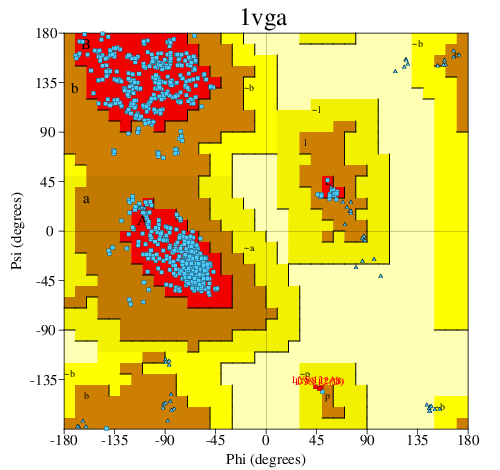
PDBsum entry 1vga

|
|
|
|
|
 |
Contents |
 |
|
|
|
|
|
|
|
|
|
|
* Residue conservation analysis
|
|
|
|
|
|
|
|
|
|
|
Enzyme class:
|
|
E.C.5.3.1.1
- triose-phosphate isomerase.
|
|
|
|
|
|
|
Reaction:
|
|
D-glyceraldehyde 3-phosphate = dihydroxyacetone phosphate
|
|
|
|
|
|
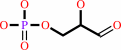 D-glyceraldehyde 3-phosphate
|
=
|
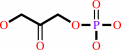 dihydroxyacetone phosphate
|
|
|
|
|
|
|
|
|
|
|
|
|
Molecule diagrams generated from .mol files obtained from the
KEGG ftp site
|
|
|
|
|
|
|
|
|
|
|
|
|
|
 |
|
|
|
|
|
|
| |
|
|
| |
|
DOI no:
|
J Mol Biol
343:671-684
(2004)
|
|
PubMed id:
|
|
|
|
|
|
| |
|
Structures of unliganded and inhibitor complexes of W168F, a Loop6 hinge mutant of Plasmodium falciparum triosephosphate isomerase: observation of an intermediate position of loop6.
|
|
K.Eaazhisai,
H.Balaram,
P.Balaram,
M.R.Murthy.
|
|
|
|
|
| |
ABSTRACT
|
|
|
|
| |
|
|
The enzymatic reaction of triosephosphate isomerase (TIM) is controlled by the
movement of a loop (loop6, residues 166-176). Crystal structures of TIMs from a
variety of sources have revealed that the loop6, which is in an open
conformation in the unliganded enzyme, adopts a closed conformation in inhibitor
complexes. In contrast, structures with loop open conformation are obtained in
most of the complexes of TIM from the malarial parasite Plasmodium falciparum
(PfTIM). W168 is a conserved N-terminal hinge residue, involved in different
sets of interactions in the "open" and "closed" forms of
loop6. The role of W168 in determining the loop conformation was examined by
structural studies on the mutant W168F and its complexes with ligands. The
three-dimensional structures of unliganded mutant (1.8 A) and complexes with
sulfate (2.8 A) and glycerol-2-phosphate (G2P) (2.8 A) have been determined.
Loop6 was found disordered in these structures, reflecting the importance of
W168 in stabilizing either the open or the closed states. Critical sequence
differences between the Plasmodium enzyme and other TIMs may influence the
equilibrium between the closed and open forms. Examination of the environment of
the loop6 shows that its propensity for the open or the closed forms is
influenced not only by Phe96 as suggested earlier, but also by Asn233, which
occurs in the vicinity of the active site. This residue is Gly in the other TIM
sequences and probably plays a crucial role in the mode of ligand binding, which
in turn affects the loop opening/closing process in PfTIM.
|
|
|
|
|
|
| |
Selected figure(s)
|
|
|
|
| |
|
|

|
|

|
|
Figure 1.
Figure 1. (a) Ribbon representation of the structure of
PfTIM monomer. Trp11 (blue) and Trp168 (green) are shown in
sticks. (b) and (c) Hydrogen bonding interactions of the
N-terminal hinge residues, Pro166, Leu167 and Trp168 in the open
and closed forms of loop6, respectively. The Figures were
generated using MOLSCRIPT39 and rendered using Raster3D.40 (d)
Chemical structures of the substrates and various ligands of
TIM; dihydroxyacetone phosphate (DHAP),
glyceraldehyde-3-phosphate (GAP), 2-phosphoglycolate (PGA),
2-phosphoglycerate (2PG), glycerol-3-phosphate (G-3P) and
glycerol-2-phosphate (G-2P).
|
|
Figure 3.
Figure 3. Stereo view of the ligand binding site in the
structures of W168F mutant of PfTIM complexed with sulfate and
G2P. (a) Fit of the sulfate ion to the electron density in a
F[obs] -F[calc] omit map contoured at 2.5s. (b) Superposition of
the active sites of sulfate complexes of TrypTIM (green), C.
elegans TIM (indigo) and W168F mutant of PfTIM (colored by atom)
showing the differences in the protein-ligand interactions. (c)
G2P at the active site of the B-subunit of W168F-G2P complex is
shown with density from the F[obs] -F[calc] omit map contoured
at 2.5s. (d) Hydrogen bonding interactions (dotted lines) of G2P
with the polypeptide.
|
|
|
|
|
|
| |
The above figures are
reprinted
by permission from Elsevier:
J Mol Biol
(2004,
343,
671-684)
copyright 2004.
|
|
| |
Figures were
selected
by an automated process.
|
|
|
|
|
|
|
|
|
|
|
|
|
|
|
|
 |
 |
 |
|
Literature references that cite this PDB file's key reference
|
|
|
| |
PubMed id
|
|
Reference
|
|
|
|
|
|
J.Moraes,
R.Arreola,
N.Cabrera,
L.Saramago,
D.Freitas,
A.Masuda,
I.da Silva Vaz,
M.Tuena de Gomez-Puyou,
R.Perez-Montfort,
A.Gomez-Puyou,
and
C.Logullo
(2011).
Structural and biochemical characterization of a recombinant triosephosphate isomerase from Rhipicephalus (Boophilus) microplus.
|
| |
Insect Biochem Mol Biol,
41,
400-409.
|
|
|
PDB code:
|
|
|
|
|
|
|
|
B.Taneja,
J.Yadav,
T.K.Chakraborty,
and
S.K.Brahmachari
(2009).
An Indian effort towards affordable drugs: "generic to designer drugs".
|
| |
Biotechnol J,
4,
348-360.
|
|
|
|
|
|
|
S.S.Thakur,
P.D.Deepalakshmi,
P.Gayathri,
M.Banerjee,
M.R.Murthy,
and
P.Balaram
(2009).
Detection of the protein dimers, multiple monomeric states and hydrated forms of Plasmodium falciparum triosephosphate isomerase in the gas phase.
|
| |
Protein Eng Des Sel,
22,
289-304.
|
|
|
|
|
|
|
M.Alahuhta,
M.G.Casteleijn,
P.Neubauer,
and
R.K.Wierenga
(2008).
Structural studies show that the A178L mutation in the C-terminal hinge of the catalytic loop-6 of triosephosphate isomerase (TIM) induces a closed-like conformation in dimeric and monomeric TIM.
|
| |
Acta Crystallogr D Biol Crystallogr,
64,
178-188.
|
|
|
PDB codes:
|
|
|
|
|
|
|
|
P.Gayathri,
M.Banerjee,
A.Vijayalakshmi,
S.Azeez,
H.Balaram,
P.Balaram,
and
M.R.Murthy
(2007).
Structure of triosephosphate isomerase (TIM) from Methanocaldococcus jannaschii.
|
| |
Acta Crystallogr D Biol Crystallogr,
63,
206-220.
|
|
|
PDB code:
|
|
|
|
|
|
|
|
F.A.Konuklar,
V.Aviyente,
and
T.Haliloğlu
(2006).
Coupling of structural fluctuations to deamidation reaction in triosephosphate isomerase by Gaussian network model.
|
| |
Proteins,
62,
715-727.
|
|
|
|
|
|
The most recent references are shown first.
Citation data come partly from CiteXplore and partly
from an automated harvesting procedure. Note that this is likely to be
only a partial list as not all journals are covered by
either method. However, we are continually building up the citation data
so more and more references will be included with time.
Where a reference describes a PDB structure, the PDB
code is
shown on the right.
|
|


 Links
Links