
|
|
|
|
|
 |
Contents |
 |
|
|
|
|
|
|
|
|
|
|
|

 295 a.a.
|
|
|
|
|
|
|
|
|
|
|

 107 a.a.
|
|
|
|
|
|
|
|
|
|
|

 213 a.a.
|
|
|
|
|
|
|
|
|
* Residue conservation analysis
|
|
|
|
|
|
PDB id:
|
|
|
|
| Name: |
|
Complex (transcription reg/ank repeat)
|
|
|
Title:
|
|
I-kappa-b-alpha/nf-kappa-b complex
|
|
Structure:
|
|
Nf-kappa-b p65. Chain: a, c. Engineered: yes. Nf-kappa-b p50. Chain: b, d. Engineered: yes. I-kappa-b-alpha. Chain: e, f. Fragment: ankyrin.
|
|
Source:
|
|
Homo sapiens. Human. Organism_taxid: 9606. Expressed in: escherichia coli. Expression_system_taxid: 562. Expression_system_taxid: 562
|
|
Biol. unit:
|
|
 Trimer (from
)
Trimer (from
)
|
|
Resolution:
|
|
|
2.70Å
|
R-factor:
|
0.223
|
R-free:
|
0.265
|
|
|
Authors:
|
|
M.D.Jacobs,S.C.Harrison
|
Key ref:

|
|
M.D.Jacobs
and
S.C.Harrison
(1998).
Structure of an IkappaBalpha/NF-kappaB complex.
Cell,
95,
749-758.
PubMed id:
DOI:

|
|
|
Date:
|
|
|
25-Aug-98
|
Release date:
|
18-Nov-98
|
|
|
|
|
|
|
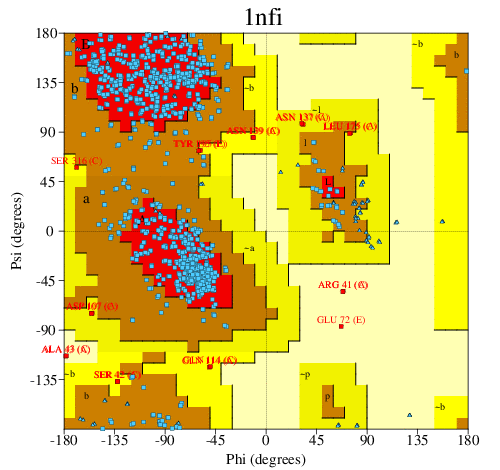
PROCHECK
|
|
|
|
|
|
Headers
|
|
|
|
References
|
|
|
|
|
|

|
|
Q04206
(TF65_HUMAN) -
Transcription factor p65 from Homo sapiens
|
|
|
|
Seq:
Struc:
|
|
|
|
551 a.a.
295 a.a.*
|
|

|

|
|
|
|
|
|
|
|
|
|
|
|
|
|
|
|
|
|
|
|
|
|
 |
|
|
|
|
|
|
| |
|
DOI no:
|
Cell
95:749-758
(1998)
|
|
PubMed id:
|
|
|
|
|
|
| |
|
Structure of an IkappaBalpha/NF-kappaB complex.
|
|
M.D.Jacobs,
S.C.Harrison.
|
|
|
|
|
| |
ABSTRACT
|
|
|
|
| |
|
|
The inhibitory protein, IkappaBalpha, sequesters the transcription factor,
NF-kappaB, as an inactive complex in the cytoplasm. The structure of the
IkappaBalpha ankyrin repeat domain, bound to a partially truncated NF-kappaB
heterodimer (p50/ p65), has been determined by X-ray crystallography at 2.7 A
resolution. It shows a stack of six IkappaBalpha ankyrin repeats facing the
C-terminal domains of the NF-kappaB Rel homology regions. Contacts occur in
discontinuous patches, suggesting a combinatorial quality for ankyrin repeat
specificity. The first two repeats cover an alpha helically ordered segment
containing the p65 nuclear localization signal. The position of the sixth
ankyrin repeat shows that full-length IkappaBalpha will occlude the NF-kappaB
DNA-binding cleft. The orientation of IkappaBalpha in the complex places its N-
and C-terminal regions in appropriate locations for their known regulatory
functions.
|
|
|
|
|
|
| |
Selected figure(s)
|
|
|
|
| |
|
|

|
|

|
|
Figure 4.
Figure 4. Contacts between NF-κB and IκBα(a) The
backbone of IκBα is shown as an orange strand against the van
der Waals contact surface of NF-κB. The surface is colored dark
blue where the center of an atom of IκBα is within 3.8 Å
of an atom of NF-κB, and graded from light blue to white for
distances up to 4.5 Å. This figure is related by a
180° rotation relative to the view in Figure 1B. The thin
strip of continuity between the p50 contact (left) and the p65
contact (right) is the conserved salt-bridge network shown in
Figure 5B.(b) The backbones of the dimerization domains of
NF-κB are shown as orange strands against the van der Waals
contact surface of IκBα. This view is in the same orientation
as Figure 1B. Note how the fingers of IκBα project forward
toward the edge of the p50 RHR-c.(c) Residues of IκBα where
side chains make contacts with NF-κB are shown in color on a
space-filling representation of the ankyrin repeat stack. The
orientation of the model is the same as in Figure 1B and Figure
4B. Residues contacting the p50 RHR-c are in red; those
contacting p65 RHR-c are in dark blue; those contacting the p65
NLS and the segment C-terminal to it are in light blue. These
residues are also indicated by colored boxes in Figure 3A. (a)
and (b) were made using the program GRASP ( [45]), and (c),
using the program RIBBONS ( [13]).
|
|
Figure 6.
Figure 6. Diagram of the IκB/NF-κB Complex, Showing
Additional Interactions and Relative Positions of Domains Not
Included in the Crystal StructureSpace-filling representations
of the ankyrin domain of IκBα and of the RHRs of p65 and p50
are shown, with strands to represent N- or C-terminal
extensions. The C-terminal extension of p65 includes segments
likely to interact with the transcription machinery. The C
terminus of p50 following the NLS is a glycine-rich tail. In
p105, this tail connects to an IκB domain. The figure shows
that this connection can be a simple loop. The N-terminal 69
residues of IκBα include the sites for phosphorylation and
ubiquitination as well as residues thought to mask the p50 NLS.
The C-terminal extension of IκBα occludes the DNA-binding
site; it contains a proline, glutamic-acid, serine, and
threonine-rich segment (PEST domain), which regulates basal
turnover ([59]). The color scheme conforms to Figure 1. Features
with labels in colored boxes are parts of the complex not
present or not ordered in the crystal structure. The p50 RHR-n
has been modeled in an orientation, relative to p50 RHR-c,
similar to the orientation of p65 RHR-n relative to p65 RHR-c in
the structure. Both of the RHR N-terminal domains may actually
adopt a variety of orientations, due to the flexibility of the
RHR linker. Figures made with the program RIBBONS ( [13]).
|
|
|
|
|
|
| |
The above figures are
reprinted
by permission from Cell Press:
Cell
(1998,
95,
749-758)
copyright 1998.
|
|
| |
Figures were
selected
by an automated process.
|
|
|
|
|
|
|
|
|
|
|
|
|
|
|
|
 |
 |
 |
|
Literature references that cite this PDB file's key reference
|
|
|
| |
PubMed id
|
|
Reference
|
|
|
|
|
|
B.Manavalan,
R.Govindaraj,
G.Lee,
and
S.Choi
(2011).
Molecular modeling-based evaluation of dual function of IκBζ ankyrin repeat domain in toll-like receptor signaling.
|
| |
J Mol Recognit,
24,
597-607.
|
|
|
|
|
|
|
C.Zheng,
Q.Yin,
and
H.Wu
(2011).
Structural studies of NF-κB signaling.
|
| |
Cell Res,
21,
183-195.
|
|
|
|
|
|
|
I.DeVries,
D.U.Ferreiro,
I.E.Sánchez,
and
E.A.Komives
(2011).
Folding kinetics of the cooperatively folded subdomain of the IκBα ankyrin repeat domain.
|
| |
J Mol Biol,
408,
163-176.
|
|
|
|
|
|
|
S.C.Sue,
V.Alverdi,
E.A.Komives,
and
H.J.Dyson
(2011).
Detection of a ternary complex of NF-kappaB and IkappaBalpha with DNA provides insights into how IkappaBalpha removes NF-kappaB from transcription sites.
|
| |
Proc Natl Acad Sci U S A,
108,
1367-1372.
|
|
|
|
|
|
|
S.Miyamoto
(2011).
Nuclear initiated NF-κB signaling: NEMO and ATM take center stage.
|
| |
Cell Res,
21,
116-130.
|
|
|
|
|
|
|
T.Valovka,
and
M.O.Hottiger
(2011).
p65 controls NF-κB activity by regulating cellular localization of IκBβ.
|
| |
Biochem J,
434,
253-263.
|
|
|
|
|
|
|
B.Manavalan,
S.Basith,
Y.M.Choi,
G.Lee,
and
S.Choi
(2010).
Structure-function relationship of cytoplasmic and nuclear IκB proteins: an in silico analysis.
|
| |
PLoS One,
5,
e15782.
|
|
|
|
|
|
|
D.U.Ferreiro,
and
E.A.Komives
(2010).
Molecular mechanisms of system control of NF-kappaB signaling by IkappaBalpha.
|
| |
Biochemistry,
49,
1560-1567.
|
|
|
|
|
|
|
L.Shu,
K.L.Cheung,
T.O.Khor,
C.Chen,
and
A.N.Kong
(2010).
Phytochemicals: cancer chemoprevention and suppression of tumor onset and metastasis.
|
| |
Cancer Metastasis Rev,
29,
483-502.
|
|
|
|
|
|
|
P.R.Markwick,
C.F.Cervantes,
B.L.Abel,
E.A.Komives,
M.Blackledge,
and
J.A.McCammon
(2010).
Enhanced conformational space sampling improves the prediction of chemical shifts in proteins.
|
| |
J Am Chem Soc,
132,
1220-1221.
|
|
|
|
|
|
|
S.Li,
W.Yu,
H.Kishikawa,
and
G.F.Hu
(2010).
Angiogenin prevents serum withdrawal-induced apoptosis of P19 embryonal carcinoma cells.
|
| |
FEBS J,
277,
3575-3587.
|
|
|
|
|
|
|
S.N.Campion,
E.A.Houseman,
M.A.Sandrof,
J.B.Hensley,
Y.Sui,
K.W.Gaido,
Z.Wu,
and
K.Boekelheide
(2010).
Suppression of radiation-induced testicular germ cell apoptosis by 2,5-hexanedione pretreatment. II. Gene array analysis reveals adaptive changes in cell cycle and cell death pathways.
|
| |
Toxicol Sci,
117,
457-465.
|
|
|
|
|
|
|
Y.Guo,
C.Yuan,
C.M.Weghorst,
and
J.Li
(2010).
IKKbeta specifically binds to P16 and phosphorylates Ser8 of P16.
|
| |
Biochem Biophys Res Commun,
393,
504-508.
|
|
|
|
|
|
|
A.L.Samuels,
S.P.Klinken,
and
E.Ingley
(2009).
Liar, a novel Lyn-binding nuclear/cytoplasmic shuttling protein that influences erythropoietin-induced differentiation.
|
| |
Blood,
113,
3845-3856.
|
|
|
|
|
|
|
A.Lake,
L.A.Shield,
P.Cordano,
D.T.Chui,
J.Osborne,
S.Crae,
K.S.Wilson,
S.Tosi,
S.J.Knight,
S.Gesk,
R.Siebert,
R.T.Hay,
and
R.F.Jarrett
(2009).
Mutations of NFKBIA, encoding IkappaB alpha, are a recurrent finding in classical Hodgkin lymphoma but are not a unifying feature of non-EBV-associated cases.
|
| |
Int J Cancer,
125,
1334-1342.
|
|
|
|
|
|
|
A.Oeckinghaus,
and
S.Ghosh
(2009).
The NF-kappaB family of transcription factors and its regulation.
|
| |
Cold Spring Harbor Perspect Biol,
1,
a000034.
|
|
|
|
|
|
|
C.F.Cervantes,
P.R.Markwick,
S.C.Sue,
J.A.McCammon,
H.J.Dyson,
and
E.A.Komives
(2009).
Functional dynamics of the folded ankyrin repeats of I kappa B alpha revealed by nuclear magnetic resonance.
|
| |
Biochemistry,
48,
8023-8031.
|
|
|
|
|
|
|
C.F.László,
and
S.Wu
(2009).
Old target new approach: an alternate NF-kappaB activation pathway via translation inhibition.
|
| |
Mol Cell Biochem,
328,
9.
|
|
|
|
|
|
|
D.Sorriento,
A.Campanile,
G.Santulli,
E.Leggiero,
L.Pastore,
B.Trimarco,
and
G.Iaccarino
(2009).
A new synthetic protein, TAT-RH, inhibits tumor growth through the regulation of NFkappaB activity.
|
| |
Mol Cancer,
8,
97.
|
|
|
|
|
|
|
G.Aparicio,
M.B.Calvo,
V.Medina,
O.Fernández,
P.Jiménez,
M.Lema,
A.Figueroa,
and
L.M.Antón Aparicio
(2009).
Comprehensive lung injury pathology induced by mTOR inhibitors.
|
| |
Clin Transl Oncol,
11,
499-510.
|
|
|
|
|
|
|
J.Song,
J.Li,
J.Qiao,
S.Jain,
B.Mark Evers,
and
D.H.Chung
(2009).
PKD prevents H2O2-induced apoptosis via NF-kappaB and p38 MAPK in RIE-1 cells.
|
| |
Biochem Biophys Res Commun,
378,
610-614.
|
|
|
|
|
|
|
L.Liu,
T.Sakai,
N.H.Tran,
R.Mukai-Sakai,
R.Kaji,
and
K.Fukui
(2009).
Nucling interacts with nuclear factor-kappaB, regulating its cellular distribution.
|
| |
FEBS J,
276,
1459-1470.
|
|
|
|
|
|
|
M.E.Cockman,
J.D.Webb,
and
P.J.Ratcliffe
(2009).
FIH-dependent asparaginyl hydroxylation of ankyrin repeat domain-containing proteins.
|
| |
Ann N Y Acad Sci,
1177,
9.
|
|
|
|
|
|
|
N.Soto-Nieves,
I.Puga,
B.T.Abe,
S.Bandyopadhyay,
I.Baine,
A.Rao,
and
F.Macian
(2009).
Transcriptional complexes formed by NFAT dimers regulate the induction of T cell tolerance.
|
| |
J Exp Med,
206,
867-876.
|
|
|
|
|
|
|
R.Ahmad,
D.Raina,
M.D.Joshi,
T.Kawano,
J.Ren,
S.Kharbanda,
and
D.Kufe
(2009).
MUC1-C oncoprotein functions as a direct activator of the nuclear factor-kappaB p65 transcription factor.
|
| |
Cancer Res,
69,
7013-7021.
|
|
|
|
|
|
|
S.Bergqvist,
V.Alverdi,
B.Mengel,
A.Hoffmann,
G.Ghosh,
and
E.A.Komives
(2009).
Kinetic enhancement of NF-kappaBxDNA dissociation by IkappaBalpha.
|
| |
Proc Natl Acad Sci U S A,
106,
19328-19333.
|
|
|
|
|
|
|
S.C.Sue,
and
H.J.Dyson
(2009).
Interaction of the IkappaBalpha C-terminal PEST sequence with NF-kappaB: insights into the inhibition of NF-kappaB DNA binding by IkappaBalpha.
|
| |
J Mol Biol,
388,
824-838.
|
|
|
|
|
|
|
S.J.Chang,
J.C.Hsiao,
S.Sonnberg,
C.T.Chiang,
M.H.Yang,
D.L.Tzou,
A.A.Mercer,
and
W.Chang
(2009).
Poxvirus host range protein CP77 contains an F-box-like domain that is necessary to suppress NF-kappaB activation by tumor necrosis factor alpha but is independent of its host range function.
|
| |
J Virol,
83,
4140-4152.
|
|
|
|
|
|
|
S.J.Werden,
J.Lanchbury,
D.Shattuck,
C.Neff,
M.Dufford,
and
G.McFadden
(2009).
The myxoma virus m-t5 ankyrin repeat host range protein is a novel adaptor that coordinately links the cellular signaling pathways mediated by Akt and Skp1 in virus-infected cells.
|
| |
J Virol,
83,
12068-12083.
|
|
|
|
|
|
|
T.Huxford,
and
G.Ghosh
(2009).
A structural guide to proteins of the NF-kappaB signaling module.
|
| |
Cold Spring Harbor Perspect Biol,
1,
a000075.
|
|
|
|
|
|
|
V.Ropars,
G.Despouy,
M.H.Stern,
S.Benichou,
C.Roumestand,
and
S.T.Arold
(2009).
The TCL1A oncoprotein interacts directly with the NF-kappaB inhibitor IkappaB.
|
| |
PLoS One,
4,
e6567.
|
|
|
|
|
|
|
Y.C.Qu,
Y.M.Du,
S.L.Wu,
Q.X.Chen,
H.L.Wu,
and
S.F.Zhou
(2009).
Activated nuclear factor-kappaB and increased tumor necrosis factor-alpha in atrial tissue of atrial fibrillation.
|
| |
Scand Cardiovasc J,
43,
292-297.
|
|
|
|
|
|
|
Y.Yang,
X.Wang,
C.A.Hawkins,
K.Chen,
J.Vaynberg,
X.Mao,
Y.Tu,
X.Zuo,
J.Wang,
Y.X.Wang,
C.Wu,
N.Tjandra,
and
J.Qin
(2009).
Structural Basis of Focal Adhesion Localization of LIM-only Adaptor PINCH by Integrin-linked Kinase.
|
| |
J Biol Chem,
284,
5836-5844.
|
|
|
|
|
|
|
Z.L.Jiang,
N.M.Fletcher,
M.P.Diamond,
H.M.Abu-Soud,
and
G.M.Saed
(2009).
Hypoxia regulates iNOS expression in human normal peritoneal and adhesion fibroblasts through nuclear factor kappa B activation mechanism.
|
| |
Fertil Steril,
91,
616-621.
|
|
|
|
|
|
|
C.S.Ramsey,
F.Yeung,
P.B.Stoddard,
D.Li,
C.E.Creutz,
and
M.W.Mayo
(2008).
Copine-I represses NF-kappaB transcription by endoproteolysis of p65.
|
| |
Oncogene,
27,
3516-3526.
|
|
|
|
|
|
|
J.A.Schmid,
and
A.Birbach
(2008).
IkappaB kinase beta (IKKbeta/IKK2/IKBKB)--a key molecule in signaling to the transcription factor NF-kappaB.
|
| |
Cytokine Growth Factor Rev,
19,
157-165.
|
|
|
|
|
|
|
R.A.Kovall
(2008).
More complicated than it looks: assembly of Notch pathway transcription complexes.
|
| |
Oncogene,
27,
5099-5109.
|
|
|
|
|
|
|
R.S.Huang,
S.Duan,
E.O.Kistner,
W.K.Bleibel,
S.M.Delaney,
D.L.Fackenthal,
S.Das,
and
M.E.Dolan
(2008).
Genetic variants contributing to daunorubicin-induced cytotoxicity.
|
| |
Cancer Res,
68,
3161-3168.
|
|
|
|
|
|
|
S.Bergqvist,
G.Ghosh,
and
E.A.Komives
(2008).
The IkappaBalpha/NF-kappaB complex has two hot spots, one at either end of the interface.
|
| |
Protein Sci,
17,
2051-2058.
|
|
|
|
|
|
|
S.C.Sue,
C.Cervantes,
E.A.Komives,
and
H.J.Dyson
(2008).
Transfer of flexibility between ankyrin repeats in IkappaB* upon formation of the NF-kappaB complex.
|
| |
J Mol Biol,
380,
917-931.
|
|
|
|
|
|
|
S.M.Truhlar,
E.Mathes,
C.F.Cervantes,
G.Ghosh,
and
E.A.Komives
(2008).
Pre-folding IkappaBalpha alters control of NF-kappaB signaling.
|
| |
J Mol Biol,
380,
67-82.
|
|
|
|
|
|
|
S.Rotem,
C.Katz,
H.Benyamini,
M.Lebendiker,
D.Veprintsev,
S.Rüdiger,
T.Danieli,
and
A.Friedler
(2008).
The structure and interactions of the proline-rich domain of ASPP2.
|
| |
J Biol Chem,
283,
18990-18999.
|
|
|
|
|
|
|
W.H.Yang,
S.Y.Park,
H.W.Nam,
d.o. .H.Kim,
J.G.Kang,
E.S.Kang,
Y.S.Kim,
H.C.Lee,
K.S.Kim,
and
J.W.Cho
(2008).
NFkappaB activation is associated with its O-GlcNAcylation state under hyperglycemic conditions.
|
| |
Proc Natl Acad Sci U S A,
105,
17345-17350.
|
|
|
|
|
|
|
Y.Matsushita,
K.Nakajima,
Y.Tohyama,
T.Kurihara,
and
S.Kohsaka
(2008).
Activation of microglia by endotoxin suppresses the secretion of glial cell line-derived neurotrophic factor (GDNF) through the action of protein kinase C alpha (PKCalpha) and mitogen-activated protein kinases (MAPKS).
|
| |
J Neurosci Res,
86,
1959-1971.
|
|
|
|
|
|
|
D.U.Ferreiro,
C.F.Cervantes,
S.M.Truhlar,
S.S.Cho,
P.G.Wolynes,
and
E.A.Komives
(2007).
Stabilizing IkappaBalpha by "consensus" design.
|
| |
J Mol Biol,
365,
1201-1216.
|
|
|
|
|
|
|
L.J.Terry,
E.B.Shows,
and
S.R.Wente
(2007).
Crossing the nuclear envelope: hierarchical regulation of nucleocytoplasmic transport.
|
| |
Science,
318,
1412-1416.
|
|
|
|
|
|
|
M.Sommerhalter,
Y.Zhang,
and
A.C.Rosenzweig
(2007).
Solution structure of the COMMD1 N-terminal domain.
|
| |
J Mol Biol,
365,
715-721.
|
|
|
PDB code:
|
|
|
|
|
|
|
|
R.Zhai,
W.Zhou,
M.N.Gong,
B.T.Thompson,
L.Su,
C.Yu,
P.Kraft,
and
D.C.Christiani
(2007).
Inhibitor kappaB-alpha haplotype GTC is associated with susceptibility to acute respiratory distress syndrome in Caucasians.
|
| |
Crit Care Med,
35,
893-898.
|
|
|
|
|
|
|
V.A.Yakovlev,
I.J.Barani,
C.S.Rabender,
S.M.Black,
J.K.Leach,
P.R.Graves,
G.E.Kellogg,
and
R.B.Mikkelsen
(2007).
Tyrosine nitration of IkappaBalpha: a novel mechanism for NF-kappaB activation.
|
| |
Biochemistry,
46,
11671-11683.
|
|
|
|
|
|
|
C.J.McCleverty,
E.Koesema,
A.Patapoutian,
S.A.Lesley,
and
A.Kreusch
(2006).
Crystal structure of the human TRPV2 channel ankyrin repeat domain.
|
| |
Protein Sci,
15,
2201-2206.
|
|
|
PDB code:
|
|
|
|
|
|
|
|
J.J.Wilson,
and
R.A.Kovall
(2006).
Crystal structure of the CSL-Notch-Mastermind ternary complex bound to DNA.
|
| |
Cell,
124,
985-996.
|
|
|
PDB code:
|
|
|
|
|
|
|
|
M.Lappas,
K.Yee,
M.Permezel,
and
G.E.Rice
(2006).
Lipopolysaccharide and TNF-alpha activate the nuclear factor kappa B pathway in the human placental JEG-3 cells.
|
| |
Placenta,
27,
568-575.
|
|
|
|
|
|
|
S.Bergqvist,
C.H.Croy,
M.Kjaergaard,
T.Huxford,
G.Ghosh,
and
E.A.Komives
(2006).
Thermodynamics reveal that helix four in the NLS of NF-kappaB p65 anchors IkappaBalpha, forming a very stable complex.
|
| |
J Mol Biol,
360,
421-434.
|
|
|
|
|
|
|
S.M.Truhlar,
C.H.Croy,
J.W.Torpey,
J.R.Koeppe,
and
E.A.Komives
(2006).
Solvent accessibility of protein surfaces by amide H/2H exchange MALDI-TOF mass spectrometry.
|
| |
J Am Soc Mass Spectrom,
17,
1490-1497.
|
|
|
|
|
|
|
S.M.Truhlar,
J.W.Torpey,
and
E.A.Komives
(2006).
Regions of IkappaBalpha that are critical for its inhibition of NF-kappaB.DNA interaction fold upon binding to NF-kappaB.
|
| |
Proc Natl Acad Sci U S A,
103,
18951-18956.
|
|
|
|
|
|
|
Y.Nam,
P.Sliz,
L.Song,
J.C.Aster,
and
S.C.Blacklow
(2006).
Structural basis for cooperativity in recruitment of MAML coactivators to Notch transcription complexes.
|
| |
Cell,
124,
973-983.
|
|
|
PDB codes:
|
|
|
|
|
|
|
|
E.Hertlein,
J.Wang,
K.J.Ladner,
N.Bakkar,
and
D.C.Guttridge
(2005).
RelA/p65 regulation of IkappaBbeta.
|
| |
Mol Cell Biol,
25,
4956-4968.
|
|
|
|
|
|
|
H.C.Chang,
K.Tan,
J.Ouyang,
E.Parisini,
J.H.Liu,
Y.Le,
X.Wang,
E.L.Reinherz,
and
J.H.Wang
(2005).
Structural and mutational analyses of a CD8alphabeta heterodimer and comparison with the CD8alphaalpha homodimer.
|
| |
Immunity,
23,
661-671.
|
|
|
PDB code:
|
|
|
|
|
|
|
|
H.Thoetkiattikul,
M.H.Beck,
and
M.R.Strand
(2005).
Inhibitor kappaB-like proteins from a polydnavirus inhibit NF-kappaB activation and suppress the insect immune response.
|
| |
Proc Natl Acad Sci U S A,
102,
11426-11431.
|
|
|
|
|
|
|
J.A.Kroemer,
and
B.A.Webb
(2005).
Ikappabeta-related vankyrin genes in the Campoletis sonorensis ichnovirus: temporal and tissue-specific patterns of expression in parasitized Heliothis virescens lepidopteran hosts.
|
| |
J Virol,
79,
7617-7628.
|
|
|
|
|
|
|
J.Osborne,
A.Lake,
F.E.Alexander,
G.M.Taylor,
and
R.F.Jarrett
(2005).
Germline mutations and polymorphisms in the NFKBIA gene in Hodgkin lymphoma.
|
| |
Int J Cancer,
116,
646-651.
|
|
|
|
|
|
|
L.Opperman,
B.Hook,
M.DeFino,
D.S.Bernstein,
and
M.Wickens
(2005).
A single spacer nucleotide determines the specificities of two mRNA regulatory proteins.
|
| |
Nat Struct Mol Biol,
12,
945-951.
|
|
|
|
|
|
|
M.P.Lussier,
S.Cayouette,
P.K.Lepage,
C.L.Bernier,
N.Francoeur,
M.St-Hilaire,
M.Pinard,
and
G.Boulay
(2005).
MxA, a member of the dynamin superfamily, interacts with the ankyrin-like repeat domain of TRPC.
|
| |
J Biol Chem,
280,
19393-19400.
|
|
|
|
|
|
|
O.Y.Lubman,
R.Kopan,
G.Waksman,
and
S.Korolev
(2005).
The crystal structure of a partial mouse Notch-1 ankyrin domain: repeats 4 through 7 preserve an ankyrin fold.
|
| |
Protein Sci,
14,
1274-1281.
|
|
|
PDB code:
|
|
|
|
|
|
|
|
R.Fagerlund,
L.Kinnunen,
M.Köhler,
I.Julkunen,
and
K.Melén
(2005).
NF-{kappa}B is transported into the nucleus by importin {alpha}3 and importin {alpha}4.
|
| |
J Biol Chem,
280,
15942-15951.
|
|
|
|
|
|
|
S.Gross,
and
D.Piwnica-Worms
(2005).
Real-time imaging of ligand-induced IKK activation in intact cells and in living mice.
|
| |
Nat Methods,
2,
607-614.
|
|
|
|
|
|
|
Y.Kabe,
K.Ando,
S.Hirao,
M.Yoshida,
and
H.Handa
(2005).
Redox regulation of NF-kappaB activation: distinct redox regulation between the cytoplasm and the nucleus.
|
| |
Antioxid Redox Signal,
7,
395-403.
|
|
|
|
|
|
|
C.H.Croy,
S.Bergqvist,
T.Huxford,
G.Ghosh,
and
E.A.Komives
(2004).
Biophysical characterization of the free IkappaBalpha ankyrin repeat domain in solution.
|
| |
Protein Sci,
13,
1767-1777.
|
|
|
|
|
|
|
G.Xiao,
A.Fong,
and
S.C.Sun
(2004).
Induction of p100 processing by NF-kappaB-inducing kinase involves docking IkappaB kinase alpha (IKKalpha) to p100 and IKKalpha-mediated phosphorylation.
|
| |
J Biol Chem,
279,
30099-30105.
|
|
|
|
|
|
|
H.Pang,
M.Bartlam,
Q.Zeng,
H.Miyatake,
T.Hisano,
K.Miki,
L.L.Wong,
G.F.Gao,
and
Z.Rao
(2004).
Crystal structure of human pirin: an iron-binding nuclear protein and transcription cofactor.
|
| |
J Biol Chem,
279,
1491-1498.
|
|
|
PDB code:
|
|
|
|
|
|
|
|
L.K.Mosavi,
T.J.Cammett,
D.C.Desrosiers,
and
Z.Y.Peng
(2004).
The ankyrin repeat as molecular architecture for protein recognition.
|
| |
Protein Sci,
13,
1435-1448.
|
|
|
|
|
|
|
N.Tanaka,
M.Nakanishi,
Y.Kusakabe,
Y.Goto,
Y.Kitade,
and
K.T.Nakamura
(2004).
Structural basis for recognition of 2',5'-linked oligoadenylates by human ribonuclease L.
|
| |
EMBO J,
23,
3929-3938.
|
|
|
PDB code:
|
|
|
|
|
|
|
|
S.Krzywda,
A.M.Brzozowski,
H.Higashitsuji,
J.Fujita,
R.Welchman,
S.Dawson,
R.J.Mayer,
and
A.J.Wilkinson
(2004).
The crystal structure of gankyrin, an oncoprotein found in complexes with cyclin-dependent kinase 4, a 19 S proteasomal ATPase regulator, and the tumor suppressors Rb and p53.
|
| |
J Biol Chem,
279,
1541-1545.
|
|
|
PDB code:
|
|
|
|
|
|
|
|
S.O'Connor,
S.D.Shumway,
I.J.Amanna,
C.E.Hayes,
and
S.Miyamoto
(2004).
Regulation of constitutive p50/c-Rel activity via proteasome inhibitor-resistant IkappaBalpha degradation in B cells.
|
| |
Mol Cell Biol,
24,
4895-4908.
|
|
|
|
|
|
|
T.Ito,
Y.Hozumi,
F.Sakane,
S.Saino-Saito,
H.Kanoh,
M.Aoyagi,
H.Kondo,
and
K.Goto
(2004).
Cloning and characterization of diacylglycerol kinase iota splice variants in rat brain.
|
| |
J Biol Chem,
279,
23317-23326.
|
|
|
|
|
|
|
A.Antonsson,
K.Hughes,
S.Edin,
and
T.Grundström
(2003).
Regulation of c-Rel nuclear localization by binding of Ca2+/calmodulin.
|
| |
Mol Cell Biol,
23,
1418-1427.
|
|
|
|
|
|
|
A.Kohl,
H.K.Binz,
P.Forrer,
M.T.Stumpp,
A.Plückthun,
and
M.G.Grütter
(2003).
Designed to be stable: crystal structure of a consensus ankyrin repeat protein.
|
| |
Proc Natl Acad Sci U S A,
100,
1700-1705.
|
|
|
PDB code:
|
|
|
|
|
|
|
|
A.Ryo,
F.Suizu,
Y.Yoshida,
K.Perrem,
Y.C.Liou,
G.Wulf,
R.Rottapel,
S.Yamaoka,
and
K.P.Lu
(2003).
Regulation of NF-kappaB signaling by Pin1-dependent prolyl isomerization and ubiquitin-mediated proteolysis of p65/RelA.
|
| |
Mol Cell,
12,
1413-1426.
|
|
|
|
|
|
|
C.M.Luque,
C.M.Pérez-Ferreiro,
A.Pérez-Gonzalez,
L.Englmeier,
M.D.Koffa,
and
I.Correas
(2003).
An alternative domain containing a leucine-rich sequence regulates nuclear cytoplasmic localization of protein 4.1R.
|
| |
J Biol Chem,
278,
2686-2691.
|
|
|
|
|
|
|
H.N.Arst,
and
M.A.Peñalva
(2003).
pH regulation in Aspergillus and parallels with higher eukaryotic regulatory systems.
|
| |
Trends Genet,
19,
224-231.
|
|
|
|
|
|
|
H.R.Mott,
D.Nietlispach,
L.J.Hopkins,
G.Mirey,
J.H.Camonis,
and
D.Owen
(2003).
Structure of the GTPase-binding domain of Sec5 and elucidation of its Ral binding site.
|
| |
J Biol Chem,
278,
17053-17059.
|
|
|
PDB code:
|
|
|
|
|
|
|
|
J.Li,
S.H.Joo,
and
M.D.Tsai
(2003).
An NF-kappaB-specific inhibitor, IkappaBalpha, binds to and inhibits cyclin-dependent kinase 4.
|
| |
Biochemistry,
42,
13476-13483.
|
|
|
|
|
|
|
K.S.Tang,
A.R.Fersht,
and
L.S.Itzhaki
(2003).
Sequential unfolding of ankyrin repeats in tumor suppressor p16.
|
| |
Structure,
11,
67-73.
|
|
|
|
|
|
|
M.E.Zweifel,
D.J.Leahy,
F.M.Hughson,
and
D.Barrick
(2003).
Structure and stability of the ankyrin domain of the Drosophila Notch receptor.
|
| |
Protein Sci,
12,
2622-2632.
|
|
|
PDB code:
|
|
|
|
|
|
|
|
M.J.Giffin,
J.C.Stroud,
D.L.Bates,
K.D.von Koenig,
J.Hardin,
and
L.Chen
(2003).
Structure of NFAT1 bound as a dimer to the HIV-1 LTR kappa B element.
|
| |
Nat Struct Biol,
10,
800-806.
|
|
|
PDB code:
|
|
|
|
|
|
|
|
M.P.Kracklauer,
and
C.Schmidt
(2003).
At the crossroads of SUMO and NF-kappaB.
|
| |
Mol Cancer,
2,
39.
|
|
|
|
|
|
|
S.Beinke,
J.Deka,
V.Lang,
M.P.Belich,
P.A.Walker,
S.Howell,
S.J.Smerdon,
S.J.Gamblin,
and
S.C.Ley
(2003).
NF-kappaB1 p105 negatively regulates TPL-2 MEK kinase activity.
|
| |
Mol Cell Biol,
23,
4739-4752.
|
|
|
|
|
|
|
S.Malek,
D.B.Huang,
T.Huxford,
S.Ghosh,
and
G.Ghosh
(2003).
X-ray crystal structure of an IkappaBbeta x NF-kappaB p65 homodimer complex.
|
| |
J Biol Chem,
278,
23094-23100.
|
|
|
PDB codes:
|
|
|
|
|
|
|
|
S.Saccani,
S.Pantano,
and
G.Natoli
(2003).
Modulation of NF-kappaB activity by exchange of dimers.
|
| |
Mol Cell,
11,
1563-1574.
|
|
|
|
|
|
|
A.Birbach,
P.Gold,
B.R.Binder,
E.Hofer,
R.de Martin,
and
J.A.Schmid
(2002).
Signaling molecules of the NF-kappa B pathway shuttle constitutively between cytoplasm and nucleus.
|
| |
J Biol Chem,
277,
10842-10851.
|
|
|
|
|
|
|
E.Fiorini,
I.Schmitz,
W.E.Marissen,
S.L.Osborn,
M.Touma,
T.Sasada,
P.A.Reche,
E.V.Tibaldi,
R.E.Hussey,
A.M.Kruisbeek,
E.L.Reinherz,
and
L.K.Clayton
(2002).
Peptide-induced negative selection of thymocytes activates transcription of an NF-kappa B inhibitor.
|
| |
Mol Cell,
9,
637-648.
|
|
|
|
|
|
|
L.F.Chen,
Y.Mu,
and
W.C.Greene
(2002).
Acetylation of RelA at discrete sites regulates distinct nuclear functions of NF-kappaB.
|
| |
EMBO J,
21,
6539-6548.
|
|
|
|
|
|
|
L.M.Budde,
C.Wu,
C.Tilman,
I.Douglas,
and
S.Ghosh
(2002).
Regulation of IkappaBbeta expression in testis.
|
| |
Mol Biol Cell,
13,
4179-4194.
|
|
|
|
|
|
|
M.Davis,
A.Hatzubai,
J.S.Andersen,
E.Ben-Shushan,
G.Z.Fisher,
A.Yaron,
A.Bauskin,
F.Mercurio,
M.Mann,
and
Y.Ben-Neriah
(2002).
Pseudosubstrate regulation of the SCF(beta-TrCP) ubiquitin ligase by hnRNP-U.
|
| |
Genes Dev,
16,
439-451.
|
|
|
|
|
|
|
P.Knuefermann,
P.Chen,
A.Misra,
S.P.Shi,
M.Abdellatif,
and
N.Sivasubramanian
(2002).
Myotrophin/V-1, a protein up-regulated in the failing human heart and in postnatal cerebellum, converts NFkappa B p50-p65 heterodimers to p50-p50 and p65-p65 homodimers.
|
| |
J Biol Chem,
277,
23888-23897.
|
|
|
|
|
|
|
P.Michaely,
D.R.Tomchick,
M.Machius,
and
R.G.Anderson
(2002).
Crystal structure of a 12 ANK repeat stack from human ankyrinR.
|
| |
EMBO J,
21,
6387-6396.
|
|
|
PDB code:
|
|
|
|
|
|
|
|
S.Ghosh,
and
M.Karin
(2002).
Missing pieces in the NF-kappaB puzzle.
|
| |
Cell,
109,
S81-S96.
|
|
|
|
|
|
|
T.C.Mitchell,
B.S.Thompson,
J.O.Trent,
and
C.R.Casella
(2002).
A short domain within Bcl-3 is responsible for its lymphocyte survival activity.
|
| |
Ann N Y Acad Sci,
975,
132-147.
|
|
|
|
|
|
|
T.Nishi,
N.Shimizu,
M.Hiramoto,
I.Sato,
Y.Yamaguchi,
M.Hasegawa,
S.Aizawa,
H.Tanaka,
K.Kataoka,
H.Watanabe,
and
H.Handa
(2002).
Spatial redox regulation of a critical cysteine residue of NF-kappa B in vivo.
|
| |
J Biol Chem,
277,
44548-44556.
|
|
|
|
|
|
|
A.Perrakis,
M.Harkiolaki,
K.S.Wilson,
and
V.S.Lamzin
(2001).
ARP/wARP and molecular replacement.
|
| |
Acta Crystallogr D Biol Crystallogr,
57,
1445-1450.
|
|
|
|
|
|
|
C.Lee,
M.P.Schwartz,
S.Prakash,
M.Iwakura,
and
A.Matouschek
(2001).
ATP-dependent proteases degrade their substrates by processively unraveling them from the degradation signal.
|
| |
Mol Cell,
7,
627-637.
|
|
|
|
|
|
|
C.Steegborn,
O.Danot,
R.Huber,
and
T.Clausen
(2001).
Crystal structure of transcription factor MalT domain III: a novel helix repeat fold implicated in regulated oligomerization.
|
| |
Structure,
9,
1051-1060.
|
|
|
PDB code:
|
|
|
|
|
|
|
|
D.Joyce,
C.Albanese,
J.Steer,
M.Fu,
B.Bouzahzah,
and
R.G.Pestell
(2001).
NF-kappaB and cell-cycle regulation: the cyclin connection.
|
| |
Cytokine Growth Factor Rev,
12,
73-90.
|
|
|
|
|
|
|
F.Michel,
M.Soler-Lopez,
C.Petosa,
P.Cramer,
U.Siebenlist,
and
C.W.Müller
(2001).
Crystal structure of the ankyrin repeat domain of Bcl-3: a unique member of the IkappaB protein family.
|
| |
EMBO J,
20,
6180-6190.
|
|
|
PDB codes:
|
|
|
|
|
|
|
|
H.Poulsen,
J.Nilsson,
C.K.Damgaard,
J.Egebjerg,
and
J.Kjems
(2001).
CRM1 mediates the export of ADAR1 through a nuclear export signal within the Z-DNA binding domain.
|
| |
Mol Cell Biol,
21,
7862-7871.
|
|
|
|
|
|
|
J.Hemelaar,
F.Bex,
B.Booth,
V.Cerundolo,
A.McMichael,
and
S.Daenke
(2001).
Human T-cell leukemia virus type 1 Tax protein binds to assembled nuclear proteasomes and enhances their proteolytic activity.
|
| |
J Virol,
75,
11106-11115.
|
|
|
|
|
|
|
J.M.Mingot,
E.A.Espeso,
E.Díez,
and
M.A.Peñalva
(2001).
Ambient pH signaling regulates nuclear localization of the Aspergillus nidulans PacC transcription factor.
|
| |
Mol Cell Biol,
21,
1688-1699.
|
|
|
|
|
|
|
K.Tago,
M.Funakoshi,
H.Mano,
K.Yanagisawa,
M.Hayakawa,
K.Kuroiwa,
H.Iwahana,
T.Kasahara,
and
S.Tominaga
(2001).
Presence of a genistein-responsive inhibitory mechanism on interleukin-1alpha-induced NF-kappaB activation.
|
| |
Eur J Biochem,
268,
6526-6533.
|
|
|
|
|
|
|
N.Nekrep,
M.Geyer,
N.Jabrane-Ferrat,
and
B.M.Peterlin
(2001).
Analysis of ankyrin repeats reveals how a single point mutation in RFXANK results in bare lymphocyte syndrome.
|
| |
Mol Cell Biol,
21,
5566-5576.
|
|
|
|
|
|
|
T.A.Edwards,
S.E.Pyle,
R.P.Wharton,
and
A.K.Aggarwal
(2001).
Structure of Pumilio reveals similarity between RNA and peptide binding motifs.
|
| |
Cell,
105,
281-289.
|
|
|
PDB code:
|
|
|
|
|
|
|
|
T.T.Huang,
and
S.Miyamoto
(2001).
Postrepression activation of NF-kappaB requires the amino-terminal nuclear export signal specific to IkappaBalpha.
|
| |
Mol Cell Biol,
21,
4737-4747.
|
|
|
|
|
|
|
W.F.Tam,
W.Wang,
and
R.Sen
(2001).
Cell-specific association and shuttling of IkappaBalpha provides a mechanism for nuclear NF-kappaB in B lymphocytes.
|
| |
Mol Cell Biol,
21,
4837-4846.
|
|
|
|
|
|
|
A.M.DeSandro,
U.M.Nagarajan,
and
J.M.Boss
(2000).
Associations and interactions between bare lymphocyte syndrome factors.
|
| |
Mol Cell Biol,
20,
6587-6599.
|
|
|
|
|
|
|
B.Jungnickel,
A.Staratschek-Jox,
A.Bräuninger,
T.Spieker,
J.Wolf,
V.Diehl,
M.L.Hansmann,
K.Rajewsky,
and
R.Küppers
(2000).
Clonal deleterious mutations in the IkappaBalpha gene in the malignant cells in Hodgkin's lymphoma.
|
| |
J Exp Med,
191,
395-402.
|
|
|
|
|
|
|
D.H.Lum,
P.E.Kuwabara,
D.Zarkower,
and
A.M.Spence
(2000).
Direct protein-protein interaction between the intracellular domain of TRA-2 and the transcription factor TRA-1A modulates feminizing activity in C. elegans.
|
| |
Genes Dev,
14,
3153-3165.
|
|
|
|
|
|
|
D.J.Begun,
and
P.Whitley
(2000).
Adaptive evolution of relish, a Drosophila NF-kappaB/IkappaB protein.
|
| |
Genetics,
154,
1231-1238.
|
|
|
|
|
|
|
E.A.Drier,
S.Govind,
and
R.Steward
(2000).
Cactus-independent regulation of Dorsal nuclear import by the ventral signal.
|
| |
Curr Biol,
10,
23-26.
|
|
|
|
|
|
|
E.Conti,
and
J.Kuriyan
(2000).
Crystallographic analysis of the specific yet versatile recognition of distinct nuclear localization signals by karyopherin alpha.
|
| |
Structure,
8,
329-338.
|
|
|
PDB codes:
|
|
|
|
|
|
|
|
M.A.Read,
J.E.Brownell,
T.B.Gladysheva,
M.Hottelet,
L.A.Parent,
M.B.Coggins,
J.W.Pierce,
V.N.Podust,
R.S.Luo,
V.Chau,
and
V.J.Palombella
(2000).
Nedd8 modification of cul-1 activates SCF(beta(TrCP))-dependent ubiquitination of IkappaBalpha.
|
| |
Mol Cell Biol,
20,
2326-2333.
|
|
|
|
|
|
|
M.Karin,
and
M.Delhase
(2000).
The I kappa B kinase (IKK) and NF-kappa B: key elements of proinflammatory signalling.
|
| |
Semin Immunol,
12,
85-98.
|
|
|
|
|
|
|
M.Karin,
and
Y.Ben-Neriah
(2000).
Phosphorylation meets ubiquitination: the control of NF-[kappa]B activity.
|
| |
Annu Rev Immunol,
18,
621-663.
|
|
|
|
|
|
|
S.Sachdev,
S.Bagchi,
D.D.Zhang,
A.C.Mings,
and
M.Hannink
(2000).
Nuclear import of IkappaBalpha is accomplished by a ran-independent transport pathway.
|
| |
Mol Cell Biol,
20,
1571-1582.
|
|
|
|
|
|
|
T.T.Huang,
N.Kudo,
M.Yoshida,
and
S.Miyamoto
(2000).
A nuclear export signal in the N-terminal regulatory domain of IkappaBalpha controls cytoplasmic localization of inactive NF-kappaB/IkappaBalpha complexes.
|
| |
Proc Natl Acad Sci U S A,
97,
1014-1019.
|
|
|
|
|
|
|
W.Vanden Berghe,
L.Vermeulen,
G.De Wilde,
K.De Bosscher,
E.Boone,
and
G.Haegeman
(2000).
Signal transduction by tumor necrosis factor and gene regulation of the inflammatory cytokine interleukin-6.
|
| |
Biochem Pharmacol,
60,
1185-1195.
|
|
|
|
|
|
|
Y.M.Janssen-Heininger,
M.E.Poynter,
and
P.A.Baeuerle
(2000).
Recent advances towards understanding redox mechanisms in the activation of nuclear factor kappaB.
|
| |
Free Radic Biol Med,
28,
1317-1327.
|
|
|
|
|
|
|
A.Kaffman,
and
E.K.O'Shea
(1999).
Regulation of nuclear localization: a key to a door.
|
| |
Annu Rev Cell Dev Biol,
15,
291-339.
|
|
|
|
|
|
|
B.Kaltschmidt,
T.Sparna,
and
C.Kaltschmidt
(1999).
Activation of NF-kappa B by reactive oxygen intermediates in the nervous system.
|
| |
Antioxid Redox Signal,
1,
129-144.
|
|
|
|
|
|
|
C.DeLuca,
H.Kwon,
R.Lin,
M.Wainberg,
and
J.Hiscott
(1999).
NF-kappaB activation and HIV-1 induced apoptosis.
|
| |
Cytokine Growth Factor Rev,
10,
235-253.
|
|
|
|
|
|
|
E.W.Harhaj,
and
S.C.Sun
(1999).
Regulation of RelA subcellular localization by a putative nuclear export signal and p50.
|
| |
Mol Cell Biol,
19,
7088-7095.
|
|
|
|
|
|
|
J.F.Engelhardt
(1999).
Redox-mediated gene therapies for environmental injury: approaches and concepts.
|
| |
Antioxid Redox Signal,
1,
5.
|
|
|
|
|
|
|
K.Rittinger,
J.Budman,
J.Xu,
S.Volinia,
L.C.Cantley,
S.J.Smerdon,
S.J.Gamblin,
and
M.B.Yaffe
(1999).
Structural analysis of 14-3-3 phosphopeptide complexes identifies a dual role for the nuclear export signal of 14-3-3 in ligand binding.
|
| |
Mol Cell,
4,
153-166.
|
|
|
PDB codes:
|
|
|
|
|
|
|
|
M.Delhase,
and
M.Karin
(1999).
The I kappa B kinase: a master regulator of NF-kappa B, innate immunity, and epidermal differentiation.
|
| |
Cold Spring Harb Symp Quant Biol,
64,
491-503.
|
|
|
|
|
|
|
M.Karin
(1999).
The beginning of the end: IkappaB kinase (IKK) and NF-kappaB activation.
|
| |
J Biol Chem,
274,
27339-27342.
|
|
|
|
|
|
|
M.R.Groves,
and
D.Barford
(1999).
Topological characteristics of helical repeat proteins.
|
| |
Curr Opin Struct Biol,
9,
383-389.
|
|
|
|
|
|
|
P.Cramer,
and
C.W.Müller
(1999).
A firm hand on NFkappaB: structures of the IkappaBalpha-NFkappaB complex.
|
| |
Structure,
7,
R1-R6.
|
|
|
|
|
|
|
R.Weil,
H.Sirma,
C.Giannini,
D.Kremsdorf,
C.Bessia,
C.Dargemont,
C.Bréchot,
and
A.Israël
(1999).
Direct association and nuclear import of the hepatitis B virus X protein with the NF-kappaB inhibitor IkappaBalpha.
|
| |
Mol Cell Biol,
19,
6345-6354.
|
|
|
|
|
|
|
S.D.Shumway,
M.Maki,
and
S.Miyamoto
(1999).
The PEST domain of IkappaBalpha is necessary and sufficient for in vitro degradation by mu-calpain.
|
| |
J Biol Chem,
274,
30874-30881.
|
|
|
|
|
|
|
S.G.Sedgwick,
and
S.J.Smerdon
(1999).
The ankyrin repeat: a diversity of interactions on a common structural framework.
|
| |
Trends Biochem Sci,
24,
311-316.
|
|
|
|
|
|
|
T.Huxford,
S.Malek,
and
G.Ghosh
(1999).
Structure and mechanism in NF-kappa B/I kappa B signaling.
|
| |
Cold Spring Harb Symp Quant Biol,
64,
533-540.
|
|
|
|
|
|
|
Y.Aihara,
M.Kurabayashi,
M.Arai,
L.Kedes,
and
R.Nagai
(1999).
Molecular cloning of rabbit CARP cDNA and its regulated expression in adriamycin-cardiomyopathy.
|
| |
Biochim Biophys Acta,
1447,
318-324.
|
|
|
|
|
|
The most recent references are shown first.
Citation data come partly from CiteXplore and partly
from an automated harvesting procedure. Note that this is likely to be
only a partial list as not all journals are covered by
either method. However, we are continually building up the citation data
so more and more references will be included with time.
Where a reference describes a PDB structure, the PDB
code is
shown on the right.
|
 |
|


 Links
Links













