 |
PDBsum entry 1bdy

|
|
|
|
|
|

|

|

|

|
|

|
|

|
|

|
|

|
|

|
|
|
 |

|

|
|
|
|
|
|
|
|
|
|
|
|
|
|
|
|
|
|
|
|
|
|
|
|
|
|
|
|
|
|
|
|
|
|
Calcium-binding
|
PDB id
|
|
|
|
1bdy
|
|
|
|
|
|
|
|
|
|
|
|
|
|
|

|

|

|
|
|
|
|
|
|
|
 |
Contents |
 |
|
|
|
|
|
|
|
|
|
|
* Residue conservation analysis
|
|
|
|
|
|
|
|
|
|
|
Enzyme class:
|
|
E.C.2.7.11.13
- protein kinase C.
|
|
|
|
|
|
|
Reaction:
|
|
|
1.
|
L-seryl-[protein] + ATP = O-phospho-L-seryl-[protein] + ADP + H+
|
|
2.
|
L-threonyl-[protein] + ATP = O-phospho-L-threonyl-[protein] + ADP + H+
|
|
|
|
|
|
|
L-seryl-[protein]
|
+
|
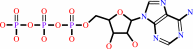 ATP
ATP
|
=
|
O-phospho-L-seryl-[protein]
|
+
|
 ADP
ADP
|
+
|
H(+)
|
|
|
|
|
|
|
L-threonyl-[protein]
|
+
|
ATP
|
=
|
O-phospho-L-threonyl-[protein]
|
+
|
ADP
|
+
|
H(+)
|
|
|
|
|
|
|
|
|
|
|
|
|
Molecule diagrams generated from .mol files obtained from the
KEGG ftp site
|
|
|
|
|
|
|
|
|
|
|
|
|
|
 |
|
|
|
|
|
|
| |
|
|
| |
|
DOI no:
|
Structure
6:885-894
(1998)
|
|
PubMed id:
|
|
|
|
|
|
| |
|
Crystal structure of the C2 domain from protein kinase C-delta.
|
|
H.Pappa,
J.Murray-Rust,
L.V.Dekker,
P.J.Parker,
N.Q.McDonald.
|
|
|
|
|
| |
ABSTRACT
|
|
|
|
| |
|
|
BACKGROUND: The protein kinase C (PKC) family of lipid-dependent serine/theonine
kinases plays a central role in many intracellular eukaryotic signalling events.
Members of the novel (delta, epsilon, eta, theta) subclass of PKC isotypes lack
the Ca2+ dependence of the conventional PKC isotypes and have an N-terminal C2
domain, originally defined as V0 (variable domain zero). Biochemical data
suggest that this domain serves to translocate novel PKC family members to the
plasma membrane and may influence binding of PKC activators. RESULTS: The
crystal structure of PKC-delta C2 domain indicates an unusual variant of the C2
fold. Structural elements unique to this C2 domain include a helix and a
protruding beta hairpin which may contribute basic sequences to a
membrane-interaction site. The invariant C2 motif, Pro-X-Trp, where X is any
amino acid, forms a short crossover loop, departing radically from its
conformation in other C2 structures, and contains a tyrosine phosphorylation
site unique to PKC-delta. This loop and two others adopt quite different
conformations from the equivalent Ca(2+)-binding loops of phospholipase C-delta
and synaptotagmin I, and lack sequences necessary for Ca2+ coordination.
CONCLUSIONS: The N-terminal sequence of Ca(2+)-independent novel PKCs defines a
divergent example of a C2 structure similar to that of phospholipase C-delta.
The Ca(2+)-independent regulation of novel PKCs is explained by major structural
and sequence differences resulting in three non-functional Ca(2+)-binding loops.
The observed structural variation and position of a tyrosine-phosphorylation
site suggest the existence of distinct subclasses of C2-like domains which may
have evolved distinct functional roles and mechanisms to interact with lipid
membranes.
|
|
|
|
|
|
| |
Selected figure(s)
|
|
|
|
| |
|
|

|
|
Figure 2.
Figure 2. Isomorphous and anomalous difference Fourier maps
using selenomethionine data, superimposed on a backbone
representation of the two molecules within the asymmetric unit.
Experimental phases from the two mercury derivatives were used
in map calculation; both maps are contoured at 5s. The ten
selenium sites in the asymmetric unit are labelled according to
the methionine residue number. (The figure was produced using
the program SETOR [40].)
|
|
|
|
|
|
| |
The above figure is
reprinted
by permission from Cell Press:
Structure
(1998,
6,
885-894)
copyright 1998.
|
|
| |
Figure was
selected
by an automated process.
|
|
|
|
|
|
|
|
|
|
|
|
|
|
|
|
 |
 |
 |
|
Literature references that cite this PDB file's key reference
|
|
|
| |
PubMed id
|
|
Reference
|
|
|
|
|
|
T.A.Leonard,
B.Różycki,
L.F.Saidi,
G.Hummer,
and
J.H.Hurley
(2011).
Crystal structure and allosteric activation of protein kinase C βII.
|
| |
Cell,
144,
55-66.
|
|
|
PDB code:
|
|
|
|
|
|
|
|
E.L.LaGory,
L.A.Sitailo,
and
M.F.Denning
(2010).
The protein kinase Cdelta catalytic fragment is critical for maintenance of the G2/M DNA damage checkpoint.
|
| |
J Biol Chem,
285,
1879-1887.
|
|
|
|
|
|
|
E.N.Churchill,
N.Qvit,
and
D.Mochly-Rosen
(2009).
Rationally designed peptide regulators of protein kinase C.
|
| |
Trends Endocrinol Metab,
20,
25-33.
|
|
|
|
|
|
|
C.A.Farah,
I.Nagakura,
D.Weatherill,
X.Fan,
and
W.S.Sossin
(2008).
Physiological role for phosphatidic acid in the translocation of the novel protein kinase C Apl II in Aplysia neurons.
|
| |
Mol Cell Biol,
28,
4719-4733.
|
|
|
|
|
|
|
K.R.Doherty,
A.R.Demonbreun,
G.Q.Wallace,
A.Cave,
A.D.Posey,
K.Heretis,
P.Pytel,
and
E.M.McNally
(2008).
The endocytic recycling protein EHD2 interacts with myoferlin to regulate myoblast fusion.
|
| |
J Biol Chem,
283,
20252-20260.
|
|
|
|
|
|
|
K.Yoshida
(2008).
Nuclear trafficking of pro-apoptotic kinases in response to DNA damage.
|
| |
Trends Mol Med,
14,
305-313.
|
|
|
|
|
|
|
S.F.Steinberg
(2008).
Structural basis of protein kinase C isoform function.
|
| |
Physiol Rev,
88,
1341-1378.
|
|
|
|
|
|
|
H.Al-Ali,
T.J.Ragan,
X.Gao,
and
T.K.Harris
(2007).
Reconstitution of modular PDK1 functions on trans-splicing of the regulatory PH and catalytic kinase domains.
|
| |
Bioconjug Chem,
18,
1294-1302.
|
|
|
|
|
|
|
J.L.Jiménez,
and
B.Davletov
(2007).
Beta-strand recombination in tricalbin evolution and the origin of synaptotagmin-like C2 domains.
|
| |
Proteins,
68,
770-778.
|
|
|
|
|
|
|
R.Brandman,
M.H.Disatnik,
E.Churchill,
and
D.Mochly-Rosen
(2007).
Peptides derived from the C2 domain of protein kinase C epsilon (epsilon PKC) modulate epsilon PKC activity and identify potential protein-protein interaction surfaces.
|
| |
J Biol Chem,
282,
4113-4123.
|
|
|
|
|
|
|
V.Kheifets,
and
D.Mochly-Rosen
(2007).
Insight into intra- and inter-molecular interactions of PKC: design of specific modulators of kinase function.
|
| |
Pharmacol Res,
55,
467-476.
|
|
|
|
|
|
|
I.Voskoboinik,
M.J.Smyth,
and
J.A.Trapani
(2006).
Perforin-mediated target-cell death and immune homeostasis.
|
| |
Nat Rev Immunol,
6,
940-952.
|
|
|
|
|
|
|
N.Bhardwaj,
R.V.Stahelin,
R.E.Langlois,
W.Cho,
and
H.Lu
(2006).
Structural bioinformatics prediction of membrane-binding proteins.
|
| |
J Mol Biol,
359,
486-495.
|
|
|
|
|
|
|
T.Yamaguchi,
M.Suzuki,
H.Kimura,
and
M.Kato
(2006).
Role of protein kinase C in eosinophil function.
|
| |
Allergol Int,
55,
245-252.
|
|
|
|
|
|
|
C.H.Benes,
N.Wu,
A.E.Elia,
T.Dharia,
L.C.Cantley,
and
S.P.Soltoff
(2005).
The C2 domain of PKCdelta is a phosphotyrosine binding domain.
|
| |
Cell,
121,
271-280.
|
|
|
|
|
|
|
I.Voskoboinik,
M.C.Thia,
J.Fletcher,
A.Ciccone,
K.Browne,
M.J.Smyth,
and
J.A.Trapani
(2005).
Calcium-dependent plasma membrane binding and cell lysis by perforin are mediated through its C2 domain: A critical role for aspartate residues 429, 435, 483, and 485 but not 491.
|
| |
J Biol Chem,
280,
8426-8434.
|
|
|
|
|
|
|
R.V.Stahelin,
M.A.Digman,
M.Medkova,
B.Ananthanarayanan,
H.R.Melowic,
J.D.Rafter,
and
W.Cho
(2005).
Diacylglycerol-induced membrane targeting and activation of protein kinase Cepsilon: mechanistic differences between protein kinases Cdelta and Cepsilon.
|
| |
J Biol Chem,
280,
19784-19793.
|
|
|
|
|
|
|
R.V.Stahelin,
M.A.Digman,
M.Medkova,
B.Ananthanarayanan,
J.D.Rafter,
H.R.Melowic,
and
W.Cho
(2004).
Mechanism of diacylglycerol-induced membrane targeting and activation of protein kinase Cdelta.
|
| |
J Biol Chem,
279,
29501-29512.
|
|
|
|
|
|
|
S.Corbalán-Garcia,
S.Sánchez-Carrillo,
J.García-García,
and
J.C.Gómez-Fernández
(2003).
Characterization of the membrane binding mode of the C2 domain of PKC epsilon.
|
| |
Biochemistry,
42,
11661-11668.
|
|
|
|
|
|
|
A.S.Solodukhin,
H.L.Caldwell,
J.J.Sando,
and
R.H.Kretsinger
(2002).
Two-dimensional crystal structures of protein kinase C-delta, its regulatory domain, and the enzyme complexed with myelin basic protein.
|
| |
Biophys J,
82,
2700-2708.
|
|
|
|
|
|
|
T.P.Sakmar,
S.T.Menon,
E.P.Marin,
and
E.S.Awad
(2002).
Rhodopsin: insights from recent structural studies.
|
| |
Annu Rev Biophys Biomol Struct,
31,
443-484.
|
|
|
|
|
|
|
B.Vanhaesebroeck,
S.J.Leevers,
K.Ahmadi,
J.Timms,
R.Katso,
P.C.Driscoll,
R.Woscholski,
P.J.Parker,
and
M.D.Waterfield
(2001).
Synthesis and function of 3-phosphorylated inositol lipids.
|
| |
Annu Rev Biochem,
70,
535-602.
|
|
|
|
|
|
|
J.García-García,
J.C.Gómez-Fernández,
and
S.Corbalán-García
(2001).
Structural characterization of the C2 domain of novel protein kinase Cepsilon.
|
| |
Eur J Biochem,
268,
1107-1117.
|
|
|
|
|
|
|
L.Chen,
H.Hahn,
G.Wu,
C.H.Chen,
T.Liron,
D.Schechtman,
G.Cavallaro,
L.Banci,
Y.Guo,
R.Bolli,
G.W.Dorn,
and
D.Mochly-Rosen
(2001).
Opposing cardioprotective actions and parallel hypertrophic effects of delta PKC and epsilon PKC.
|
| |
Proc Natl Acad Sci U S A,
98,
11114-11119.
|
|
|
|
|
|
|
S.H.Gerber,
J.Garcia,
J.Rizo,
and
T.C.Südhof
(2001).
An unusual C(2)-domain in the active-zone protein piccolo: implications for Ca(2+) regulation of neurotransmitter release.
|
| |
EMBO J,
20,
1605-1619.
|
|
|
|
|
|
|
A.Arbuzova,
L.Wang,
J.Wang,
G.Hangyás-Mihályné,
D.Murray,
B.Honig,
and
S.McLaughlin
(2000).
Membrane binding of peptides containing both basic and aromatic residues. Experimental studies with peptides corresponding to the scaffolding region of caveolin and the effector region of MARCKS.
|
| |
Biochemistry,
39,
10330-10339.
|
|
|
|
|
|
|
J.H.Hurley,
and
S.Misra
(2000).
Signaling and subcellular targeting by membrane-binding domains.
|
| |
Annu Rev Biophys Biomol Struct,
29,
49-79.
|
|
|
|
|
|
|
P.Conesa-Zamora,
J.C.Gómez-Fernández,
and
S.Corbalán-García
(2000).
The C2 domain of protein kinase calpha is directly involved in the diacylglycerol-dependent binding of the C1 domain to the membrane.
|
| |
Biochim Biophys Acta,
1487,
246-254.
|
|
|
|
|
|
|
J.O.Lee,
H.Yang,
M.M.Georgescu,
A.Di Cristofano,
T.Maehama,
Y.Shi,
J.E.Dixon,
P.Pandolfi,
and
N.P.Pavletich
(1999).
Crystal structure of the PTEN tumor suppressor: implications for its phosphoinositide phosphatase activity and membrane association.
|
| |
Cell,
99,
323-334.
|
|
|
PDB code:
|
|
|
|
|
|
|
|
N.Verdaguer,
S.Corbalan-Garcia,
W.F.Ochoa,
I.Fita,
and
J.C.Gómez-Fernández
(1999).
Ca(2+) bridges the C2 membrane-binding domain of protein kinase Calpha directly to phosphatidylserine.
|
| |
EMBO J,
18,
6329-6338.
|
|
|
PDB code:
|
|
|
|
|
|
|
|
O.Perisic,
H.F.Paterson,
G.Mosedale,
S.Lara-González,
and
R.L.Williams
(1999).
Mapping the phospholipid-binding surface and translocation determinants of the C2 domain from cytosolic phospholipase A2.
|
| |
J Biol Chem,
274,
14979-14987.
|
|
|
|
|
|
|
R.B.Sutton,
and
S.R.Sprang
(1998).
Structure of the protein kinase Cbeta phospholipid-binding C2 domain complexed with Ca2+.
|
| |
Structure,
6,
1395-1405.
|
|
|
PDB code:
|
|
|
|
|
|
|
The most recent references are shown first.
Citation data come partly from CiteXplore and partly
from an automated harvesting procedure. Note that this is likely to be
only a partial list as not all journals are covered by
either method. However, we are continually building up the citation data
so more and more references will be included with time.
Where a reference describes a PDB structure, the PDB
code is
shown on the right.
|
|


 Links
Links


