
|
|
|
|
|
 |
Contents |
 |
|
|
|
|
|
|
|
|
* Residue conservation analysis
|
|
|
|
|
|
|
|
|
|
Enzyme class 2:
|
|
Chains A, B:
E.C.?
|
|
|
|
|
|
|
Enzyme class 3:
|
|
Chain C:
E.C.2.7.10.2
- non-specific protein-tyrosine kinase.
|
|
|
|
|
|
|
Reaction:
|
|
L-tyrosyl-[protein] + ATP = O-phospho-L-tyrosyl-[protein] + ADP + H+
|
|
|
|
|
|
L-tyrosyl-[protein]
|
+
|
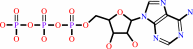 ATP
ATP
|
=
|
O-phospho-L-tyrosyl-[protein]
|
+
|
 ADP
ADP
|
+
|
H(+)
|
|
|
|
|
|
|
|
|
|
|
|
|
Note, where more than one E.C. class is given (as above), each may
correspond to a different protein domain or, in the case of polyprotein
precursors, to a different mature protein.
|
|
|
|
Molecule diagrams generated from .mol files obtained from the
KEGG ftp site
|
|
|
|
|
|
|
|
|
|
|
|
|
|
 |
|
|
|
|
|
|
| |
|
|
| |
|
DOI no:
|
Structure
5:1361-1372
(1997)
|
|
PubMed id:
|
|
|
|
|
|
| |
|
The crystal structure of HIV-1 Nef protein bound to the Fyn kinase SH3 domain suggests a role for this complex in altered T cell receptor signaling.
|
|
S.Arold,
P.Franken,
M.P.Strub,
F.Hoh,
S.Benichou,
R.Benarous,
C.Dumas.
|
|
|
|
|
| |
ABSTRACT
|
|
|
|
| |
|
|
BACKGROUND: Human immunodeficiency virus (HIV) Nef protein accelerates virulent
progression of acquired immunodeficiency syndrome (AIDS) by its interaction with
specific cellular proteins involved in signal transduction and host cell
activation. Nef has been shown to bind specifically to a subset of the Src
family of kinases. The structures of free Nef and Nef bound to Src homology
region 3 (SH3) domain are important for the elucidation of how the affinity and
specificity for the Src kinase family SH3 domains are achieved, and also for the
development of potential drugs and vaccines against AIDS. RESULTS: We have
determined the crystal structures of the conserved core of HIV-1 Nef protein
alone and in complex with the wild-type SH3 domain of the p59fyn protein
tyrosine kinase (Fyn), at 3.0 A resolution. Comparison of the bound and unbound
Nef structures revealed that a proline-rich motif (Pro-x-x-Pro), which is
implicated in SH3 binding, is partially disordered in the absence of the binding
partner; this motif only fully adopts a left-handed polyproline type II helix
conformation upon complex formation with the Fyn SH3 domain. In addition, the
structures show how an arginine residue (Arg77) of Nef interacts with Asp 100 of
the so-called RT loop within the Fyn SH3 domain, and triggers a hydrogen-bond
rearrangement which allows the loop to adapt to complement the Nef surface. The
Arg96 residue of the Fyn SH3 domain is specifically accommodated in the same
hydrophobic pocket of Nef as the isoleucine residue of a previously described
Fyn SH3 (Arg96-->lle) mutant that binds to Nef with higher affinity than the
wild type. CONCLUSIONS: The three-dimensional structures support evidence that
the Nef-Fyn complex forms in vivo and may have a crucial role in the T cell
perturbating action of Nef by altering T cell receptor signaling. The structures
of bound and unbound Nef reveal that the multivalency of SH3 binding may be
achieved by a ligand induced flexibility in the RT loop. The structures suggest
possible targets for the design of inhibitors which specifically block Nef-SH3
interactions.
|
|
|
|
|
|
| |
Selected figure(s)
|
|
|
|
| |
|
|

|
|
Figure 7.
Figure 7. Superimposition of the crystal structures of
Nef–SH3 complexes. Stereoview of the interface showing the
environment of the Nef polyproline type II helix region
(residues 71–77) and conserved residues. The two Nef isolates
are superimposed: Nef HIV-1[LAI] isolate in green and Nef[T71R]
HIV-1[NL43] isolate (Nef-D molecule in PDB entry 1EFN in red.
The hydrogen bond between the Arg71 sidechain and Tyr137 of
Fyn[R96I] is shown as a dotted white line. The SH3 domains are
coloured in light purple and dark purple for Fyn[wt] and
Fyn[R96I] (SH3-C molecule in PDB entry 1EFN), respectively.
(Figure generated using the program O [69].)
|
|
|
|
|
|
| |
The above figure is
reprinted
by permission from Cell Press:
Structure
(1997,
5,
1361-1372)
copyright 1997.
|
|
| |
Figure was
selected
by an automated process.
|
|
|
|
|
|
|
|
|
|
|
|
|
|
|
|
 |
 |
 |
|
Literature references that cite this PDB file's key reference
|
|
|
| |
PubMed id
|
|
Reference
|
|
|
|
|
|
X.Jia,
R.Singh,
S.Homann,
H.Yang,
J.Guatelli,
and
Y.Xiong
(2012).
Structural basis of evasion of cellular adaptive immunity by HIV-1 Nef.
|
| |
Nat Struct Mol Biol,
19,
701-706.
|
|
|
PDB codes:
|
|
|
|
|
|
|
|
J.Jung,
I.J.Byeon,
J.Ahn,
and
A.M.Gronenborn
(2011).
Structure, dynamics, and Hck interaction of full-length HIV-1 Nef.
|
| |
Proteins,
79,
1609-1622.
|
|
|
|
|
|
|
J.L.Foster,
S.J.Denial,
B.R.Temple,
and
J.V.Garcia
(2011).
Mechanisms of HIV-1 Nef Function and Intracellular Signaling.
|
| |
J Neuroimmune Pharmacol,
6,
230-246.
|
|
|
|
|
|
|
N.E.Davey,
G.Travé,
and
T.J.Gibson
(2011).
How viruses hijack cell regulation.
|
| |
Trends Biochem Sci,
36,
159-169.
|
|
|
|
|
|
|
C.S.Adamson,
and
E.O.Freed
(2010).
Novel approaches to inhibiting HIV-1 replication.
|
| |
Antiviral Res,
85,
119-141.
|
|
|
|
|
|
|
J.D.Dikeakos,
K.M.Atkins,
L.Thomas,
L.Emert-Sedlak,
I.J.Byeon,
J.Jung,
J.Ahn,
M.D.Wortman,
B.Kukull,
M.Saito,
H.Koizumi,
D.M.Williamson,
M.Hiyoshi,
E.Barklis,
M.Takiguchi,
S.Suzu,
A.M.Gronenborn,
T.E.Smithgall,
and
G.Thomas
(2010).
Small molecule inhibition of HIV-1-induced MHC-I down-regulation identifies a temporally regulated switch in Nef action.
|
| |
Mol Biol Cell,
21,
3279-3292.
|
|
|
|
|
|
|
L.Dai,
and
M.Stevenson
(2010).
A novel motif in HIV-1 Nef that regulates MIP-1beta chemokine release in macrophages.
|
| |
J Virol,
84,
8327-8331.
|
|
|
|
|
|
|
M.Pizzato
(2010).
MLV glycosylated-Gag is an infectivity factor that rescues Nef-deficient HIV-1.
|
| |
Proc Natl Acad Sci U S A,
107,
9364-9369.
|
|
|
|
|
|
|
W.M.Kim,
A.B.Sigalov,
and
L.J.Stern
(2010).
Pseudo-merohedral twinning and noncrystallographic symmetry in orthorhombic crystals of SIVmac239 Nef core domain bound to different-length TCRzeta fragments.
|
| |
Acta Crystallogr D Biol Crystallogr,
66,
163-175.
|
|
|
PDB codes:
|
|
|
|
|
|
|
|
X.Shi,
S.Opi,
A.Lugari,
A.Restouin,
T.Coursindel,
I.Parrot,
J.Perez,
E.Madore,
P.Zimmermann,
J.Corbeil,
M.Huang,
S.T.Arold,
Y.Collette,
and
X.Morelli
(2010).
Identification and biophysical assessment of the molecular recognition mechanisms between the human haemopoietic cell kinase Src homology domain 3 and ALG-2-interacting protein X.
|
| |
Biochem J,
431,
93.
|
|
|
|
|
|
|
Y.J.Jin,
X.Zhang,
C.Y.Cai,
and
S.J.Burakoff
(2010).
Alkylating HIV-1 Nef - a potential way of HIV intervention.
|
| |
AIDS Res Ther,
7,
26.
|
|
|
|
|
|
|
Y.T.Kwak,
A.Raney,
L.S.Kuo,
S.J.Denial,
B.R.Temple,
J.V.Garcia,
and
J.L.Foster
(2010).
Self-association of the Lentivirus protein, Nef.
|
| |
Retrovirology,
7,
77.
|
|
|
|
|
|
|
J.A.Poe,
and
T.E.Smithgall
(2009).
HIV-1 Nef dimerization is required for Nef-mediated receptor downregulation and viral replication.
|
| |
J Mol Biol,
394,
329-342.
|
|
|
|
|
|
|
L.Emert-Sedlak,
T.Kodama,
E.C.Lerner,
W.Dai,
C.Foster,
B.W.Day,
J.S.Lazo,
and
T.E.Smithgall
(2009).
Chemical library screens targeting an HIV-1 accessory factor/host cell kinase complex identify novel antiretroviral compounds.
|
| |
ACS Chem Biol,
4,
939-947.
|
|
|
|
|
|
|
R.Vermasvuori,
J.Koskinen,
K.Salonen,
N.Sirén,
J.Weegar,
J.Dahlbacka,
N.Kalkkinen,
and
N.von Weymarn
(2009).
Production of recombinant HIV-1 nef protein using different expression host systems: a techno-economical comparison.
|
| |
Biotechnol Prog,
25,
95.
|
|
|
|
|
|
|
C.H.Reynolds,
C.J.Garwood,
S.Wray,
C.Price,
S.Kellie,
T.Perera,
M.Zvelebil,
A.Yang,
P.W.Sheppard,
I.M.Varndell,
D.P.Hanger,
and
B.H.Anderton
(2008).
Phosphorylation regulates tau interactions with Src homology 3 domains of phosphatidylinositol 3-kinase, phospholipase Cgamma1, Grb2, and Src family kinases.
|
| |
J Biol Chem,
283,
18177-18186.
|
|
|
|
|
|
|
H.Shelton,
and
M.Harris
(2008).
Hepatitis C virus NS5A protein binds the SH3 domain of the Fyn tyrosine kinase with high affinity: mutagenic analysis of residues within the SH3 domain that contribute to the interaction.
|
| |
Virol J,
5,
24.
|
|
|
|
|
|
|
A.Raney,
A.Y.Shaw,
J.L.Foster,
and
J.V.Garcia
(2007).
Structural constraints on human immunodeficiency virus type 1 Nef function.
|
| |
Virology,
368,
7.
|
|
|
|
|
|
|
B.Bommarius,
D.Maxwell,
A.Swimm,
S.Leung,
A.Corbett,
W.Bornmann,
and
D.Kalman
(2007).
Enteropathogenic Escherichia coli Tir is an SH2/3 ligand that recruits and activates tyrosine kinases required for pedestal formation.
|
| |
Mol Microbiol,
63,
1748-1768.
|
|
|
|
|
|
|
G.Mangino,
Z.A.Percario,
G.Fiorucci,
G.Vaccari,
S.Manrique,
G.Romeo,
M.Federico,
M.Geyer,
and
E.Affabris
(2007).
In vitro treatment of human monocytes/macrophages with myristoylated recombinant Nef of human immunodeficiency virus type 1 leads to the activation of mitogen-activated protein kinases, IkappaB kinases, and interferon regulatory factor 3 and to the release of beta interferon.
|
| |
J Virol,
81,
2777-2791.
|
|
|
|
|
|
|
S.Bharti,
H.Inoue,
K.Bharti,
D.S.Hirsch,
Z.Nie,
H.Y.Yoon,
V.Artym,
K.M.Yamada,
S.C.Mueller,
V.A.Barr,
and
P.A.Randazzo
(2007).
Src-dependent phosphorylation of ASAP1 regulates podosomes.
|
| |
Mol Cell Biol,
27,
8271-8283.
|
|
|
|
|
|
|
T.Stangler,
T.Tran,
S.Hoffmann,
H.Schmidt,
E.Jonas,
and
D.Willbold
(2007).
Competitive displacement of full-length HIV-1 Nef from the Hck SH3 domain by a high-affinity artificial peptide.
|
| |
Biol Chem,
388,
611-615.
|
|
|
|
|
|
|
J.F.Roeth,
and
K.L.Collins
(2006).
Human immunodeficiency virus type 1 Nef: adapting to intracellular trafficking pathways.
|
| |
Microbiol Mol Biol Rev,
70,
548-563.
|
|
|
|
|
|
|
K.Agopian,
B.L.Wei,
J.V.Garcia,
and
D.Gabuzda
(2006).
A hydrophobic binding surface on the human immunodeficiency virus type 1 Nef core is critical for association with p21-activated kinase 2.
|
| |
J Virol,
80,
3050-3061.
|
|
|
|
|
|
|
R.P.Trible,
L.Emert-Sedlak,
and
T.E.Smithgall
(2006).
HIV-1 Nef selectively activates Src family kinases Hck, Lyn, and c-Src through direct SH3 domain interaction.
|
| |
J Biol Chem,
281,
27029-27038.
|
|
|
|
|
|
|
C.A.Dennis,
A.Baron,
J.G.Grossmann,
S.Mazaleyrat,
M.Harris,
and
J.Jaeger
(2005).
Co-translational myristoylation alters the quaternary structure of HIV-1 Nef in solution.
|
| |
Proteins,
60,
658-669.
|
|
|
|
|
|
|
D.Segal,
and
M.Eisenstein
(2005).
The effect of resolution-dependent global shape modifications on rigid-body protein-protein docking.
|
| |
Proteins,
59,
580-591.
|
|
|
|
|
|
|
E.Priceputu,
I.Rodrigue,
P.Chrobak,
J.Poudrier,
T.W.Mak,
Z.Hanna,
C.Hu,
D.G.Kay,
and
P.Jolicoeur
(2005).
The Nef-mediated AIDS-like disease of CD4C/human immunodeficiency virus transgenic mice is associated with increased Fas/FasL expression on T cells and T-cell death but is not prevented in Fas-, FasL-, tumor necrosis factor receptor 1-, or interleukin-1beta-converting enzyme-deficient or Bcl2-expressing transgenic mice.
|
| |
J Virol,
79,
6377-6391.
|
|
|
|
|
|
|
F.Bauer,
K.Schweimer,
H.Meiselbach,
S.Hoffmann,
P.Rösch,
and
H.Sticht
(2005).
Structural characterization of Lyn-SH3 domain in complex with a herpesviral protein reveals an extended recognition motif that enhances binding affinity.
|
| |
Protein Sci,
14,
2487-2498.
|
|
|
PDB code:
|
|
|
|
|
|
|
|
L.Briese,
A.Preusser,
and
D.Willbold
(2005).
Mapping the binding site of full length HIV-1 Nef on human Lck SH3 by NMR spectroscopy.
|
| |
J Biomed Sci,
12,
451-456.
|
|
|
|
|
|
|
M.Matsubara,
T.Jing,
K.Kawamura,
N.Shimojo,
K.Titani,
K.Hashimoto,
and
N.Hayashi
(2005).
Myristoyl moiety of HIV Nef is involved in regulation of the interaction with calmodulin in vivo.
|
| |
Protein Sci,
14,
494-503.
|
|
|
|
|
|
|
S.Kronenberg,
B.Böttcher,
C.W.von der Lieth,
S.Bleker,
and
J.A.Kleinschmidt
(2005).
A conformational change in the adeno-associated virus type 2 capsid leads to the exposure of hidden VP1 N termini.
|
| |
J Virol,
79,
5296-5303.
|
|
|
|
|
|
|
A.Berchanski,
B.Shapira,
and
M.Eisenstein
(2004).
Hydrophobic complementarity in protein-protein docking.
|
| |
Proteins,
56,
130-142.
|
|
|
|
|
|
|
H.J.Choi,
and
T.E.Smithgall
(2004).
HIV-1 Nef promotes survival of TF-1 macrophages by inducing Bcl-XL expression in an extracellular signal-regulated kinase-dependent manner.
|
| |
J Biol Chem,
279,
51688-51696.
|
|
|
|
|
|
|
J.E.Larsen,
R.H.Massol,
T.J.Nieland,
and
T.Kirchhausen
(2004).
HIV Nef-mediated major histocompatibility complex class I down-modulation is independent of Arf6 activity.
|
| |
Mol Biol Cell,
15,
323-331.
|
|
|
|
|
|
|
S.L.Ropp,
C.E.Wees,
Y.Fang,
E.A.Nelson,
K.D.Rossow,
M.Bien,
B.Arndt,
S.Preszler,
P.Steen,
J.Christopher-Hennings,
J.E.Collins,
D.A.Benfield,
and
K.S.Faaberg
(2004).
Characterization of emerging European-like porcine reproductive and respiratory syndrome virus isolates in the United States.
|
| |
J Virol,
78,
3684-3703.
|
|
|
|
|
|
|
T.Tsukahara,
and
L.Ratner
(2004).
Substitution of HIV Type 1 Nef with HTLV-1 p12.
|
| |
AIDS Res Hum Retroviruses,
20,
938-943.
|
|
|
|
|
|
|
A.L.Greenway,
G.Holloway,
D.A.McPhee,
P.Ellis,
A.Cornall,
and
M.Lidman
(2003).
HIV-1 Nef control of cell signalling molecules: multiple strategies to promote virus replication.
|
| |
J Biosci,
28,
323-335.
|
|
|
|
|
|
|
R.Chen,
L.Li,
and
Z.Weng
(2003).
ZDOCK: an initial-stage protein-docking algorithm.
|
| |
Proteins,
52,
80-87.
|
|
|
|
|
|
|
S.L.Lam,
and
V.L.Hsu
(2003).
NMR identification of left-handed polyproline type II helices.
|
| |
Biopolymers,
69,
270-281.
|
|
|
|
|
|
|
C.A.Lundquist,
M.Tobiume,
J.Zhou,
D.Unutmaz,
and
C.Aiken
(2002).
Nef-mediated downregulation of CD4 enhances human immunodeficiency virus type 1 replication in primary T lymphocytes.
|
| |
J Virol,
76,
4625-4633.
|
|
|
|
|
|
|
D.Messmer,
J.Bromberg,
G.Devgan,
J.M.Jacqué,
A.Granelli-Piperno,
and
M.Pope
(2002).
Human immunodeficiency virus type 1 Nef mediates activation of STAT3 in immature dendritic cells.
|
| |
AIDS Res Hum Retroviruses,
18,
1043-1050.
|
|
|
|
|
|
|
K.Schweimer,
S.Hoffmann,
F.Bauer,
U.Friedrich,
C.Kardinal,
S.M.Feller,
B.Biesinger,
and
H.Sticht
(2002).
Structural investigation of the binding of a herpesviral protein to the SH3 domain of tyrosine kinase Lck.
|
| |
Biochemistry,
41,
5120-5130.
|
|
|
PDB codes:
|
|
|
|
|
|
|
|
K.Yusim,
C.Kesmir,
B.Gaschen,
M.M.Addo,
M.Altfeld,
S.Brunak,
A.Chigaev,
V.Detours,
and
B.T.Korber
(2002).
Clustering patterns of cytotoxic T-lymphocyte epitopes in human immunodeficiency virus type 1 (HIV-1) proteins reveal imprints of immune evasion on HIV-1 global variation.
|
| |
J Virol,
76,
8757-8768.
|
|
|
|
|
|
|
M.Williams,
J.F.Roeth,
M.R.Kasper,
R.I.Fleis,
C.G.Przybycin,
and
K.L.Collins
(2002).
Direct binding of human immunodeficiency virus type 1 Nef to the major histocompatibility complex class I (MHC-I) cytoplasmic tail disrupts MHC-I trafficking.
|
| |
J Virol,
76,
12173-12184.
|
|
|
|
|
|
|
A.H.Chang,
M.V.O'Shaughnessy,
and
F.R.Jirik
(2001).
Hck SH3 domain-dependent abrogation of Nef-induced class 1 MHC down-regulation.
|
| |
Eur J Immunol,
31,
2382-2387.
|
|
|
|
|
|
|
A.Preusser,
L.Briese,
A.S.Baur,
and
D.Willbold
(2001).
Direct in vitro binding of full-length human immunodeficiency virus type 1 Nef protein to CD4 cytoplasmic domain.
|
| |
J Virol,
75,
3960-3964.
|
|
|
|
|
|
|
M.Geyer,
O.T.Fackler,
and
B.M.Peterlin
(2001).
Structure--function relationships in HIV-1 Nef.
|
| |
EMBO Rep,
2,
580-585.
|
|
|
|
|
|
|
O.T.Fackler,
D.Wolf,
H.O.Weber,
B.Laffert,
P.D'Aloja,
B.Schuler-Thurner,
R.Geffin,
K.Saksela,
M.Geyer,
B.M.Peterlin,
G.Schuler,
and
A.S.Baur
(2001).
A natural variability in the proline-rich motif of Nef modulates HIV-1 replication in primary T cells.
|
| |
Curr Biol,
11,
1294-1299.
|
|
|
|
|
|
|
S.T.Arold,
and
A.S.Baur
(2001).
Dynamic Nef and Nef dynamics: how structure could explain the complex activities of this small HIV protein.
|
| |
Trends Biochem Sci,
26,
356-363.
|
|
|
|
|
|
|
D.E.Wakeham,
J.A.Ybe,
F.M.Brodsky,
and
P.K.Hwang
(2000).
Molecular structures of proteins involved in vesicle coat formation.
|
| |
Traffic,
1,
393-398.
|
|
|
|
|
|
|
L.Erdtmann,
K.Janvier,
G.Raposo,
H.M.Craig,
P.Benaroch,
C.Berlioz-Torrent,
J.C.Guatelli,
R.Benarous,
and
S.Benichou
(2000).
Two independent regions of HIV-1 Nef are required for connection with the endocytic pathway through binding to the mu 1 chain of AP1 complex.
|
| |
Traffic,
1,
871-883.
|
|
|
|
|
|
|
S.Arold,
F.Hoh,
S.Domergue,
C.Birck,
M.A.Delsuc,
M.Jullien,
and
C.Dumas
(2000).
Characterization and molecular basis of the oligomeric structure of HIV-1 nef protein.
|
| |
Protein Sci,
9,
1137-1148.
|
|
|
|
|
|
|
S.Carl,
A.J.Iafrate,
S.M.Lang,
N.Stolte,
C.Stahl-Hennig,
K.Mätz-Rensing,
D.Fuchs,
J.Skowronski,
and
F.Kirchhoff
(2000).
Simian immunodeficiency virus containing mutations in N-terminal tyrosine residues and in the PxxP motif in Nef replicates efficiently in rhesus macaques.
|
| |
J Virol,
74,
4155-4164.
|
|
|
|
|
|
|
S.M.Larson,
and
A.R.Davidson
(2000).
The identification of conserved interactions within the SH3 domain by alignment of sequences and structures.
|
| |
Protein Sci,
9,
2170-2180.
|
|
|
|
|
|
|
T.Swigut,
A.J.Iafrate,
J.Muench,
F.Kirchhoff,
and
J.Skowronski
(2000).
Simian and human immunodeficiency virus Nef proteins use different surfaces to downregulate class I major histocompatibility complex antigen expression.
|
| |
J Virol,
74,
5691-5701.
|
|
|
|
|
|
|
Y.Collette,
S.Arold,
C.Picard,
K.Janvier,
S.Benichou,
R.Benarous,
D.Olive,
and
C.Dumas
(2000).
HIV-2 and SIV nef proteins target different Src family SH3 domains than does HIV-1 Nef because of a triple amino acid substitution.
|
| |
J Biol Chem,
275,
4171-4176.
|
|
|
|
|
|
|
A.L.Greenway,
H.Dutartre,
K.Allen,
D.A.McPhee,
D.Olive,
and
Y.Collette
(1999).
Simian immunodeficiency virus and human immunodeficiency virus type 1 nef proteins show distinct patterns and mechanisms of Src kinase activation.
|
| |
J Virol,
73,
6152-6158.
|
|
|
|
|
|
|
A.Plemenitas,
X.Lu,
M.Geyer,
P.Veranic,
M.N.Simon,
and
B.M.Peterlin
(1999).
Activation of Ste20 by Nef from human immunodeficiency virus induces cytoskeletal rearrangements and downstream effector functions in Saccharomyces cerevisiae.
|
| |
Virology,
258,
271-281.
|
|
|
|
|
|
|
F.Kirchhoff,
J.Münch,
S.Carl,
N.Stolte,
K.Mätz-Rensing,
D.Fuchs,
P.T.Haaft,
J.L.Heeney,
T.Swigut,
J.Skowronski,
and
C.Stahl-Hennig
(1999).
The human immunodeficiency virus type 1 nef gene can to a large extent replace simian immunodeficiency virus nef in vivo.
|
| |
J Virol,
73,
8371-8383.
|
|
|
|
|
|
|
I.McPhee,
S.J.Yarwood,
G.Scotland,
E.Huston,
M.B.Beard,
A.H.Ross,
E.S.Houslay,
and
M.D.Houslay
(1999).
Association with the SRC family tyrosyl kinase LYN triggers a conformational change in the catalytic region of human cAMP-specific phosphodiesterase HSPDE4A4B. Consequences for rolipram inhibition.
|
| |
J Biol Chem,
274,
11796-11810.
|
|
|
|
|
|
|
J.Skowronski,
M.E.Greenberg,
M.Lock,
R.Mariani,
S.Salghetti,
T.Swigut,
and
A.J.Iafrate
(1999).
HIV and SIV Nef modulate signal transduction and protein sorting in T cells.
|
| |
Cold Spring Harb Symp Quant Biol,
64,
453-463.
|
|
|
|
|
|
|
O.T.Fackler,
W.Luo,
M.Geyer,
A.S.Alberts,
and
B.M.Peterlin
(1999).
Activation of Vav by Nef induces cytoskeletal rearrangements and downstream effector functions.
|
| |
Mol Cell,
3,
729-739.
|
|
|
|
|
|
|
M.E.Greenberg,
A.J.Iafrate,
and
J.Skowronski
(1998).
The SH3 domain-binding surface and an acidic motif in HIV-1 Nef regulate trafficking of class I MHC complexes.
|
| |
EMBO J,
17,
2777-2789.
|
|
|
|
|
|
|
S.Arold,
R.O'Brien,
P.Franken,
M.P.Strub,
F.Hoh,
C.Dumas,
and
J.E.Ladbury
(1998).
RT loop flexibility enhances the specificity of Src family SH3 domains for HIV-1 Nef.
|
| |
Biochemistry,
37,
14683-14691.
|
|
|
PDB code:
|
|
|
|
|
|
|
The most recent references are shown first.
Citation data come partly from CiteXplore and partly
from an automated harvesting procedure. Note that this is likely to be
only a partial list as not all journals are covered by
either method. However, we are continually building up the citation data
so more and more references will be included with time.
Where a reference describes a PDB structure, the PDB
codes are
shown on the right.
|
 |


 Links
Links


