 |
PDBsum entry 6ynb
|
|
 |
|
|
|
|
|
|
Enzyme class:
|
|
Chain A:
E.C.2.7.11.11
- cAMP-dependent protein kinase.
|
|
|
|
|
|
|
Reaction:
|
|
|
1.
|
L-seryl-[protein] + ATP = O-phospho-L-seryl-[protein] + ADP + H+
|
|
2.
|
L-threonyl-[protein] + ATP = O-phospho-L-threonyl-[protein] + ADP + H+
|
|
|
|
|
|
|
L-seryl-[protein]
|
+
|
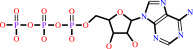 ATP
ATP
|
=
|
O-phospho-L-seryl-[protein]
|
+
|
 ADP
ADP
|
+
|
H(+)
|
|
|
|
|
|
|
L-threonyl-[protein]
|
+
|
ATP
|
=
|
O-phospho-L-threonyl-[protein]
|
+
|
ADP
|
+
|
H(+)
|
|
|
|
|
|
|
|
|
|
|
|
|
Molecule diagrams generated from .mol files obtained from the
KEGG ftp site
|
|
|
|
|
|
|
|
|
|
|
|
|
|
 |
|
|
|
|
|
|
| |
|
|
| |
|
DOI no:
|
ChemMedChem
16:292-300
(2021)
|
|
PubMed id:
|
|
|
|
|
|
| |
|
Two Methods, One Goal: Structural Differences between Cocrystallization and Crystal Soaking to Discover Ligand Binding Poses.
|
|
B.Wienen-Schmidt,
M.Oebbeke,
K.Ngo,
A.Heine,
G.Klebe.
|
|
|
|
|
| |
ABSTRACT
|
|
|
|
| |
|
|
In lead optimization, protein crystallography is an indispensable tool to
analyze drug binding. Binding modes and non-covalent interaction inventories are
essential to design follow-up synthesis candidates. Two protocols are commonly
applied to produce protein-ligand complexes: cocrystallization and soaking.
Because of its time and cost effectiveness, soaking is the more popular method.
Taking eight ligand hinge binders of protein kinase A, we demonstrate that
cocrystallization is superior. Particularly for flexible proteins, such as
kinases, and larger ligands cocrystallization captures more reliable the correct
binding pose and induced protein adaptations. The geometrical discrepancies
between soaking and cocrystallization appear smaller for fragment-sized ligands.
For larger flexible ligands that trigger conformational changes of the protein,
soaking can be misleading and underestimates the number of possible polar
interactions due to inadequate, highly impaired positions of protein amino-acid
side and main chain atoms. Thus, if applicable cocrystallization should be the
gold standard to study protein-ligand complexes.
|
|
|
|
|
|
|
|
|
|
|
|
|
|
|
|
|
|
 |
 |
 |
|
|


 Links
Links


