 |
PDBsum entry 6f4c
 |
|
|
|
|
|
|
Enzyme class:
|
|
E.C.3.2.1.22
- alpha-galactosidase.
|
|
|
|
|
|
|
Reaction:
|
|
Melibiose + H2O = galactose + glucose
|
|
|
|
|
|
|
|
|
|
|
|
|
|
|
Cofactor:
|
|
Mg(2+); NAD(+)
|
|
|
|
|
|
Mg(2+)
|
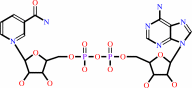 NAD(+)
|
|
|
|
|
|
|
Molecule diagrams generated from .mol files obtained from the
KEGG ftp site
|
|
|
|
|
|
|
|
|
|
|
|
|
|
 |
|
|
|
|
|
|
| |
|
|
| |
|
DOI no:
|
J Biol Chem
293:10042-10058
(2018)
|
|
PubMed id:
|
|
|
|
|
|
| |
|
Nicotiana benthamiana α-galactosidase A1.1 can functionally complement human α-galactosidase A deficiency associated with Fabry disease.
|
|
K.Kytidou,
J.Beekwilder,
M.Artola,
E.van Meel,
R.H.P.Wilbers,
G.F.Moolenaar,
N.Goosen,
M.J.Ferraz,
R.Katzy,
P.Voskamp,
B.I.Florea,
C.H.Hokke,
H.S.Overkleeft,
A.Schots,
D.Bosch,
N.Pannu,
J.M.F.G.Aerts.
|
|
|
|
|
| |
ABSTRACT
|
|
|
|
| |
|
|
α-Galactosidases (EC 3.2.1.22) are retaining glycosidases that cleave terminal
α-linked galactose residues from glycoconjugate substrates. α-Galactosidases
take part in the turnover of cell wall-associated galactomannans in plants and
in the lysosomal degradation of glycosphingolipids in animals. Deficiency of
human α-galactosidase A (α-Gal A) causes Fabry disease (FD), a heritable,
X-linked lysosomal storage disorder, characterized by accumulation of
globotriaosylceramide (Gb3) and globotriaosylsphingosine (lyso-Gb3). Current
management of FD involves enzyme-replacement therapy (ERT). An activity-based
probe (ABP) covalently labeling the catalytic nucleophile of α-Gal A has been
previously designed to study α-galactosidases for use in FD therapy. Here, we
report that this ABP labels proteins in Nicotiana benthamiana leaf
extracts, enabling the identification and biochemical characterization of an
N. benthamiana α-galactosidase we name here A1.1 (gene accession ID
GJZM-1660). The transiently overexpressed and purified enzyme was a monomer
lacking N-glycans and was active toward
4-methylumbelliferyl-α-d-galactopyranoside substrate (Km =
0.17 mm) over a broad pH range. A1.1 structural analysis by X-ray
crystallography revealed marked similarities with human α-Gal A, even including
A1.1's ability to hydrolyze Gb3 and lyso-Gb3, which are not endogenous in
plants. Of note, A1.1 uptake into FD fibroblasts reduced the elevated lyso-Gb3
levels in these cells, consistent with A1.1 delivery to lysosomes as revealed by
confocal microscopy. The ease of production and the features of A1.1, such as
stability over a broad pH range, combined with its capacity to degrade
glycosphingolipid substrates, warrant further examination of its value as a
potential therapeutic agent for ERT-based FD management.
|
|
|
|
|
|
|
|
|
|
|
|
|
|
|
|
|
|
 |
 |
 |
|


 Links
Links


