|
PDBsum entry 4zw2

|
|
|
|
|
|

|

|

|

|
|

|
|

|
|

|
|

|
|

|
|
|
 |

|

|
|
|
|
|
|
|
|
|
|
|
|
|
|
|
|
|
|
|
|
|
|
|
|
|
|
|
|
|
|
|
|
|
|
Metal transport
|
PDB id
|
|
|
|
4zw2
|
|
|
|
|
|
|
|
|
|
|
|
|
|
|

|

|

|
|
|
|
|
|
|
PDB id:
|
|
|
|
| Name: |
|
Metal transport
|
|
|
Title:
|
|
Crystal structure of the mouse voltage gated calcium channel beta subunit isoform 1a in complex with alpha interaction domain peptide.
|
|
Structure:
|
|
Voltage-dependent l-type calcium channel subunit beta-1, voltage-dependent l-type calcium channel subunit beta-1. Chain: a. Fragment: unp residue 68-185, linker, 261-462. Synonym: cab1,calcium channel voltage-dependent subunit beta 1,cab1, calcium channel voltage-dependent subunit beta 1. Engineered: yes. Voltage-dependent l-type calcium channel subunit alpha-1s. Chain: b.
|
|
Source:
|
|
Mus musculus. Mouse. Organism_taxid: 10090. Gene: cacnb1, cacnlb1. Expressed in: escherichia coli. Expression_system_taxid: 511693. Synthetic: yes. Organism_taxid: 10090
|
|
Resolution:
|
|
|
1.86Å
|
R-factor:
|
0.171
|
R-free:
|
0.207
|
|
|
Authors:
|
|
N.C.Norris,A.J.Oakley
|
|
Key ref:
|
|
N.C.Norris
et al.
(2017).
Structural and biophysical analyses of the skeletal dihydropyridine receptor β subunit β1areveal critical roles of domain interactions for stability.
J Biol Chem,
292,
8401-8411.
PubMed id:
|
|
|
Date:
|
|
|
19-May-15
|
Release date:
|
01-Jun-16
|
|
|
|
|
|
|
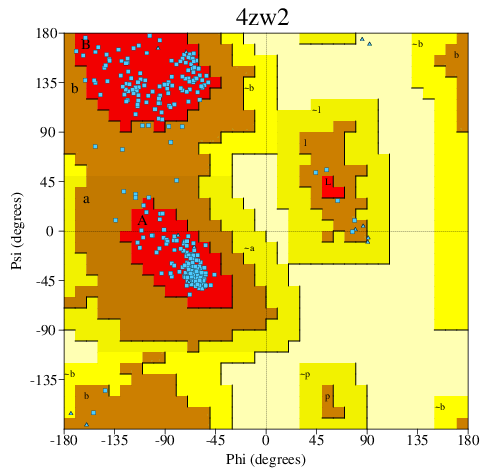
PROCHECK
|
|
|
|
|
|
Headers
|
|
|
|
References
|
|
|
|
|
|
|
|
|
|
|
|
|
|
|
|
 |
|
|
|
|
|
|
| |
|
|
J Biol Chem
292:8401-8411
(2017)
|
|
PubMed id:
|
|
|
|
|
|
| |
|
Structural and biophysical analyses of the skeletal dihydropyridine receptor β subunit β1areveal critical roles of domain interactions for stability.
|
|
N.C.Norris,
S.Joseph,
S.Aditya,
Y.Karunasekara,
P.G.Board,
A.F.Dulhunty,
A.J.Oakley,
M.G.Casarotto.
|
|
|
|
|
| |
ABSTRACT
|
|
|
|
| |
|
|
Excitation-contraction (EC) coupling in skeletal muscle requires a physical
interaction between the voltage-gated calcium channel dihydropyridine receptor
(DHPR) and the ryanodine receptor Ca2+release channel. Although the
exact molecular mechanism that initiates skeletal EC coupling is unresolved, it
is clear that both the α1and β subunits of DHPR are essential for
this process. Here, we employed a series of techniques, including size-exclusion
chromatography-multi-angle light scattering, differential scanning fluorimetry,
and isothermal calorimetry, to characterize various biophysical properties of
the skeletal DHPR β subunit β1aRemoval of the intrinsically
disordered N and C termini and the hook region of β1aprevented
oligomerization, allowing for its structural determination by X-ray
crystallography. The structure had a topology similar to that of previously
determined β isoforms, which consist of SH3 and guanylate kinase domains.
However, transition melting temperatures derived from the differential scanning
fluorimetry experiments indicated a significant difference in stability of
∼2-3 °C between the β1aand β2aconstructs, and the
addition of the DHPR α1sI-II loop (α-interaction domain) peptide
stabilized both β isoforms by ∼6-8 °C. Similar to other β isoforms,
β1abound with nanomolar affinity to the α-interaction domain, but
binding affinities were influenced by amino acid substitutions in the adjacent
SH3 domain. These results suggest that intramolecular interactions between the
SH3 and guanylate kinase domains play a role in the stability of
β1awhile also providing a conduit for allosteric signaling events.
|
|
|
|
|
|
|
|
|
|
|
|
|
|
|
|
|
|
 |
 |
 |
|
|


 Links
Links