 |
PDBsum entry 4z0s
 |
|
|
|
|
|
|
Enzyme class:
|
|
E.C.5.3.1.1
- triose-phosphate isomerase.
|
|
|
|
|
|
|
Reaction:
|
|
D-glyceraldehyde 3-phosphate = dihydroxyacetone phosphate
|
|
|
|
|
|
D-glyceraldehyde 3-phosphate
Bound ligand (Het Group name = )
matches with 40.00% similarity
|
=
|
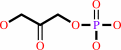 dihydroxyacetone phosphate
|
|
|
|
|
|
|
|
|
|
|
|
|
Molecule diagrams generated from .mol files obtained from the
KEGG ftp site
|
|
|
|
|
|
|
|
|
|
|
|
|
|
 |
|
|
|
|
|
|
| |
|
|
| |
|
DOI no:
|
Chembiochem
17:620-629
(2016)
|
|
PubMed id:
|
|
|
|
|
|
| |
|
Connecting Active-Site Loop Conformations and Catalysis in Triosephosphate Isomerase: Insights from a Rare Variation at Residue 96 in the Plasmodial Enzyme.
|
|
V.Pareek,
M.Samanta,
N.V.Joshi,
H.Balaram,
M.R.Murthy,
P.Balaram.
|
|
|
|
|
| |
ABSTRACT
|
|
|
|
| |
|
|
Despite extensive research into triosephosphate isomerases (TIMs), there exists
a gap in understanding of the remarkable conjunction between catalytic loop-6
(residues 166-176) movement and the conformational flip of Glu165 (catalytic
base) upon substrate binding that primes the active site for efficient
catalysis. The overwhelming occurrence of serine at position 96 (98 % of the
6277 unique TIM sequences), spatially proximal to E165 and the loop-6 residues,
raises questions about its role in catalysis. Notably, Plasmodium falciparum TIM
has an extremely rare residue-phenylalanine-at this position whereas, curiously,
the mutant F96S was catalytically defective. We have obtained insights into the
influence of residue 96 on the loop-6 conformational flip and E165 positioning
by combining kinetic and structural studies on the PfTIM F96 mutants F96Y, F96A,
F96S/S73A, and F96S/L167V with sequence conservation analysis and comparative
analysis of the available apo and holo structures of the enzyme from diverse
organisms.
|
|
|
|
|
|
|
|
|
|
|
|
|
|
|
|
|
|
 |
 |
 |
|


 Links
Links


