|
PDBsum entry 4qwc

|
|
|
|
|
|

|

|

|

|
|

|
|

|
|

|
|

|
|

|
|

|
|

|
|

|
|
|
 |

|

|
|
|
|
|
|
|
|
|
|
|
|
|
|
|
|
|
|
|
|
|
|
|
|
|
|
|
|
|
|
|
|
|
|
|
|
|
Transferase/DNA
|
PDB id
|
|
|
|
4qwc
|
|
|
|
|
|
|
|
|
|
|
|
|
|
|

|

|

|
|
|
|
|
|
|
|
|
Enzyme class:
|
|
E.C.2.7.7.7
- DNA-directed Dna polymerase.
|
|
|
|
|
|
|
Reaction:
|
|
DNA(n) + a 2'-deoxyribonucleoside 5'-triphosphate = DNA(n+1) + diphosphate
|
|
|
|
|
|
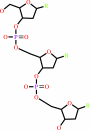 DNA(n)
|
+
|
2'-deoxyribonucleoside 5'-triphosphate
|
=
|
DNA(n+1)
|
+
|
 diphosphate
|
|
|
|
|
|
|
|
|
|
|
|
|
Molecule diagrams generated from .mol files obtained from the
KEGG ftp site
|
|
|
|
|
|
|
|
|
|
|
|
|
|
 |
|
|
|
|
|
|
| |
|
|
| |
|
DOI no:
|
Nucleic Acids Res
42:9984-9995
(2014)
|
|
PubMed id:
|
|
|
|
|
|
| |
|
Structural and kinetic insights into binding and incorporation of L-nucleotide analogs by a Y-family DNA polymerase.
|
|
V.Gaur,
R.Vyas,
J.D.Fowler,
G.Efthimiopoulos,
J.Y.Feng,
Z.Suo.
|
|
|
|
|
| |
ABSTRACT
|
|
|
|
| |
|
|
Considering that all natural nucleotides (D-dNTPs) and the building blocks
(D-dNMPs) of DNA chains possess D-stereochemistry, DNA polymerases and reverse
transcriptases (RTs) likely possess strongD-stereoselectivity by preferably
binding and incorporating D-dNTPs over unnatural L-dNTPs during DNA synthesis.
Surprisingly, a structural basis for the discrimination against L-dNTPs by DNA
polymerases or RTs has not been established although L-deoxycytidine analogs
(lamivudine and emtricitabine) and L-thymidine (telbivudine) have been widely
used as antiviral drugs for years. Here we report seven high-resolution ternary
crystal structures of a prototype Y-family DNA polymerase, DNA, and D-dCTP,
D-dCDP, L-dCDP, or the diphosphates and triphosphates of lamivudine and
emtricitabine. These structures reveal that relative to D-dCTP, each of these
L-nucleotides has its sugar ring rotated by 180° with an unusual O4'-endo sugar
puckering and exhibits multiple triphosphate-binding conformations within the
active site of the polymerase. Such rare binding modes significantly decrease
the incorporation rates and efficiencies of these L-nucleotides catalyzed by the
polymerase.
|
|
|
|
|
|
|
|
|
|
|
|
|
|
|
|
|
|
 |
 |
 |
|


 Links
Links