 |
PDBsum entry 4lgl

|
|
|
|
|
|

|

|

|

|
|

|
|

|
|

|
|

|
|

|
|

|
|

|
|
|
 |

|

|
|
|
|
|
|
|
|
|
|
|
|
|
|
|
|
|
|
|
|
|
|
|
|
|
|
|
|
|
|
|
|
|
|
|
|
Oxidoreductase
|
PDB id
|
|
|
|
4lgl
|
|
|
|
|
|
|
|
|
|
|
|
|
|
|

|

|

|
|
|
|
|
|
|
PDB id:
|
|
|
|
| Name: |
|
Oxidoreductase
|
|
|
Title:
|
|
Crystal structure of glycine decarboxylase p-protein from synechocystis sp. Pcc 6803, apo form
|
|
Structure:
|
|
Glycine dehydrogenase [decarboxylating]. Chain: a, b. Synonym: glycine cleavage system p-protein, glycine decarboxylase. Engineered: yes
|
|
Source:
|
|
Synechocystis sp.. Organism_taxid: 1111708. Strain: pcc 6803 / kazusa. Gene: gcvp, slr0293. Expressed in: escherichia coli. Expression_system_taxid: 562.
|
|
Resolution:
|
|
|
2.00Å
|
R-factor:
|
0.162
|
R-free:
|
0.192
|
|
|
Authors:
|
|
D.Hasse,E.Andersson,G.Carlsson,A.Masloboy,M.Hagemann,H.Bauwe, I.Andersson
|
|
Key ref:
|
|
D.Hasse
et al.
(2013).
Structure of the homodimeric glycine decarboxylase P-protein from Synechocystis sp. PCC 6803 suggests a mechanism for redox regulation.
J Biol Chem,
288,
35333-35345.
PubMed id:
DOI:
|
|
|
Date:
|
|
|
28-Jun-13
|
Release date:
|
16-Oct-13
|
|
|
|
|
|
|
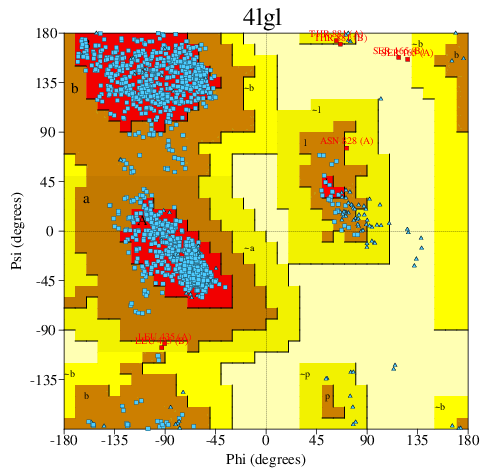
PROCHECK
|
|
|
|
|
|
Headers
|
|
|
|
References
|
|
|
|
|
|

|
|
P74416
(GCSP_SYNY3) -
Glycine dehydrogenase (decarboxylating) from Synechocystis sp. (strain ATCC 27184 / PCC 6803 / Kazusa)
|
|
|
|
Seq:
Struc:
|
|
|
|
983 a.a.
948 a.a.*
|
|

|

|

|
|
|
|
|
|
|
|
|
|
|
Key: |
 |
PfamA domain |
|
|
 |
Secondary structure |
|
|
*
PDB and UniProt seqs differ
at 2 residue positions (black
crosses)
|
|
|
|
|
|
|
|
|
|
|
|
|
Enzyme class:
|
|
E.C.1.4.4.2
- glycine dehydrogenase (aminomethyl-transferring).
|
|
|
|
|
|
|
Pathway:
|
|
Glycine Cleavage System
|
|
|
|
|
|
Reaction:
|
|
N6-[(R)-lipoyl]-L-lysyl-[glycine-cleavage complex H protein] + glycine + H+ = N6-[(R)-S(8)-aminomethyldihydrolipoyl]-L-lysyl-[glycine- cleavage complex H protein] + CO2
|
|
|
|
|
|
N(6)-[(R)-lipoyl]-L-lysyl-[glycine-cleavage complex H protein]
Bound ligand (Het Group name = )
matches with 44.44% similarity
|
+
|
 glycine
|
+
|
H(+)
|
=
|
N(6)-[(R)-S(8)-aminomethyldihydrolipoyl]-L-lysyl-[glycine- cleavage complex H protein]
|
+
|
 CO2
CO2
|
|
|
|
|
|
|
|
|
|
Cofactor:
|
|
Pyridoxal 5'-phosphate
|
|
|
|
|
|
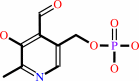 Pyridoxal 5'-phosphate
|
|
|
|
|
|
|
Molecule diagrams generated from .mol files obtained from the
KEGG ftp site
|
|
|
|
|
|
|
|
|
|
|
|
|
|
 |
|
|
|
|
|
|
| |
|
|
| |
|
DOI no:
|
J Biol Chem
288:35333-35345
(2013)
|
|
PubMed id:
|
|
|
|
|
|
| |
|
Structure of the homodimeric glycine decarboxylase P-protein from Synechocystis sp. PCC 6803 suggests a mechanism for redox regulation.
|
|
D.Hasse,
E.Andersson,
G.Carlsson,
A.Masloboy,
M.Hagemann,
H.Bauwe,
I.Andersson.
|
|
|
|
|
| |
ABSTRACT
|
|
|
|
| |
|
|
Glycine decarboxylase, or P-protein, is a pyridoxal 5'-phosphate (PLP)-dependent
enzyme in one-carbon metabolism of all organisms, in the glycine and serine
catabolism of vertebrates, and in the photorespiratory pathway of oxygenic
phototrophs. P-protein from the cyanobacterium Synechocystis sp. PCC 6803 is an
α2 homodimer with high homology to eukaryotic P-proteins. The crystal structure
of the apoenzyme shows the C terminus locked in a closed conformation by a
disulfide bond between Cys(972) in the C terminus and Cys(353) located in the
active site. The presence of the disulfide bridge isolates the active site from
solvent and hinders the binding of PLP and glycine in the active site. Variants
produced by substitution of Cys(972) and Cys(353) by Ser using site-directed
mutagenesis have distinctly lower specific activities, supporting the crucial
role of these highly conserved redox-sensitive amino acid residues for P-protein
activity. Reduction of the 353-972 disulfide releases the C terminus and allows
access to the active site. PLP and the substrate glycine bind in the active site
of this reduced enzyme and appear to cause further conformational changes
involving a flexible surface loop. The observation of the disulfide bond that
acts to stabilize the closed form suggests a molecular mechanism for the
redox-dependent activation of glycine decarboxylase observed earlier.
|
|
|
|
|
|
|
|
|
|
|
|
|
|
|
|
|
|
 |
 |
 |
|


 Links
Links


