 |
PDBsum entry 4jkt
|
|

|
|
PDB id:
|
|
|
|
| Name: |
|
Hydrolase
|
|
|
Title:
|
|
Crystal structure of mouse glutaminasE C, bptes-bound form
|
|
Structure:
|
|
Glutaminase kidney isoform, mitochondrial. Chain: a, b, c, d. Synonym: gls. Engineered: yes
|
|
Source:
|
|
Mus musculus. Mouse. Organism_taxid: 10090. Gene: gls, gls1, kiaa0838. Expressed in: escherichia coli. Expression_system_taxid: 562.
|
|
Resolution:
|
|
|
2.77Å
|
R-factor:
|
0.255
|
R-free:
|
0.295
|
|
|
Authors:
|
|
C.Fornezari,A.P.S.Ferreira,S.M.G.Dias,A.L.B.Ambrosio
|
|
Key ref:
|
|
A.P.Ferreira
et al.
(2013).
Active glutaminase C self-assembles into a supratetrameric oligomer that can be disrupted by an allosteric inhibitor.
J Biol Chem,
288,
28009-28020.
PubMed id:
DOI:
|
|
|
Date:
|
|
|
11-Mar-13
|
Release date:
|
14-Aug-13
|
|
|
|
|
|
|
PROCHECK
|

|
|
|
|
|
Headers
|
|
|
|
References
|
|
|
|
|
|

|
|
D3Z7P3
(GLSK_MOUSE) -
Glutaminase kidney isoform, mitochondrial from Mus musculus
|
|
|
|
Seq:
Struc:
|
|
|
|
674 a.a.
395 a.a.
|
|

|

|
|
|
|
|
|
|
|
|
|
|
|
Key: |
 |
PfamA domain |
|
|
 |
Secondary structure |
|
 |
CATH domain |
|
|
|
|
|
|
|
|
|
|
|
|
|
Enzyme class:
|
|
E.C.3.5.1.2
- glutaminase.
|
|
|
|
|
|
|
Reaction:
|
|
L-glutamine + H2O = L-glutamate + NH4+
|
|
|
|
|
|
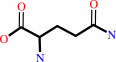 L-glutamine
|
+
|
H2O
|
=
|
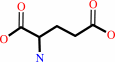 L-glutamate
|
+
|
NH4(+)
|
|
|
|
|
|
|
|
|
|
|
|
|
Molecule diagrams generated from .mol files obtained from the
KEGG ftp site
|
|
|
|
|
|
|
|
|
|
|
|
|
|
 |
|
|
|
|
|
|
| |
|
|
| |
|
DOI no:
|
J Biol Chem
288:28009-28020
(2013)
|
|
PubMed id:
|
|
|
|
|
|
| |
|
Active glutaminase C self-assembles into a supratetrameric oligomer that can be disrupted by an allosteric inhibitor.
|
|
A.P.Ferreira,
A.Cassago,
K.d.e. .A.Gonçalves,
M.M.Dias,
D.Adamoski,
C.F.Ascenção,
R.V.Honorato,
J.F.de Oliveira,
I.M.Ferreira,
C.Fornezari,
J.Bettini,
P.S.Oliveira,
A.F.Paes Leme,
R.V.Portugal,
A.L.Ambrosio,
S.M.Dias.
|
|
|
|
|
| |
ABSTRACT
|
|
|
|
| |
|
|
The phosphate-dependent transition between enzymatically inert dimers into
catalytically capable tetramers has long been the accepted mechanism for the
glutaminase activation. Here, we demonstrate that activated glutaminase C (GAC)
self-assembles into a helical, fiber-like double-stranded oligomer and propose a
molecular model consisting of seven tetramer copies per turn per strand
interacting via the N-terminal domains. The loop (321)LRFNKL(326) is projected
as the major regulating element for self-assembly and enzyme activation.
Furthermore, the previously identified in vivo lysine acetylation (Lys(311) in
humans, Lys(316) in mouse) is here proposed as an important down-regulator of
superoligomer assembly and protein activation.
Bis-2-(5-phenylacetamido-1,3,4-thiadiazol-2-yl)ethyl sulfide, a known
glutaminase inhibitor, completely disrupted the higher order oligomer,
explaining its allosteric mechanism of inhibition via tetramer stabilization. A
direct correlation between the tendency to self-assemble and the activity levels
of the three mammalian glutaminase isozymes was established, with GAC being the
most active enzyme while forming the longest structures. Lastly, the ectopic
expression of a fiber-prone superactive GAC mutant in MDA-MB 231 cancer cells
provided considerable proliferative advantages to transformed cells. These
findings yield unique implications for the development of GAC-oriented
therapeutics targeting tumor metabolism.
|
|
|
|
|
|
|
|
|
|
|
|
|
|
|
|
|
|
 |
 |
 |
|


 Links
Links


