 |
PDBsum entry 4inh

|
|
|
|
|
|

|

|

|

|
|

|
|

|
|

|
|

|
|

|
|
|
 |

|

|
|
|
|
|
|
|
|
|
|
|
|
|
|
|
|
|
|
|
|
|
|
|
|
|
|
|
|
|
|
|
|
|
|
Hydrolase/hydrolase inhibitor
|
PDB id
|
|
|
|
4inh
|
|
|
|
|
|
|
|
|
|
|
|
|
|
|

|

|

|
|
|
|
|
|
|
PDB id:
|
|
|
|
| Name: |
|
Hydrolase/hydrolase inhibitor
|
|
|
Title:
|
|
Structural basis of substrate specificity and protease inhibition in norwalk virus
|
|
Structure:
|
|
Genome polyprotein. Chain: a, b, c, d, e, f, g, h. Fragment: norwalk virus protease (unp residues 1101-1281). Synonym: protein p48, ntpase, p41, protein p22, viral genome-linked protein, vpg, 3c-like protease, 3clpro, calicivirin, RNA-directed RNA polymerase, rdrp. Engineered: yes. Peptide inhibitor, syc59. Chain: j, m, s, t, n, o, p, q.
|
|
Source:
|
|
Norovirus hu/1968/us. Hu/nv/nv/1968/us. Organism_taxid: 524364. Strain: gi/human/united states/norwalk/1968. Gene: orf1. Expressed in: escherichia coli. Expression_system_taxid: 562. Synthetic: yes. Synthetic construct.
|
|
Resolution:
|
|
|
1.70Å
|
R-factor:
|
0.178
|
R-free:
|
0.208
|
|
|
Authors:
|
|
B.V.V.Prasad,Z.Muhaxhiri,L.Deng,S.Shanker,B.Sankaran,M.K.Estes, T.Palzkill,Y.Song
|
|
Key ref:
|
|
Z.Muhaxhiri
et al.
(2013).
Structural basis of substrate specificity and protease inhibition in Norwalk virus.
J Virol,
87,
4281-4292.
PubMed id:
DOI:
|
|
|
Date:
|
|
|
04-Jan-13
|
Release date:
|
20-Feb-13
|
|
|
|
|
|
|
PROCHECK
|

|
|
|
|
|
Headers
|
|
|
|
References
|
|
|
|
|
|

|
|
Q83883
(POLG_NVN68) -
Genome polyprotein from Norovirus (strain Human/NoV/United States/Norwalk/1968/GI)
|
|
|
|
Seq:
Struc:
|
|
|
|
1789 a.a.
172 a.a.*
|
|

|

|

|
|
|
|
|
|
|
|
|
|
|
Key: |
 |
PfamA domain |
|
|
 |
Secondary structure |
|
 |
CATH domain |
|
|
*
PDB and UniProt seqs differ
at 4 residue positions (black
crosses)
|
|
|
|
|
|
|
|
|
|
|
|
|
Enzyme class 1:
|
|
E.C.2.7.7.48
- RNA-directed Rna polymerase.
|
|
|
|
|
|
|
Reaction:
|
|
RNA(n) + a ribonucleoside 5'-triphosphate = RNA(n+1) + diphosphate
|
|
|
|
|
|
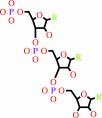 RNA(n)
|
+
|
ribonucleoside 5'-triphosphate
|
=
|
RNA(n+1)
|
+
|
 diphosphate
|
|
|
|
|
|
|
|
|
|
Enzyme class 2:
|
|
E.C.3.4.22.66
- calicivirin.
|
|
|
|
|
|
|
Enzyme class 3:
|
|
E.C.3.6.1.15
- nucleoside-triphosphate phosphatase.
|
|
|
|
|
|
|
Reaction:
|
|
a ribonucleoside 5'-triphosphate + H2O = a ribonucleoside 5'-diphosphate + phosphate + H+
|
|
|
|
|
|
ribonucleoside 5'-triphosphate
|
+
|
H2O
|
=
|
ribonucleoside 5'-diphosphate
|
+
|
 phosphate
|
+
|
H(+)
|
|
|
|
|
|
|
|
|
|
|
|
|
Note, where more than one E.C. class is given (as above), each may
correspond to a different protein domain or, in the case of polyprotein
precursors, to a different mature protein.
|
|
|
|
Molecule diagrams generated from .mol files obtained from the
KEGG ftp site
|
|
|
|
|
|
|
|
|
|
|
|
|
|
 |
|
|
|
|
|
|
| |
|
|
| |
|
DOI no:
|
J Virol
87:4281-4292
(2013)
|
|
PubMed id:
|
|
|
|
|
|
| |
|
Structural basis of substrate specificity and protease inhibition in Norwalk virus.
|
|
Z.Muhaxhiri,
L.Deng,
S.Shanker,
B.Sankaran,
M.K.Estes,
T.Palzkill,
Y.Song,
B.V.Prasad.
|
|
|
|
|
| |
ABSTRACT
|
|
|
|
| |
|
|
Norwalk virus (NV), the prototype human calicivirus, is the leading cause of
nonbacterial acute gastroenteritis. The NV protease cleaves the polyprotein
encoded by open reading frame 1 of the viral genome at five nonhomologous sites,
releasing six nonstructural proteins that are essential for viral replication.
The structural details of how NV protease recognizes multiple substrates are
unclear. In our X-ray structure of an NV protease construct, we observed that
the C-terminal tail, representing the native substrate positions P5 to P1, is
inserted into the active site cleft of the neighboring protease molecule,
providing atomic details of how NV protease recognizes a substrate. The
crystallographic structure of NV protease with the C-terminal tail redesigned to
mimic P4 to P1 of another substrate site provided further structural details on
how the active site accommodates sequence variations in the substrates. Based on
these structural analyses, substrate-based aldehyde inhibitors were synthesized
and screened for inhibition potency. Crystallographic structures of the protease
in complex with each of the three most potent inhibitors were determined. These
structures showed concerted conformational changes in the S4 and S2 pockets of
the protease to accommodate variations in the P4 and P2 residues of the
substrate/inhibitor, which could be a mechanism for how the NV protease
recognizes multiple sites in the polyprotein with differential affinities during
virus replication. These structures further indicate that the mechanism of
inhibition by these inhibitors involves covalent bond formation with the side
chain of the conserved cysteine in the active site by nucleophilic addition, and
such substrate-based aldehydes could be effective protease inhibitors.
|
|
|
|
|
|
|
|
|
|
|
|
|
|
|
|
|
|
 |
 |
 |
|


 Links
Links


