 |
PDBsum entry 4i2c

|
|
|
|
|
|

|

|

|

|
|

|
|

|
|

|
|

|
|

|
|

|
|

|
|
|
 |

|

|
|
|
|
|
|
|
|
|
|
|
|
|
|
|
|
|
|
|
|
|
|
|
|
|
|
|
|
|
|
|
|
|
|
|
|
Transferase/DNA
|
PDB id
|
|
|
|
4i2c
|
|
|
|
|
|
|
|
|
|
|
|
|
|
|

|

|

|
|
|
|
|
|
|
|
|
Enzyme class 1:
|
|
E.C.2.7.7.31
- Dna nucleotidylexotransferase.
|
|
|
|
|
|
|
Reaction:
|
|
DNA(n) + a 2'-deoxyribonucleoside 5'-triphosphate = DNA(n+1) + diphosphate
|
|
|
|
|
|
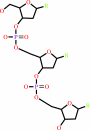 DNA(n)
|
+
|
2'-deoxyribonucleoside 5'-triphosphate
|
=
|
DNA(n+1)
|
+
|
 diphosphate
|
|
|
|
|
|
|
|
|
|
Enzyme class 2:
|
|
E.C.3.1.11.-
- ?????
|
|
|
|
|
|
|
|
|
|
Note, where more than one E.C. class is given (as above), each may
correspond to a different protein domain or, in the case of polyprotein
precursors, to a different mature protein.
|
|
|
|
Molecule diagrams generated from .mol files obtained from the
KEGG ftp site
|
|
|
|
|
|
|
|
|
|
|
|
|
|
 |
|
|
|
|
|
|
| |
|
|
| |
|
DOI no:
|
J Mol Biol
425:4334-4352
(2013)
|
|
PubMed id:
|
|
|
|
|
|
| |
|
Structures of intermediates along the catalytic cycle of terminal deoxynucleotidyltransferase: dynamical aspects of the two-metal ion mechanism.
|
|
J.Gouge,
S.Rosario,
F.Romain,
P.Beguin,
M.Delarue.
|
|
|
|
|
| |
ABSTRACT
|
|
|
|
| |
|
|
Terminal deoxynucleotidyltransferase (Tdt) is a non-templated eukaryotic DNA
polymerase of the polX family that is responsible for the random addition of
nucleotides at the V(D)J junctions of immunoglobulins and T-cell receptors. Here
we describe a series of high-resolution X-ray structures that mimic the
pre-catalytic state, the post-catalytic state and a competent state that can be
transformed into the two other ones in crystallo via the addition of dAMPcPP and
Zn(2+), respectively. We examined the effect of Mn(2+), Co(2+) and Zn(2+)
because they all have a marked influence on the kinetics of the reaction. We
demonstrate a dynamic role of divalent transition metal ions bound to site A:
(i) Zn(2+) (or Co(2+)) in Metal A site changes coordination from octahedral to
tetrahedral after the chemical step, which explains the known higher affinity of
Tdt for the primer strand when these ions are present, and (ii) metal A has to
leave to allow the translocation of the primer strand and to clear the active
site, a typical feature for a ratchet-like mechanism. Except for Zn(2+), the
sugar puckering of the primer strand 3' terminus changes from C2'-endo to
C3'-endo during catalysis. In addition, our data are compatible with a scheme
where metal A is the last component that binds to the active site to complete
its productive assembly, as already inferred in human pol beta. The new
structures have potential implications for modeling pol mu, a closely related
polX implicated in the repair of DNA double-strand breaks, in a complex with a
DNA synapsis.
|
|
|
|
|
|
|
|
|
|
|
|
|
|
|
|
|
|
 |
 |
 |
|


 Links
Links


