 |
PDBsum entry 4gss

|
|
|
|
|
 |
Contents |
 |
|
|
|
|
|
|
|
|
|
|
|
|
* Residue conservation analysis
|
|
|
|
|
|
|
|
|
|
|
Enzyme class:
|
|
E.C.2.5.1.18
- glutathione transferase.
|
|
|
|
|
|
|
Reaction:
|
|
RX + glutathione = an S-substituted glutathione + a halide anion + H+
|
|
|
|
|
|
RX
Bound ligand (Het Group name = )
matches with 76.92% similarity
|
+
|
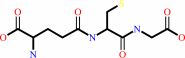 glutathione
|
=
|
S-substituted glutathione
|
+
|
halide anion
|
+
|
H(+)
|
|
|
|
|
|
|
|
|
|
|
|
|
Molecule diagrams generated from .mol files obtained from the
KEGG ftp site
|
|
|
|
|
|
|
|
|
|
|
|
|
|
 |
|
|
|
|
|
|
| |
|
|
| |
|
DOI no:
|
Biochemistry
36:6207-6217
(1997)
|
|
PubMed id:
|
|
|
|
|
|
| |
|
Multifunctional role of Tyr 108 in the catalytic mechanism of human glutathione transferase P1-1. Crystallographic and kinetic studies on the Y108F mutant enzyme.
|
|
M.Lo Bello,
A.J.Oakley,
A.Battistoni,
A.P.Mazzetti,
M.Nuccetelli,
G.Mazzarese,
J.Rossjohn,
M.W.Parker,
G.Ricci.
|
|
|
|
|
| |
ABSTRACT
|
|
|
|
| |
|
|
The possible role of the hydroxyl group of Tyr 108 in the catalytic mechanism of
human glutathione transferase P1-1 has been investigated by means of
site-directed mutagenesis, steady-state kinetic analysis, and crystallographic
studies. Three representative cosubstrates have been used, i.e. ethacrynic acid,
7-chloro-4-nitrobenz-2-oxa-1,3-diazole, and 1-chloro-2,4-dinitrobenzene. In the
presence of ethacrynic acid, the enzyme follows a rapid equilibrium random bi-bi
mechanism with a rate-limiting step which occurs after the addition of the
substrates and before the release of products. The replacement of Tyr 108 with
Phe yields a 14-fold decrease of k(cat), while it does not change appreciably
the affinity of the H site for the substrate. In this case, it would appear that
the role of the hydroxyl function is to stabilize the transition state for the
chemical step, i.e. the Michael addition of GSH to the electrophilic substrate.
Crystallographic data are compatible with this conclusion showing the hydroxyl
group of Y108 in hydrogen bonding distance of the ketone moiety of ethacrynic
acid [Oakley, A. J., Rossjohn, J., Lo Bello, M., Caccuri, A. M., Federici, G.,
& Parker, M. W. (1997) Biochemistry 36, 576-585]. Moreover, no structural
differences are observed between the Y108F mutant and the wild type, suggesting
that the removal of the hydroxyl group is solely responsible for the loss of
activity. A different involvement of Tyr 108 appears in the catalyzed
conjugation of 7-chloro-4-nitrobenz-2-oxa-1,3-diazole with GSH in which the
rate-limiting step is of a physical nature, probably a structural transition of
the ternary complex. The substitution of Tyr 108 yields an approximately 7-fold
increase of k(cat) and a constant k(cat)/Km(NBD-Cl) value. Lack of a critical
hydrogen bond between 7-chloro-4-nitrobenz-2-oxa-1,3-diazole and Tyr 108 appears
to be the basis of the increased k(cat). In the 1-chloro-2,4-dinitrobenzene/GSH
system, no appreciable changes of kinetics parameters are found in the Y108F
mutant. We conclude that Y108 has a multifunctional role in glutathione
transferase P1-1 catalysis, depending on the nature of the electrophilic
cosubstrate.
|
|
|
|
|
|
|
|
|
|
|
|
|
|
|
|
|
|
 |
 |
 |
|
Literature references that cite this PDB file's key reference
|
|
|
| |
PubMed id
|
|
Reference
|
|
|
|
|
|
A.Oakley
(2011).
Glutathione transferases: a structural perspective.
|
| |
Drug Metab Rev,
43,
138-151.
|
|
|
|
|
|
|
I.Quesada-Soriano,
L.J.Parker,
A.Primavera,
J.Wielens,
J.K.Holien,
J.M.Casas-Solvas,
A.Vargas-Berenguel,
A.M.Aguilera,
M.Nuccetelli,
A.P.Mazzetti,
M.L.Bello,
M.W.Parker,
and
L.García-Fuentes
(2011).
Diuretic drug binding to human glutathione transferase P1-1: potential role of Cys-101 revealed in the double mutant C47S/Y108V.
|
| |
J Mol Recognit,
24,
220-234.
|
|
|
PDB codes:
|
|
|
|
|
|
|
|
J.Wongsantichon,
R.C.Robinson,
and
A.J.Ketterman
(2010).
Structural contributions of delta class glutathione transferase active-site residues to catalysis.
|
| |
Biochem J,
428,
25-32.
|
|
|
PDB codes:
|
|
|
|
|
|
|
|
I.Axarli,
P.Dhavala,
A.C.Papageorgiou,
and
N.E.Labrou
(2009).
Crystal structure of Glycine max glutathione transferase in complex with glutathione: investigation of the mechanism operating by the Tau class glutathione transferases.
|
| |
Biochem J,
422,
247-256.
|
|
|
PDB code:
|
|
|
|
|
|
|
|
I.Quesada-Soriano,
L.J.Parker,
A.Primavera,
J.M.Casas-Solvas,
A.Vargas-Berenguel,
C.Barón,
C.J.Morton,
A.Paola Mazzetti,
M.Lo Bello,
M.W.Parker,
and
L.García-Fuentes
(2009).
Influence of the H-site residue 108 on human glutathione transferase P1-1 ligand binding: Structure-thermodynamic relationships and thermal stability.
|
| |
Protein Sci,
18,
2454-2470.
|
|
|
PDB codes:
|
|
|
|
|
|
|
|
J.Müller,
D.Sidler,
U.Nachbur,
J.Wastling,
T.Brunner,
and
A.Hemphill
(2008).
Thiazolides inhibit growth and induce glutathione-S-transferase Pi (GSTP1)-dependent cell death in human colon cancer cells.
|
| |
Int J Cancer,
123,
1797-1806.
|
|
|
|
|
|
|
M.Perbandt,
J.Höppner,
C.Betzel,
R.D.Walter,
and
E.Liebau
(2005).
Structure of the major cytosolic glutathione S-transferase from the parasitic nematode Onchocerca volvulus.
|
| |
J Biol Chem,
280,
12630-12636.
|
|
|
PDB codes:
|
|
|
|
|
|
|
|
E.Ortiz-Salmerón,
M.Nuccetelli,
A.J.Oakley,
M.W.Parker,
M.Lo Bello,
and
L.García-Fuentes
(2003).
Thermodynamic description of the effect of the mutation Y49F on human glutathione transferase P1-1 in binding with glutathione and the inhibitor S-hexylglutathione.
|
| |
J Biol Chem,
278,
46938-46948.
|
|
|
PDB code:
|
|
|
|
|
|
|
|
H.M.McDiarmid,
G.R.Douglas,
B.L.Coomber,
and
P.D.Josephy
(2002).
2-Amino-1-methyl-6-phenylimidazo[4,5-b]pyridine (PhIP)-induced mutagenesis in cultured Big Blue rat mammary epithelial and fibroblast cells.
|
| |
Environ Mol Mutagen,
39,
245-253.
|
|
|
|
|
|
|
T.Bucciarelli,
P.Sacchetta,
F.Amicarelli,
R.Petruzzelli,
S.Melino,
D.Rotilio,
N.Celli,
and
C.Di Ilio
(2002).
Amino acid sequence of the major form of toad liver glutathione transferase.
|
| |
Int J Biochem Cell Biol,
34,
1286-1290.
|
|
|
|
|
|
|
C.Micaloni,
A.P.Mazzetti,
M.Nuccetelli,
J.Rossjohn,
W.J.McKinstry,
G.Antonini,
A.M.Caccuri,
A.J.Oakley,
G.Federici,
G.Ricci,
M.W.Parker,
and
M.Lo Bello
(2000).
Valine 10 may act as a driver for product release from the active site of human glutathione transferase P1-1.
|
| |
Biochemistry,
39,
15961-15970.
|
|
|
|
|
|
|
C.C.Chuang,
S.H.Wu,
S.H.Chiou,
and
G.G.Chang
(1999).
Homology modeling of cephalopod lens S-crystallin: a natural mutant of sigma-class glutathione transferase with diminished endogenous activity.
|
| |
Biophys J,
76,
679-690.
|
|
|
|
|
|
|
A.J.Oakley,
M.Lo Bello,
G.Ricci,
G.Federici,
and
M.W.Parker
(1998).
Evidence for an induced-fit mechanism operating in pi class glutathione transferases.
|
| |
Biochemistry,
37,
9912-9917.
|
|
|
PDB codes:
|
|
|
|
|
|
|
|
M.C.Vega,
S.B.Walsh,
T.J.Mantle,
and
M.Coll
(1998).
The three-dimensional structure of Cys-47-modified mouse liver glutathione S-transferase P1-1. Carboxymethylation dramatically decreases the affinity for glutathione and is associated with a loss of electron density in the alphaB-310B region.
|
| |
J Biol Chem,
273,
2844-2850.
|
|
|
PDB codes:
|
|
|
|
|
|
|
|
M.Nicotra,
M.Paci,
M.Sette,
A.J.Oakley,
M.W.Parker,
M.Lo Bello,
A.M.Caccuri,
G.Federici,
and
G.Ricci
(1998).
Solution structure of glutathione bound to human glutathione transferase P1-1: comparison of NMR measurements with the crystal structure.
|
| |
Biochemistry,
37,
3020-3027.
|
|
|
|
|
|
|
R.N.Armstrong
(1998).
Mechanistic imperatives for the evolution of glutathione transferases.
|
| |
Curr Opin Chem Biol,
2,
618-623.
|
|
|
|
|
|
|
A.M.Caccuri,
G.Antonini,
M.Nicotra,
A.Battistoni,
M.Lo Bello,
P.G.Board,
M.W.Parker,
and
G.Ricci
(1997).
Catalytic mechanism and role of hydroxyl residues in the active site of theta class glutathione S-transferases. Investigation of Ser-9 and Tyr-113 in a glutathione S-transferase from the Australian sheep blowfly, Lucilia cuprina.
|
| |
J Biol Chem,
272,
29681-29686.
|
|
|
|
|
|
The most recent references are shown first.
Citation data come partly from CiteXplore and partly
from an automated harvesting procedure. Note that this is likely to be
only a partial list as not all journals are covered by
either method. However, we are continually building up the citation data
so more and more references will be included with time.
Where a reference describes a PDB structure, the PDB
codes are
shown on the right.
|
|


 Links
Links


