 |
PDBsum entry 4cgo
|
|

|
|
PDB id:
|
|
|
|
| Name: |
|
Transferase
|
|
|
Title:
|
|
Leishmania major n-myristoyltransferase in complex with a thienopyrimidine inhibitor
|
|
Structure:
|
|
Glycylpeptide n-tetradecanoyltransferase. Chain: a. Fragment: residues 11-421. Engineered: yes
|
|
Source:
|
|
Leishmania major. Organism_taxid: 5664. Expressed in: escherichia coli. Expression_system_taxid: 469008. Expression_system_variant: plyss, rosetta2.
|
|
Resolution:
|
|
|
1.30Å
|
R-factor:
|
0.163
|
R-free:
|
0.196
|
|
|
Authors:
|
|
J.A.Brannigan,S.M.Roberts,A.S.Bell,J.A.Hutton,D.F.Smith,E.W.Tate, R.J.Leatherbarrow,A.J.Wilkinson
|
|
Key ref:
|
|
J.A.Brannigan
et al.
(2014).
Diverse modes of binding in structures of Leishmania major N-myristoyltransferase with selective inhibitors.
Iucrj,
1,
250-260.
PubMed id:
DOI:
|
|
|
Date:
|
|
|
25-Nov-13
|
Release date:
|
09-Jul-14
|
|
|
|
|
|
|
PROCHECK
|

|
|
|
|
|
Headers
|
|
|
|
References
|
|
|
|
|
|

|
|
Q4Q5S8
(Q4Q5S8_LEIMA) -
Glycylpeptide N-tetradecanoyltransferase from Leishmania major
|
|
|
|
Seq:
Struc:
|
|
|
|
421 a.a.
411 a.a.
|
|

|

|

|
|
|
|
|
|
|
|
|
|
|
Key: |
 |
PfamA domain |
|
|
 |
Secondary structure |
|
 |
CATH domain |
|
|
|
|
|
|
|
|
|
|
|
|
|
Enzyme class:
|
|
E.C.2.3.1.97
- glycylpeptide N-tetradecanoyltransferase.
|
|
|
|
|
|
|
Reaction:
|
|
N-terminal glycyl-[protein] + tetradecanoyl-CoA = N-tetradecanoylglycyl- [protein] + CoA + H+
|
|
|
|
|
|
N-terminal glycyl-[protein]
|
+
|
tetradecanoyl-CoA
Bound ligand (Het Group name = )
corresponds exactly
|
=
|
N-tetradecanoylglycyl- [protein]
|
+
|
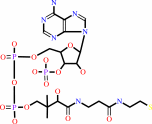 CoA
CoA
|
+
|
H(+)
|
|
|
|
|
|
|
|
|
|
|
|
|
Molecule diagrams generated from .mol files obtained from the
KEGG ftp site
|
|
|
|
|
|
|
|
|
|
|
|
|
|
 |
|
|
|
|
|
|
| |
|
|
| |
|
DOI no:
|
Iucrj
1:250-260
(2014)
|
|
PubMed id:
|
|
|
|
|
|
| |
|
Diverse modes of binding in structures of Leishmania major N-myristoyltransferase with selective inhibitors.
|
|
J.A.Brannigan,
S.M.Roberts,
A.S.Bell,
J.A.Hutton,
M.R.Hodgkinson,
E.W.Tate,
R.J.Leatherbarrow,
D.F.Smith,
A.J.Wilkinson.
|
|
|
|
|
| |
ABSTRACT
|
|
|
|
| |
|
|
The leishmaniases are a spectrum of global diseases of poverty associated with
immune dysfunction and are the cause of high morbidity. Despite the long history
of these diseases, no effective vaccine is available and the currently used
drugs are variously compromised by moderate efficacy, complex side effects and
the emergence of resistance. It is therefore widely accepted that new therapies
are needed. N-Myristoyltransferase (NMT) has been validated pre-clinically as a
target for the treatment of fungal and parasitic infections. In a previously
reported high-throughput screening program, a number of hit compounds with
activity against NMT from Leishmania donovani have been identified. Here,
high-resolution crystal structures of representative compounds from four hit
series in ternary complexes with myristoyl-CoA and NMT from the closely related
L. major are reported. The structures reveal that the inhibitors associate with
the peptide-binding groove at a site adjacent to the bound myristoyl-CoA and the
catalytic α-carboxylate of Leu421. Each inhibitor makes extensive apolar
contacts as well as a small number of polar contacts with the protein.
Remarkably, the compounds exploit different features of the peptide-binding
groove and collectively occupy a substantial volume of this pocket, suggesting
that there is potential for the design of chimaeric inhibitors with
significantly enhanced binding. Despite the high conservation of the active
sites of the parasite and human NMTs, the inhibitors act selectively over the
host enzyme. The role of conformational flexibility in the side chain of Tyr217
in conferring selectivity is discussed.
|
|
|
|
|
|
|
|
|
|
|
|
|
|
|
|
|
|
 |
 |
 |
|


 Links
Links


