 |
PDBsum entry 3ehh

|
|
|
|
|
 |
Contents |
 |
|
|
|
|
|
|
|
|
|
|
|
|
|
|
* Residue conservation analysis
|
|
|
|
|
|
|
|
|
|
|
Enzyme class:
|
|
E.C.2.7.13.3
- histidine kinase.
|
|
|
|
|
|
|
Reaction:
|
|
ATP + protein L-histidine = ADP + protein N-phospho-L-histidine
|
|
|
|
|
|
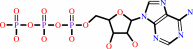 ATP
ATP
|
+
|
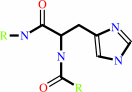 protein L-histidine
|
=
|
ADP
Bound ligand (Het Group name = )
corresponds exactly
|
+
|
protein N-phospho-L-histidine
|
|
|
|
|
|
|
|
|
|
|
|
|
Molecule diagrams generated from .mol files obtained from the
KEGG ftp site
|
|
|
|
|
|
|
|
|
|
|
|
|
|
 |
|
|
|
|
|
|
| |
|
|
| |
|
DOI no:
|
Proc Natl Acad Sci U S A
106:16185-16190
(2009)
|
|
PubMed id:
|
|
|
|
|
|
| |
|
Structural plasticity and catalysis regulation of a thermosensor histidine kinase.
|
|
D.Albanesi,
M.Martín,
F.Trajtenberg,
M.C.Mansilla,
A.Haouz,
P.M.Alzari,
D.de Mendoza,
A.Buschiazzo.
|
|
|
|
|
| |
ABSTRACT
|
|
|
|
| |
|
|
Temperature sensing is essential for the survival of living cells. A major
challenge is to understand how a biological thermometer processes thermal
information to optimize cellular functions. Using structural and biochemical
approaches, we show that the thermosensitive histidine kinase, DesK, from
Bacillus subtilis is cold-activated through specific interhelical rearrangements
in its central four-helix bundle domain. As revealed by the crystal structures
of DesK in different functional states, the plasticity of this helical domain
influences the catalytic activities of the protein, either by modifying the
mobility of the ATP-binding domains for autokinase activity or by modulating
binding of the cognate response regulator to sustain the phosphotransferase and
phosphatase activities. The structural and biochemical data suggest a model in
which the transmembrane sensor domain of DesK promotes these structural changes
through conformational signals transmitted by the membrane-connecting
two-helical coiled-coil, ultimately controlling the alternation between output
autokinase and phosphatase activities. The structural comparison of the
different DesK variants indicates that incoming signals can take the form of
helix rotations and asymmetric helical bends similar to those reported for other
sensing systems, suggesting that a similar switching mechanism could be
operational in a wide range of sensor histidine kinases.
|
|
|
|
|
|
| |
Selected figure(s)
|
|
|
|
| |
|
|

|
|

|
|
Figure 1.
Three distinct conformational states of DesKC. Cartoon
representations of the DesK homodimers, with the two
[alpha]-helical hairpins from the DHp domain highlighted in pink
([alpha]1) and blue ([alpha]2), the ABDs colored in yellow, and
bound nucleotides in green. (A) Overall structures of
DesKC[[Delta]174] (Top) and E188b (Bottom), with mobile ABDs.
(B) Structure of DesKC-P (Top), similar to E188a (Bottom),
rotated approximately 60[deg] around the vertical axis with
respect to (A) for clarity. (C) Structures of V188a (Top) and
V188b (Bottom). (D) Superposition of the 11 independent ABDs
seen in all DesKC variants. The bound nucleotide is shown in
cyan, with the adenine ring stacked against F324 (in yellow).
The Mg^2+ ion (in red) contacts the nucleotide phosphates and
two residues (E289 and N293, in green) that belong to the
conserved N box (17). The ATP-lid (residues 321 --334) shows the
largest structural differences and is partially disordered in
many crystal structures. (E) Hydrophobic residues (CPK spheres)
of one helical hairpin that, upon dimerization, forms the core
of the 4-HB in DesKC[[Delta]174]. For each residue, its a/d
position within the heptad repeats and the percentage of members
of the HisKA_3 subfamily having a hydrophobic residue (AVLMI) at
the same position are indicated in parenthesis.
|
|
Figure 3.
Extensive intradomain interactions in DesKC[H188V]. (A) Close
view of the interaction between the ABDs and the DHp domain in
DesKC[H188V]. Key residues are colored according to the type of
interaction (electrostatic in red, hydrophobic in blue, and
H-bonding in green). (B) Cartoon representation (Right) of the
two-helical coiled-coil formed by the homodimerization of
residues 160 --180. Core hydrophobic residues are shown in stick
representation. Molecular surface representation (Left) of the
same helical region for one monomer, showing the exposed
hydrophobic patch. (C) Overall view of the parallel coiled-coil
and the 4-HB in DesKC[H188V]. The molecular surface color-coded
according to electrostatic charges is shown for helix [alpha]1
in one monomer. The side-chains of I183 and L187, which were
part of the DHp core in DesKC[[Delta]174], are now at the outer
surface of the domain (engaged in interactions with the ABD
domain, not shown).
|
|
|
|
| |
Figures were
selected
by an automated process.
|
|
|
|
|
|
|
|
|
|
|
|
|
|
|
|
 |
 |
 |
|
Literature references that cite this PDB file's key reference
|
|
|
| |
PubMed id
|
|
Reference
|
|
|
|
|
|
R.R.Araghi,
and
B.Koksch
(2011).
A helix-forming αβγ-chimeric peptide with catalytic activity: a hybrid peptide ligase.
|
| |
Chem Commun (Camb),
47,
3544-3546.
|
|
|
|
|
|
|
A.Möglich,
and
K.Moffat
(2010).
Engineered photoreceptors as novel optogenetic tools.
|
| |
Photochem Photobiol Sci,
9,
1286-1300.
|
|
|
|
|
|
|
C.E.Noriega,
H.Y.Lin,
L.L.Chen,
S.B.Williams,
and
V.Stewart
(2010).
Asymmetric cross-regulation between the nitrate-responsive NarX-NarL and NarQ-NarP two-component regulatory systems from Escherichia coli K-12.
|
| |
Mol Microbiol,
75,
394-412.
|
|
|
|
|
|
|
D.I.Chan,
and
H.J.Vogel
(2010).
Current understanding of fatty acid biosynthesis and the acyl carrier protein.
|
| |
Biochem J,
430,
1.
|
|
|
|
|
|
|
J.Cheung,
and
W.A.Hendrickson
(2010).
Sensor domains of two-component regulatory systems.
|
| |
Curr Opin Microbiol,
13,
116-123.
|
|
|
|
|
|
|
K.S.Ramamurthi
(2010).
Signal transduction: bacterial thermometer works by measuring membrane thickness.
|
| |
Curr Biol,
20,
R707-R709.
|
|
|
|
|
|
|
L.E.Cybulski,
M.Martín,
M.C.Mansilla,
A.Fernández,
and
D.de Mendoza
(2010).
Membrane thickness cue for cold sensing in a bacterium.
|
| |
Curr Biol,
20,
1539-1544.
|
|
|
|
|
|
|
P.Slavny,
R.Little,
P.Salinas,
T.A.Clarke,
and
R.Dixon
(2010).
Quaternary structure changes in a second Per-Arnt-Sim domain mediate intramolecular redox signal relay in the NifL regulatory protein.
|
| |
Mol Microbiol,
75,
61-75.
|
|
|
|
|
|
|
S.D.Goldberg,
G.D.Clinthorne,
M.Goulian,
and
W.F.DeGrado
(2010).
Transmembrane polar interactions are required for signaling in the Escherichia coli sensor kinase PhoQ.
|
| |
Proc Natl Acad Sci U S A,
107,
8141-8146.
|
|
|
|
|
|
|
T.N.Huynh,
C.E.Noriega,
and
V.Stewart
(2010).
Conserved mechanism for sensor phosphatase control of two-component signaling revealed in the nitrate sensor NarX.
|
| |
Proc Natl Acad Sci U S A,
107,
21140-21145.
|
|
|
|
|
|
|
V.Stewart,
and
L.L.Chen
(2010).
The S helix mediates signal transmission as a HAMP domain coiled-coil extension in the NarX nitrate sensor from Escherichia coli K-12.
|
| |
J Bacteriol,
192,
734-745.
|
|
|
|
|
|
The most recent references are shown first.
Citation data come partly from CiteXplore and partly
from an automated harvesting procedure. Note that this is likely to be
only a partial list as not all journals are covered by
either method. However, we are continually building up the citation data
so more and more references will be included with time.
|
|


 Links
Links


