 |
PDBsum entry 2zyf

|
|
|
|
|
 |
Contents |
 |
|
|
|
|
|
|
|
|
|
|
|
|
|
|
* Residue conservation analysis
|
|
|
|
|
|
|
|
|
|
|
Enzyme class:
|
|
E.C.2.3.3.14
- homocitrate synthase.
|
|
|
|
|
|
|
Pathway:
|
|
Oxo-acid lyases with thioester hydrolysis
|
|
|
|
|
|
Reaction:
|
|
acetyl-CoA + 2-oxoglutarate + H2O = (2R)-homocitrate + CoA + H+
|
|
|
|
|
|
acetyl-CoA
Bound ligand (Het Group name = )
corresponds exactly
|
+
|
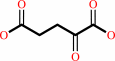 2-oxoglutarate
|
+
|
H2O
|
=
|
(2R)-homocitrate
|
+
|
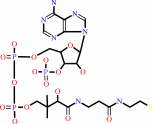 CoA
CoA
|
+
|
H(+)
|
|
|
|
|
|
|
|
|
|
|
|
|
Molecule diagrams generated from .mol files obtained from the
KEGG ftp site
|
|
|
|
|
|
|
|
|
|
|
|
|
|
 |
|
|
|
|
|
|
| |
|
|
| |
|
|
J Biol Chem
285:4195-4205
(2010)
|
|
PubMed id:
|
|
|
|
|
|
| |
|
Mechanism of substrate recognition and insight into feedback inhibition of homocitrate synthase from Thermus thermophilus.
|
|
T.Okada,
T.Tomita,
A.P.Wulandari,
T.Kuzuyama,
M.Nishiyama.
|
|
|
|
|
| |
ABSTRACT
|
|
|
|
| |
|
|
Homocitrate synthase (HCS) catalyzes aldol-type condensation of acetyl coenzyme
A (acetyl-CoA) and alpha-ketoglutarate (alpha-KG) to synthesize homocitrate
(HC), which is the first and committed step in the lysine biosynthetic pathway
through alpha-aminoadipate. As known in most enzymes catalyzing the first
reactions in amino acid biosynthetic pathways, HCS is regulated via feedback
inhibition by the end product, lysine. Here, we determined the crystal
structures of HCS from Thermus thermophilus complexed with alpha-KG, HC, or
lysine. In the HC complex, the C1-carboxyl group of HC, which is derived from
acetyl-CoA, is hydrogen-bonded with His-292* from another subunit (indicated by
the asterisk), indicating direct involvement of this residue in the catalytic
mechanism of HCS. The crystal structure of HCS complexed with lysine showed that
lysine is bound to the active site with rearrangement of amino acid residues in
the substrate-binding site, which accounts for the competitive inhibition by
lysine with alpha-KG. Comparison between the structures suggests that His-72,
which is conserved in lysine-sensitive HCSs and binds the C5-carboxyl group of
alpha-KG, serves as a switch for the conformational change. Replacement of
His-72 by leucine made HCS resistant to lysine inhibition, demonstrating the
regulatory role of this conserved residue.
|
|
|
|
|
|
|
|
|
|
|
|
|
|
|
|
|
|
 |
 |
 |
|
Literature references that cite this PDB file's key reference
|
|
|
| |
PubMed id
|
|
Reference
|
|
|
|
|
|
S.L.Bulfer,
E.M.Scott,
L.Pillus,
and
R.C.Trievel
(2010).
Structural basis for L-lysine feedback inhibition of homocitrate synthase.
|
| |
J Biol Chem,
285,
10446-10453.
|
|
|
PDB codes:
|
|
|
|
|
|
|
The most recent references are shown first.
Citation data come partly from CiteXplore and partly
from an automated harvesting procedure. Note that this is likely to be
only a partial list as not all journals are covered by
either method. However, we are continually building up the citation data
so more and more references will be included with time.
Where a reference describes a PDB structure, the PDB
codes are
shown on the right.
|
|


 Links
Links


