|
PDBsum entry 2x0s

|
|
|
|
|
 |
Contents |
 |
|
|
|
|
|
|
|
|
|
|
* Residue conservation analysis
|
|
|
|
|
|
|
|
|
|
|
Enzyme class:
|
|
E.C.2.7.9.1
- pyruvate, phosphate dikinase.
|
|
|
|
|
|
|
Reaction:
|
|
pyruvate + phosphate + ATP = phosphoenolpyruvate + AMP + diphosphate + H+
|
|
|
|
|
|
 pyruvate
|
+
|
 phosphate
|
+
|
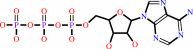 ATP
ATP
|
=
|
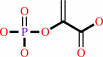 phosphoenolpyruvate
|
+
|
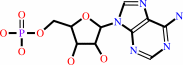 AMP
AMP
|
+
|
 diphosphate
|
+
|
H(+)
|
|
|
|
|
|
|
|
|
|
|
|
|
Molecule diagrams generated from .mol files obtained from the
KEGG ftp site
|
|
|
|
|
|
|
|
|
|
|
|
|
|
 |
|
|
|
|
|
|
| |
|
|
| |
|
DOI no:
|
J Mol Biol
318:1417-1432
(2002)
|
|
PubMed id:
|
|
|
|
|
|
| |
|
The 3.0 A resolution crystal structure of glycosomal pyruvate phosphate dikinase from Trypanosoma brucei.
|
|
L.W.Cosenza,
F.Bringaud,
T.Baltz,
F.M.Vellieux.
|
|
|
|
|
| |
ABSTRACT
|
|
|
|
| |
|
|
The crystal structure of the glycosomal enzyme pyruvate phosphate dikinase from
the African protozoan parasite Trypanosoma brucei has been solved to 3.0 A
resolution by molecular replacement. The search model was the 2.3 A resolution
structure of the Clostridium symbiosum enzyme. Due to different relative
orientations of the domains and sub-domains in the two structures, molecular
replacement could be achieved only by positioning these elements (four bodies
altogether) sequentially in the asymmetric unit of the P2(1)2(1)2 crystal, which
contains one pyruvate phosphate dikinase (PPDK) subunit. The refined model,
comprising 898 residues and 188 solvent molecules per subunit, has a
crystallographic residual index Rf = 0.245 (cross-validation residual index
Rfree = 0.291) and displays satisfactory stereochemistry. Eight regions,
comprising a total of 69 amino acid residues at the surface of the molecule, are
disordered in this crystal form. The PPDK subunits are arranged around the
crystallographic 2-fold axis as a dimer, analogous to that observed in the C.
symbiosum enzyme. Comparison of the two structures was carried out by
superposition of the models. Although the fold of each domain or sub-domain is
similar, the relative orientations of these constitutive elements are different
in the two structures. The trypanosome enzyme is more "bent" than the
bacterial enzyme, with bending increasing from the center of the molecule (close
to the molecular 2-fold axis) towards the periphery where the N-terminal domain
is located. As a consequence of this increased bending and of the differences in
relative positions of subdomains, the nucleotide-binding cleft in the
amino-terminal domain is wider in T. brucei PPDK: the N-terminal fragment of the
amino-terminal domain is distant from the catalytic, phospho-transfer competent
histidine 482 (ca 10 A away). Our observations suggest that the requirements of
domain motion during enzyme catalysis might include widening of the
nucleotide-binding cleft to allow access and departure of the AMP or ATP ligand.
|
|
|
|
|
|
| |
Selected figure(s)
|
|
|
|
| |
|
|

|
|

|
|
Figure 6.
Figure 6. A GRASP representation of the electrostatic
potential at the surface of the glycosomal PPDK molecule. This
Figure shows the PPDK dimer viewed from opposite sides (related
by a 180° rotation). The separation between the two monomers
is indicated by a thick line. The entire surface of the molecule
is covered by basic residues, giving a blue surface. The only
area where acidic residues are in excess (red area) is located
in the inter-domain depression where the central domain is
situated.
|
|
Figure 7.
Figure 7. Superimposed subunits of T. brucei and C.
symbiosum PPDK. The superposition operation was carried out
using only the C-terminal domains. The C^a tracings of the
superimposed subunits are shown, with T. brucei PPDK in black
and bacterial PPDK in gray. For easier understanding, the
equivalent domains and sub-domains in the two subunits are also
represented by vectors between corresponding residues in the two
structures (shown as thick lines).
|
|
|
|
|
|
| |
The above figures are
reprinted
by permission from Elsevier:
J Mol Biol
(2002,
318,
1417-1432)
copyright 2002.
|
|
| |
Figures were
selected
by the author.
|
|
|
|
|
|
|
|
|
|
|
|
|
|
|
|
 |
 |
 |
|
Literature references that cite this PDB file's key reference
|
|
|
| |
PubMed id
|
|
Reference
|
|
|
|
|
|
A.Teplyakov,
K.Lim,
P.P.Zhu,
G.Kapadia,
C.C.Chen,
J.Schwartz,
A.Howard,
P.T.Reddy,
A.Peterkofsky,
and
O.Herzberg
(2006).
Structure of phosphorylated enzyme I, the phosphoenolpyruvate:sugar phosphotransferase system sugar translocation signal protein.
|
| |
Proc Natl Acad Sci U S A,
103,
16218-16223.
|
|
|
PDB code:
|
|
|
|
|
|
|
|
D.Das,
and
M.M.Georgiadis
(2004).
The crystal structure of the monomeric reverse transcriptase from Moloney murine leukemia virus.
|
| |
Structure,
12,
819-829.
|
|
|
PDB code:
|
|
|
|
|
|
|
The most recent references are shown first.
Citation data come partly from CiteXplore and partly
from an automated harvesting procedure. Note that this is likely to be
only a partial list as not all journals are covered by
either method. However, we are continually building up the citation data
so more and more references will be included with time.
Where a reference describes a PDB structure, the PDB
code is
shown on the right.
|
|


 Links
Links