 |
PDBsum entry 2v8x

|
|
|
|
|
 |
Contents |
 |
|
|
|
|
|
|
|
|
|
|
|
|
* Residue conservation analysis
|
|
|
|
|
|
PDB id:
|
|
|
|
| Name: |
|
Translation
|
|
|
Title:
|
|
Crystallographic and mass spectrometric characterisation of eif4e with n7-cap derivatives
|
|
Structure:
|
|
Eukaryotic translation initiation factor 4e. Chain: a, e. Synonym: eif4e, eif-4e, mRNA cap-binding protein, eif-4f 25 kda subunit. Engineered: yes. Eukaryotic translation initiation factor 4e-binding protein 1. Chain: b, f. Fragment: phas-i4e-bp1 binding peptide, residues 50-63.
|
|
Source:
|
|
Homo sapiens. Human. Organism_taxid: 9606. Expressed in: escherichia coli. Expression_system_taxid: 562. Synthetic: yes. Organism_taxid: 9606
|
|
Resolution:
|
|
|
2.30Å
|
R-factor:
|
0.192
|
R-free:
|
0.259
|
|
|
Authors:
|
|
C.J.Brown,I.Mcnae,P.M.Fischer,M.D.Walkinshaw
|
Key ref:

|
|
C.J.Brown
et al.
(2007).
Crystallographic and mass spectrometric characterisation of eIF4E with N7-alkylated cap derivatives.
J Mol Biol,
372,
7.
PubMed id:
DOI:

|
|
|
Date:
|
|
|
16-Aug-07
|
Release date:
|
28-Aug-07
|
|
|
|
|
|
|
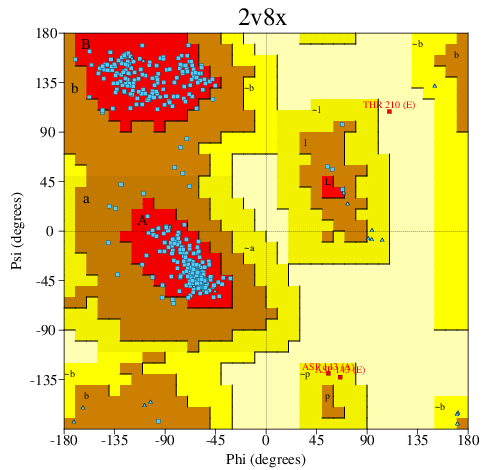
PROCHECK
|
|
|
|
|
|
Headers
|
|
|
|
References
|
|
|
|
|
|
|
|
|
|
|
|
|
|
|
|
 |
|
|
|
|
|
|
| |
|
DOI no:
|
J Mol Biol
372:7
(2007)
|
|
PubMed id:
|
|
|
|
|
|
| |
|
Crystallographic and mass spectrometric characterisation of eIF4E with N7-alkylated cap derivatives.
|
|
C.J.Brown,
I.McNae,
P.M.Fischer,
M.D.Walkinshaw.
|
|
|
|
|
| |
ABSTRACT
|
|
|
|
| |
|
|
Structural complexes of the eukaryotic translation initiation factor 4E (eIF4E)
with a series of N(7)-alkylated guanosine derivative mRNA cap analogue
structures have been characterised. Mass spectrometry was used to determine
apparent gas-phase equilibrium dissociation constants (K(d)) values of 0.15
microM, 13.6 microM, and 55.7 microM for eIF4E with 7-methyl-GTP (m(7)GTP), GTP,
and GMP, respectively. For tight and specific binding to the eIF4E
mononucleotide binding site, there seems to be a clear requirement for guanosine
derivatives to possess both the delocalised positive charge of the
N(7)-methylated guanine system and at least one phosphate group. We show that
the N(7)-benzylated monophosphates 7-benzyl-GMP (Bn(7)GMP) and
7-(p-fluorobenzyl)-GMP (FBn(7)GMP) bind eIF4E substantially more tightly than
non-N(7)-alkylated guanosine derivatives (K(d) values of 7.0 microM and 2.0
microM, respectively). The eIF4E complex crystal structures with Bn(7)GMP and
FBn(7)GMP show that additional favourable contacts of the benzyl groups with
eIF4E contribute binding energy that compensates for loss of the beta and
gamma-phosphates. The N(7)-benzyl groups pack into a hydrophobic pocket behind
the two tryptophan side-chains that are involved in the cation-pi stacking
interaction between the cap and the eIF4E mononucleotide binding site. This
pocket is formed by an induced fit in which one of the tryptophan residues
involved in cap binding flips through 180 degrees relative to structures with
N(7)-methylated cap derivatives. This and other observations made here will be
useful in the design of new families of eIF4E inhibitors, which may have
potential therapeutic applications in cancer.
|
|
|
|
|
|
| |
Selected figure(s)
|
|
|
|
| |
|
|

|
|

|
|
Figure 1.
Figure 1. Chemical structures of the mRNA cap and some cap
derivatives. The N^7-substituted GMP cap analogues were
synthesised from GMP and an appropriate benzyl halide.
Experimental details are given as Supplementary Data.
|
|
Figure 3.
Figure 3. Electron density and electrostatic surface of three
ligands m^7GTP, Bn^7GMP and FBn^7GMP bound to eIF4E. (a), (c)
and (e) The F[o]–F[c] electron density (2.5σ) for the ligands
m^7GTP, Bn^7GMP and FBn^7GMP, respectively, in blue, with the
green mesh showing the 2 F[o]–F[c] map for eIF4E (1.2σ) and
the structured waters. Incorporation of the bulky benzyl group
in Bn^7GMP and FBn^7GMP causes the W102 side-chain to flip
180°. The m^7G moiety of the cap analogue forms the same
hydrogen bonds (shown in yellow) with the E103 side-chain and
the amide backbone of W102. (b), (d) and (f) The electrostatic
potential of the eIF4E surface. The phosphate-binding region has
a distinctive positive charge whilst the pocket in which the
m^7G moiety intercalates is more hydrophobic in nature. The m^7G
moiety forms a parallel stack with W102 and W56 and interacts
with the two ring systems via cation–π interactions.
|
|
|
|
|
|
| |
The above figures are
reprinted
by permission from Elsevier:
J Mol Biol
(2007,
372,
7-0)
copyright 2007.
|
|
| |
Figures were
selected
by an automated process.
|
|
|
|
|
|
|
|
|
|
|
|
|
|
|
|
 |
 |
 |
|
Literature references that cite this PDB file's key reference
|
|
|
| |
PubMed id
|
|
Reference
|
|
|
|
|
|
J.A.Ashby,
C.E.Stevenson,
G.E.Jarvis,
D.M.Lawson,
and
A.J.Maule
(2011).
Structure-based mutational analysis of eIF4E in relation to sbm1 resistance to pea seed-borne mosaic virus in pea.
|
| |
PLoS One,
6,
e15873.
|
|
|
PDB code:
|
|
|
|
|
|
|
|
K.Ruszczyńska-Bartnik,
M.Maciejczyk,
and
R.Stolarski
(2011).
Dynamical insight into Caenorhabditis elegans eIF4E recognition specificity for mono-and trimethylated structures of mRNA 5' cap.
|
| |
J Mol Model,
17,
727-737.
|
|
|
|
|
|
|
Y.Jia,
T.L.Chiu,
E.A.Amin,
V.Polunovsky,
P.B.Bitterman,
and
C.R.Wagner
(2010).
Design, synthesis and evaluation of analogs of initiation factor 4E (eIF4E) cap-binding antagonist Bn7-GMP.
|
| |
Eur J Med Chem,
45,
1304-1313.
|
|
|
|
|
|
|
B.Ghosh,
A.O.Benyumov,
P.Ghosh,
Y.Jia,
S.Avdulov,
P.S.Dahlberg,
M.Peterson,
K.Smith,
V.A.Polunovsky,
P.B.Bitterman,
and
C.R.Wagner
(2009).
Nontoxic chemical interdiction of the epithelial-to-mesenchymal transition by targeting cap-dependent translation.
|
| |
ACS Chem Biol,
4,
367-377.
|
|
|
|
|
|
|
W.Liu,
R.Zhao,
C.McFarland,
J.Kieft,
A.Niedzwiecka,
M.Jankowska-Anyszka,
J.Stepinski,
E.Darzynkiewicz,
D.N.Jones,
and
R.E.Davis
(2009).
Structural insights into parasite eIF4E binding specificity for m7G and m2,2,7G mRNA caps.
|
| |
J Biol Chem,
284,
31336-31349.
|
|
|
PDB codes:
|
|
|
|
|
|
|
|
P.Ghosh,
J.Cheng,
T.F.Chou,
Y.Jia,
S.Avdulov,
P.B.Bitterman,
V.A.Polunovsky,
and
C.R.Wagner
(2008).
Expression, purification and characterization of recombinant mouse translation initiation factor eIF4E as a dihydrofolate reductase (DHFR) fusion protein.
|
| |
Protein Expr Purif,
60,
132-139.
|
|
|
|
|
|
The most recent references are shown first.
Citation data come partly from CiteXplore and partly
from an automated harvesting procedure. Note that this is likely to be
only a partial list as not all journals are covered by
either method. However, we are continually building up the citation data
so more and more references will be included with time.
Where a reference describes a PDB structure, the PDB
code is
shown on the right.
|
|
|


 Links
Links


