 |
PDBsum entry 2kfn

|
|
|
|
|
|

|

|

|

|
|

|
|

|
|

|
|

|
|

|
|

|
|
|
 |

|

|
|
|
|
|
|
|
|
|
|
|
|
|
|
|
|
|
|
|
|
|
|
|
|
|
|
|
|
|
|
|
|
|
|
|
Transferase/DNA
|
PDB id
|
|
|
|
2kfn
|
|
|
|
|
|
|
|
|
|
|
|
|
|
|

|

|

|
|
|
|
|
|
|
|
 |
Contents |
 |
|
|
|
|
|
|
|
|
|
|
|
|
|
|
* Residue conservation analysis
|
|
|
|
|
|
|
|
|
|
|
Enzyme class:
|
|
E.C.2.7.7.7
- DNA-directed Dna polymerase.
|
|
|
|
|
|
|
Reaction:
|
|
DNA(n) + a 2'-deoxyribonucleoside 5'-triphosphate = DNA(n+1) + diphosphate
|
|
|
|
|
|
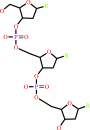 DNA(n)
|
+
|
2'-deoxyribonucleoside 5'-triphosphate
|
=
|
DNA(n+1)
|
+
|
 diphosphate
|
|
|
|
|
|
|
|
|
|
|
|
|
Molecule diagrams generated from .mol files obtained from the
KEGG ftp site
|
|
|
|
|
|
|
|
|
|
|
|
|
|
 |
|
|
|
|
|
|
| |
|
|
| |
|
DOI no:
|
Biochemistry
38:696-704
(1999)
|
|
PubMed id:
|
|
|
|
|
|
| |
|
Structures of normal single-stranded DNA and deoxyribo-3'-S-phosphorothiolates bound to the 3'-5' exonucleolytic active site of DNA polymerase I from Escherichia coli.
|
|
C.A.Brautigam,
S.Sun,
J.A.Piccirilli,
T.A.Steitz.
|
|
|
|
|
| |
ABSTRACT
|
|
|
|
| |
|
|
The interaction of a divalent metal ion with a leaving 3' oxygen is a central
component of several proposed mechanisms of phosphoryl transfer. In support of
this are recent kinetic studies showing that thiophilic metal ions (e.g., Mn2+)
stimulate the hydrolysis of compounds in which sulfur takes the place of the
leaving oxygen. To examine the structural basis of this phenomenon, we have
solved four crystal structures of single-stranded DNA's containing either oxygen
or sulfur at a 3'-bridging position bound in conjunction with various metal ions
at the 3'-5' exonucleolytic active site of the Klenow fragment (KF) of DNA
polymerase I from Escherichia coli. Two structures of normal ssDNA bound to KF
in the presence of Zn2+ and Mn2+ or Zn2+ alone were refined at 2.6- and 2.25-A
resolution, respectively. They serve as standards for comparison with other
Mn2+- and Zn2+-containing structures. In these cases, Mn2+ and Zn2+ bind at
metal ion site B in a nearly identical position to Mg2+ (Brautigam and Steitz
(1998) J. Mol. Biol. 277, 363-377). Two structures of KF bound to a
deoxyoligonucleotide that contained a 3'-bridging sulfur at the scissile
phosphate were refined at 2.03-A resolution. Although the bridging sulfur
compounds bind in a manner very similar to that of the normal oligonucleotides,
the presence of the sulfur changes the metal ion binding properties of the
active site such that Mn2+ and Zn2+ are observed at metal ion site B, but Mg2+
is not. It therefore appears that the ability of the bridging sulfur compounds
to exclude nonthiophilic metal ions from metal ion site B explains the low
activity of KF exonuclease on these substrates in the presence of Mg2+ (Curley
et al. (1997) J. Am. Chem. Soc. 119, 12691-12692) and that the 3'-bridging atom
of the substrate is influencing the binding of metal ion B prior to catalysis.
|
|
|
|
|
|
|
|
|
|
|
|
|
|
|
|
|
|
 |
 |
 |
|
Literature references that cite this PDB file's key reference
|
|
|
| |
PubMed id
|
|
Reference
|
|
|
|
|
|
J.Orans,
E.A.McSweeney,
R.R.Iyer,
M.A.Hast,
H.W.Hellinga,
P.Modrich,
and
L.S.Beese
(2011).
Structures of human exonuclease 1 DNA complexes suggest a unified mechanism for nuclease family.
|
| |
Cell,
145,
212-223.
|
|
|
PDB codes:
|
|
|
|
|
|
|
|
K.M.Hastie,
C.R.Kimberlin,
M.A.Zandonatti,
I.J.MacRae,
and
E.O.Saphire
(2011).
Structure of the Lassa virus nucleoprotein reveals a dsRNA-specific 3' to 5' exonuclease activity essential for immune suppression.
|
| |
Proc Natl Acad Sci U S A,
108,
2396-2401.
|
|
|
PDB codes:
|
|
|
|
|
|
|
|
W.Yang
(2011).
Nucleases: diversity of structure, function and mechanism.
|
| |
Q Rev Biophys,
44,
1.
|
|
|
|
|
|
|
J.E.Deweese,
and
N.Osheroff
(2010).
The use of divalent metal ions by type II topoisomerases.
|
| |
Metallomics,
2,
450-459.
|
|
|
|
|
|
|
G.A.Cisneros,
L.Perera,
R.M.Schaaper,
L.C.Pedersen,
R.E.London,
L.G.Pedersen,
and
T.A.Darden
(2009).
Reaction mechanism of the epsilon subunit of E. coli DNA polymerase III: insights into active site metal coordination and catalytically significant residues.
|
| |
J Am Chem Soc,
131,
1550-1556.
|
|
|
|
|
|
|
K.R.Andersen,
A.T.Jonstrup,
L.B.Van,
and
D.E.Brodersen
(2009).
The activity and selectivity of fission yeast Pop2p are affected by a high affinity for Zn2+ and Mn2+ in the active site.
|
| |
RNA,
15,
850-861.
|
|
|
PDB codes:
|
|
|
|
|
|
|
|
S.Yang,
S.Park,
L.Makowski,
and
B.Roux
(2009).
A rapid coarse residue-based computational method for x-ray solution scattering characterization of protein folds and multiple conformational states of large protein complexes.
|
| |
Biophys J,
96,
4449-4463.
|
|
|
|
|
|
|
C.S.Francklyn
(2008).
DNA polymerases and aminoacyl-tRNA synthetases: shared mechanisms for ensuring the fidelity of gene expression.
|
| |
Biochemistry,
47,
11695-11703.
|
|
|
|
|
|
|
F.Xie,
S.H.Qureshi,
G.A.Papadakos,
and
C.M.Dupureur
(2008).
One- and two-metal ion catalysis: global single-turnover kinetic analysis of the PvuII endonuclease mechanism.
|
| |
Biochemistry,
47,
12540-12550.
|
|
|
|
|
|
|
J.E.Deweese,
A.B.Burgin,
and
N.Osheroff
(2008).
Human topoisomerase IIalpha uses a two-metal-ion mechanism for DNA cleavage.
|
| |
Nucleic Acids Res,
36,
4883-4893.
|
|
|
|
|
|
|
M.Brucet,
J.Querol-Audí,
K.Bertlik,
J.Lloberas,
I.Fita,
and
A.Celada
(2008).
Structural and biochemical studies of TREX1 inhibition by metals. Identification of a new active histidine conserved in DEDDh exonucleases.
|
| |
Protein Sci,
17,
2059-2069.
|
|
|
PDB codes:
|
|
|
|
|
|
|
|
R.D.Busam
(2008).
Structure of Escherichia coli exonuclease I in complex with thymidine 5'-monophosphate.
|
| |
Acta Crystallogr D Biol Crystallogr,
64,
206-210.
|
|
|
PDB code:
|
|
|
|
|
|
|
|
W.Yang
(2008).
An equivalent metal ion in one- and two-metal-ion catalysis.
|
| |
Nat Struct Mol Biol,
15,
1228-1231.
|
|
|
|
|
|
|
J.W.Gaynor,
J.Bentley,
and
R.Cosstick
(2007).
Synthesis of the 3'-thio-nucleosides and subsequent automated synthesis of oligodeoxynucleotides containing a 3'-S-phosphorothiolate linkage.
|
| |
Nat Protoc,
2,
3122-3135.
|
|
|
|
|
|
|
W.Yang,
J.Y.Lee,
and
M.Nowotny
(2006).
Making and breaking nucleic acids: two-Mg2+-ion catalysis and substrate specificity.
|
| |
Mol Cell,
22,
5.
|
|
|
|
|
|
|
F.W.Perrino,
S.Harvey,
S.McMillin,
and
T.Hollis
(2005).
The human TREX2 3' -> 5'-exonuclease structure suggests a mechanism for efficient nonprocessive DNA catalysis.
|
| |
J Biol Chem,
280,
15212-15218.
|
|
|
PDB code:
|
|
|
|
|
|
|
|
M.Osawa,
A.Dace,
K.I.Tong,
A.Valiveti,
M.Ikura,
and
J.B.Ames
(2005).
Mg2+ and Ca2+ differentially regulate DNA binding and dimerization of DREAM.
|
| |
J Biol Chem,
280,
18008-18014.
|
|
|
|
|
|
|
M.Wu,
M.Reuter,
H.Lilie,
Y.Liu,
E.Wahle,
and
H.Song
(2005).
Structural insight into poly(A) binding and catalytic mechanism of human PARN.
|
| |
EMBO J,
24,
4082-4093.
|
|
|
PDB codes:
|
|
|
|
|
|
|
|
G.Sabbagh,
K.J.Fettes,
R.Gosain,
I.A.O'Neil,
and
R.Cosstick
(2004).
Synthesis of phosphorothioamidites derived from 3'-thio-3'-deoxythymidine and 3'-thio-2',3'-dideoxycytidine and the automated synthesis of oligodeoxynucleotides containing a 3'-S-phosphorothiolate linkage.
|
| |
Nucleic Acids Res,
32,
495-501.
|
|
|
|
|
|
|
Y.G.Ren,
L.A.Kirsebom,
and
A.Virtanen
(2004).
Coordination of divalent metal ions in the active site of poly(A)-specific ribonuclease.
|
| |
J Biol Chem,
279,
48702-48706.
|
|
|
|
|
|
|
C.P.Da Costa,
A.Okruszek,
and
H.Sigel
(2003).
Complex formation of divalent metal ions with uridine 5'-O-thiomonophosphate or methyl thiophosphate: comparison of complex stabilities with those of the parent phosphate ligands.
|
| |
Chembiochem,
4,
593-602.
|
|
|
|
|
|
|
S.Park,
M.Seetharaman,
A.Ogdie,
D.Ferguson,
and
N.Tretyakova
(2003).
3'-Exonuclease resistance of DNA oligodeoxynucleotides containing O6-[4-oxo-4-(3-pyridyl)butyl]guanine.
|
| |
Nucleic Acids Res,
31,
1984-1994.
|
|
|
|
|
|
|
E.L.Christian,
N.M.Kaye,
and
M.E.Harris
(2002).
Evidence for a polynuclear metal ion binding site in the catalytic domain of ribonuclease P RNA.
|
| |
EMBO J,
21,
2253-2262.
|
|
|
|
|
|
|
Y.Zuo,
and
M.P.Deutscher
(2001).
Exoribonuclease superfamilies: structural analysis and phylogenetic distribution.
|
| |
Nucleic Acids Res,
29,
1017-1026.
|
|
|
|
|
|
|
J.C.Morales,
and
E.T.Kool
(2000).
Importance of terminal base pair hydrogen-bonding in 3'-end proofreading by the Klenow fragment of DNA polymerase I.
|
| |
Biochemistry,
39,
2626-2632.
|
|
|
|
|
|
|
J.C.Morales,
and
E.T.Kool
(2000).
Functional hydrogen-bonding map of the minor groove binding tracks of six DNA polymerases.
|
| |
Biochemistry,
39,
12979-12988.
|
|
|
|
|
|
|
J.C.Morales,
and
E.T.Kool
(2000).
Varied Molecular Interactions at the Active Sites of Several DNA Polymerases: Nonpolar Nucleoside Isosteres as Probes.
|
| |
J Am Chem Soc,
122,
1001-1007.
|
|
|
|
|
|
|
J.M.Warnecke,
E.J.Sontheimer,
J.A.Piccirilli,
and
R.K.Hartmann
(2000).
Active site constraints in the hydrolysis reaction catalyzed by bacterial RNase P: analysis of precursor tRNAs with a single 3'-S-phosphorothiolate internucleotide linkage.
|
| |
Nucleic Acids Res,
28,
720-727.
|
|
|
|
|
|
|
K.Yoshinari,
and
K.Taira
(2000).
A further investigation and reappraisal of the thio effect in the cleavage reaction catalyzed by a hammerhead ribozyme.
|
| |
Nucleic Acids Res,
28,
1730-1742.
|
|
|
|
|
|
|
S.Wang,
K.Karbstein,
A.Peracchi,
L.Beigelman,
and
D.Herschlag
(1999).
Identification of the hammerhead ribozyme metal ion binding site responsible for rescue of the deleterious effect of a cleavage site phosphorothioate.
|
| |
Biochemistry,
38,
14363-14378.
|
|
|
|
|
|
The most recent references are shown first.
Citation data come partly from CiteXplore and partly
from an automated harvesting procedure. Note that this is likely to be
only a partial list as not all journals are covered by
either method. However, we are continually building up the citation data
so more and more references will be included with time.
Where a reference describes a PDB structure, the PDB
codes are
shown on the right.
|
|


 Links
Links


