 |
PDBsum entry 2ix1

|
|
|
|
|
 |
Contents |
 |
|
|
|
|
|
|
|
|
|
|
|
|
|
|
* Residue conservation analysis
|
|
|
|
|
|
PDB id:
|
|
|
|
| Name: |
|
Hydrolase
|
|
|
Title:
|
|
Rnase ii d209n mutant
|
|
Structure:
|
|
Exoribonuclease 2. Chain: a. Fragment: residues 6-644. Synonym: rnase ii d209n mutant, exoribonuclease ii, ribonuclease ii, rnase ii. Engineered: yes. Mutation: yes. 5'-d( Ap Ap Ap Ap Ap Ap Ap Ap Ap Ap Ap Ap A)-3'. Chain: b.
|
|
Source:
|
|
Escherichia coli. Organism_taxid: 562. Strain: c600. Expressed in: escherichia coli. Expression_system_taxid: 469008. Escherichia coli bl21(de3). Organism_taxid: 469008
|
|
Biol. unit:
|
|
Dimer (from PDB file)
|
|
Resolution:
|
|
|
2.74Å
|
R-factor:
|
0.187
|
R-free:
|
0.225
|
|
|
Authors:
|
|
C.Frazao,C.E.Mcvey,M.Amblar,A.Barbas,C.Vonrhein,C.M.Arraiano, M.A.Carrondo
|
Key ref:

|
|
C.Frazão
et al.
(2006).
Unravelling the dynamics of RNA degradation by ribonuclease II and its RNA-bound complex.
Nature,
443,
110-114.
PubMed id:
DOI:

|
|
|
Date:
|
|
|
05-Jul-06
|
Release date:
|
05-Oct-06
|
|
|
|
|
|
|
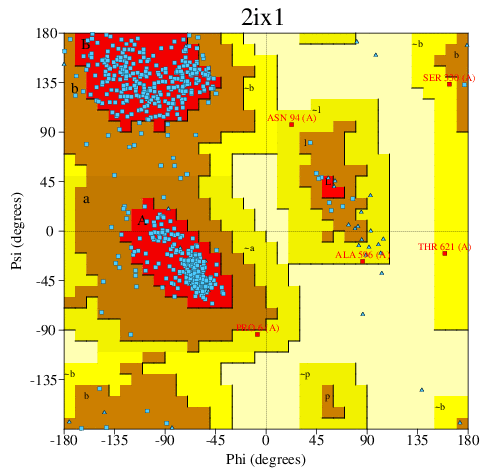
PROCHECK
|
|
|
|
|
|
Headers
|
|
|
|
References
|
|
|
|
|
|

|
|
P30850
(RNB_ECOLI) -
Exoribonuclease 2 from Escherichia coli (strain K12)
|
|
|
|
Seq:
Struc:
|
|
|
|
644 a.a.
643 a.a.*
|
|

|
|
|
|
|
|
|
|
|
|
|
|
|
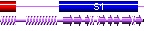
Key: |
 |
PfamA domain |
|
|
 |
Secondary structure |
|
 |
CATH domain |
|
|
*
PDB and UniProt seqs differ
at 5 residue positions (black
crosses)
|
|
|
|
|
|
|
|

|
|
|
|
A-A-A-A-A-A-A-A-A-A-A-A-A
13 bases
|
|
|
|
|
|
|
|
|
|
|
|
|
|
Enzyme class:
|
|
E.C.3.1.13.1
- exoribonuclease Ii.
|
|
|
|
|
|
|
Reaction:
|
|
Exonucleolytic cleavage in the 3'- to 5'-direction to yield nucleoside 5'-phosphates.
|
|
|
|
|
|
|
|
|
|
|
|
|
|
|
|
|
|
 |
|
|
|
|
|
|
| |
|
DOI no:
|
Nature
443:110-114
(2006)
|
|
PubMed id:
|
|
|
|
|
|
| |
|
Unravelling the dynamics of RNA degradation by ribonuclease II and its RNA-bound complex.
|
|
C.Frazão,
C.E.McVey,
M.Amblar,
A.Barbas,
C.Vonrhein,
C.M.Arraiano,
M.A.Carrondo.
|
|
|
|
|
| |
ABSTRACT
|
|
|
|
| |
|
|
RNA degradation is a determining factor in the control of gene expression. The
maturation, turnover and quality control of RNA is performed by many different
classes of ribonucleases. Ribonuclease II (RNase II) is a major exoribonuclease
that intervenes in all of these fundamental processes; it can act independently
or as a component of the exosome, an essential RNA-degrading multiprotein
complex. RNase II-like enzymes are found in all three kingdoms of life, but
there are no structural data for any of the proteins of this family. Here we
report the X-ray crystallographic structures of both the ligand-free (at 2.44 A
resolution) and RNA-bound (at 2.74 A resolution) forms of Escherichia coli RNase
II. In contrast to sequence predictions, the structures show that RNase II is
organized into four domains: two cold-shock domains, one RNB catalytic domain,
which has an unprecedented alphabeta-fold, and one S1 domain. The enzyme
establishes contacts with RNA in two distinct regions, the 'anchor' and the
'catalytic' regions, which act synergistically to provide catalysis. The active
site is buried within the RNB catalytic domain, in a pocket formed by four
conserved sequence motifs. The structure shows that the catalytic pocket is only
accessible to single-stranded RNA, and explains the specificity for RNA versus
DNA cleavage. It also explains the dynamic mechanism of RNA degradation by
providing the structural basis for RNA translocation and enzyme processivity. We
propose a reaction mechanism for exonucleolytic RNA degradation involving key
conserved residues. Our three-dimensional model corroborates all existing
biochemical data for RNase II, and elucidates the general basis for RNA
degradation. Moreover, it reveals important structural features that can be
extrapolated to other members of this family.
|
|
|
|
|
|
| |
Selected figure(s)
|
|
|
|
| |
|
|

|
|

|
|
Figure 2.
Figure 2: RNase II–ssRNA interactions.
Figure 2 :
RNase II|[ndash]|ssRNA interactions. Unfortunately we are
unable to provide accessible alternative text for this.
If you require assistance to access this image, or to
obtain a text description, please contact npg@nature.com-
a, Atomic interactions scheme between RNA (enclosed atoms in
black or in red for O2'-protein interactions) and protein
residues (coloured by domains as in Fig. 1a). Hb indicates
hydrogen bonds up to 3.2 Å, and vdW indicates van der
Waals interactions up to 3.6 Å. b, c, RNA docking
catalytic region (b) with residues 364–381 deleted for
clarity, and anchor region (c) involving canonical
oligonucleotide-binding motifs^16 L[23] of CSD2, and chain  3
and loop L[45] of S1. RNA (coloured as in Fig. 1) and protein
hydrogen-bonding side-chain residues shown in sticks (carbon in
yellow, nitrogen in cyan, oxygen in red), enzyme domains as
cartoons (coloured as in Fig. 1). Hydrogen bonds shown as dashed
green lines, Mg shown as green sphere with coordination in
dashed yellow lines. Nucleotides (Nt) 9–13 are clamped between
the aromatic side-chains of Tyr 253 and Phe 358 (with labels
highlighted in green), nucleotides 3 and 4 are between Phe 588
and Pro 104, and nucleotide 5 is nestled between His 103, Pro
104, Asp 102 and Arg 167. 3
and loop L[45] of S1. RNA (coloured as in Fig. 1) and protein
hydrogen-bonding side-chain residues shown in sticks (carbon in
yellow, nitrogen in cyan, oxygen in red), enzyme domains as
cartoons (coloured as in Fig. 1). Hydrogen bonds shown as dashed
green lines, Mg shown as green sphere with coordination in
dashed yellow lines. Nucleotides (Nt) 9–13 are clamped between
the aromatic side-chains of Tyr 253 and Phe 358 (with labels
highlighted in green), nucleotides 3 and 4 are between Phe 588
and Pro 104, and nucleotide 5 is nestled between His 103, Pro
104, Asp 102 and Arg 167.
|
|
Figure 3.
Figure 3: RNA degradation by RNase II.
Figure 3 : RNA
degradation by RNase II. Unfortunately we are unable to
provide accessible alternative text for this. If you
require assistance to access this image, or to obtain a
text description, please contact npg@nature.com-
a, Stereo view of RNase II D209N mutant active site; bonds
are shown as sticks (oxygen in red, nitrogen in blue, phosphorus
in orange), waters as red spheres, Mg as a green sphere and its
coordination as dashed orange lines, and hydrogen bonds as
dashed green lines, superposed with sigma-A corrected Fourier
synthesis electron density map (brown mesh) contoured at 1  .
Additionally, N1 and N6 of nucleotide 13 are in the vicinity of
the carboxylate oxygens of Glu 542, at 3.2 Å (hydrogen
bond as dashed green lines) and at 4.3 Å (distance as
dotted orange line), respectively. b, Magnified view of the Mg
ion and its coordinating environment (distances in Å)
superposed with the positive 3 sigma-A
corrected Fourier difference map (green mesh) calculated with
the Mg and coordinating waters omitted from the model. c, Stereo
view of the superposition of the RNase II D209N mutant (yellow)
and RNase H (grey) with magnesium coordinating spheres (opposite
view to Fig. 3a). RNase H displays two magnesium ions ligated by
Glu 109, D132N, Glu 188 and Asp 192 that correspond in RNase II
to Asp 201, Asp 210, D209N and Asp 207, respectively. d,
Proposed catalytic mechanism for RNase II, showing the
postulated second Mg (Mg II) and the attacking hydroxyl group
(grey). e, Model for RNA degradation by RNase II. ssRNA (red) is
threaded into the catalytic cavity and clamped between Tyr 253
and Phe 358. The additional stabilization of RNA inside the
cavity drives the RNA translocation after each cleavage, up to a
final four-nucleotide fragment. .
Additionally, N1 and N6 of nucleotide 13 are in the vicinity of
the carboxylate oxygens of Glu 542, at 3.2 Å (hydrogen
bond as dashed green lines) and at 4.3 Å (distance as
dotted orange line), respectively. b, Magnified view of the Mg
ion and its coordinating environment (distances in Å)
superposed with the positive 3 sigma-A
corrected Fourier difference map (green mesh) calculated with
the Mg and coordinating waters omitted from the model. c, Stereo
view of the superposition of the RNase II D209N mutant (yellow)
and RNase H (grey) with magnesium coordinating spheres (opposite
view to Fig. 3a). RNase H displays two magnesium ions ligated by
Glu 109, D132N, Glu 188 and Asp 192 that correspond in RNase II
to Asp 201, Asp 210, D209N and Asp 207, respectively. d,
Proposed catalytic mechanism for RNase II, showing the
postulated second Mg (Mg II) and the attacking hydroxyl group
(grey). e, Model for RNA degradation by RNase II. ssRNA (red) is
threaded into the catalytic cavity and clamped between Tyr 253
and Phe 358. The additional stabilization of RNA inside the
cavity drives the RNA translocation after each cleavage, up to a
final four-nucleotide fragment.
|
|
|
|
|
|
| |
The above figures are
reprinted
by permission from Macmillan Publishers Ltd:
Nature
(2006,
443,
110-114)
copyright 2006.
|
|
| |
Figures were
selected
by an automated process.
|
|
|
|
|
|
|
|
|
|
|
|
|
|
|
|
 |
 |
 |
|
Literature references that cite this PDB file's key reference
|
|
|
| |
PubMed id
|
|
Reference
|
|
|
|
|
|
K.Nakanishi,
D.E.Weinberg,
D.P.Bartel,
and
D.J.Patel
(2012).
Structure of yeast Argonaute with guide RNA.
|
| |
Nature,
486,
368-374.
|
|
|
PDB code:
|
|
|
|
|
|
|
|
D.Schaeffer,
and
A.van Hoof
(2011).
Different nuclease requirements for exosome-mediated degradation of normal and nonstop mRNAs.
|
| |
Proc Natl Acad Sci U S A,
108,
2366-2371.
|
|
|
|
|
|
|
R.G.Matos,
A.Barbas,
P.Gómez-Puertas,
and
C.M.Arraiano
(2011).
Swapping the domains of exoribonucleases RNase II and RNase R: Conferring upon RNase II the ability to degrade ds RNA.
|
| |
Proteins,
79,
1853-1867.
|
|
|
|
|
|
|
W.Yang
(2011).
Nucleases: diversity of structure, function and mechanism.
|
| |
Q Rev Biophys,
44,
1.
|
|
|
|
|
|
|
B.K.Mohanty,
and
S.R.Kushner
(2010).
Processing of the Escherichia coli leuX tRNA transcript, encoding tRNA(Leu5), requires either the 3'-->5' exoribonuclease polynucleotide phosphorylase or RNase P to remove the Rho-independent transcription terminator.
|
| |
Nucleic Acids Res,
38,
597-607.
|
|
|
|
|
|
|
B.Tsanova,
and
A.van Hoof
(2010).
Poring over exosome structure.
|
| |
EMBO Rep,
11,
900-901.
|
|
|
|
|
|
|
N.Awano,
V.Rajagopal,
M.Arbing,
S.Patel,
J.Hunt,
M.Inouye,
and
S.Phadtare
(2010).
Escherichia coli RNase R has dual activities, helicase and RNase.
|
| |
J Bacteriol,
192,
1344-1352.
|
|
|
|
|
|
|
N.Henriksson,
P.Nilsson,
M.Wu,
H.Song,
and
A.Virtanen
(2010).
Recognition of adenosine residues by the active site of poly(A)-specific ribonuclease.
|
| |
J Biol Chem,
285,
163-170.
|
|
|
|
|
|
|
R.G.Matos,
A.Barbas,
and
C.M.Arraiano
(2010).
Comparison of EMSA and SPR for the characterization of RNA-RNase II complexes.
|
| |
Protein J,
29,
394-397.
|
|
|
|
|
|
|
R.H.Staals,
A.W.Bronkhorst,
G.Schilders,
S.Slomovic,
G.Schuster,
A.J.Heck,
R.Raijmakers,
and
G.J.Pruijn
(2010).
Dis3-like 1: a novel exoribonuclease associated with the human exosome.
|
| |
EMBO J,
29,
2358-2367.
|
|
|
|
|
|
|
R.Tomecki,
K.Drazkowska,
and
A.Dziembowski
(2010).
Mechanisms of RNA degradation by the eukaryotic exosome.
|
| |
Chembiochem,
11,
938-945.
|
|
|
|
|
|
|
R.Tomecki,
M.S.Kristiansen,
S.Lykke-Andersen,
A.Chlebowski,
K.M.Larsen,
R.J.Szczesny,
K.Drazkowska,
A.Pastula,
J.S.Andersen,
P.P.Stepien,
A.Dziembowski,
and
T.H.Jensen
(2010).
The human core exosome interacts with differentially localized processive RNases: hDIS3 and hDIS3L.
|
| |
EMBO J,
29,
2342-2357.
|
|
|
|
|
|
|
W.Zhang,
C.Murphy,
and
L.E.Sieburth
(2010).
Conserved RNaseII domain protein functions in cytoplasmic mRNA decay and suppresses Arabidopsis decapping mutant phenotypes.
|
| |
Proc Natl Acad Sci U S A,
107,
15981-15985.
|
|
|
|
|
|
|
Y.Matsumoto,
Q.Xu,
S.Miyazaki,
C.Kaito,
C.L.Farr,
H.L.Axelrod,
H.J.Chiu,
H.E.Klock,
M.W.Knuth,
M.D.Miller,
M.A.Elsliger,
A.M.Deacon,
A.Godzik,
S.A.Lesley,
K.Sekimizu,
and
I.A.Wilson
(2010).
Structure of a virulence regulatory factor CvfB reveals a novel winged helix RNA binding module.
|
| |
Structure,
18,
537-547.
|
|
|
PDB code:
|
|
|
|
|
|
|
|
Z.Ge,
P.Mehta,
J.Richards,
and
A.W.Karzai
(2010).
Non-stop mRNA decay initiates at the ribosome.
|
| |
Mol Microbiol,
78,
1159-1170.
|
|
|
|
|
|
|
A.Barbas,
R.G.Matos,
M.Amblar,
E.López-Viñas,
P.Gomez-Puertas,
and
C.M.Arraiano
(2009).
Determination of key residues for catalysis and RNA cleavage specificity: one mutation turns RNase II into a "SUPER-ENZYME".
|
| |
J Biol Chem,
284,
20486-20498.
|
|
|
|
|
|
|
D.Schaeffer,
B.Tsanova,
A.Barbas,
F.P.Reis,
E.G.Dastidar,
M.Sanchez-Rotunno,
C.M.Arraiano,
and
A.van Hoof
(2009).
The exosome contains domains with specific endoribonuclease, exoribonuclease and cytoplasmic mRNA decay activities.
|
| |
Nat Struct Mol Biol,
16,
56-62.
|
|
|
|
|
|
|
F.Bonneau,
J.Basquin,
J.Ebert,
E.Lorentzen,
and
E.Conti
(2009).
The yeast exosome functions as a macromolecular cage to channel RNA substrates for degradation.
|
| |
Cell,
139,
547-559.
|
|
|
PDB code:
|
|
|
|
|
|
|
|
F.Garza-Sánchez,
S.Shoji,
K.Fredrick,
and
C.S.Hayes
(2009).
RNase II is important for A-site mRNA cleavage during ribosome pausing.
|
| |
Mol Microbiol,
73,
882-897.
|
|
|
|
|
|
|
H.A.Vincent,
and
M.P.Deutscher
(2009).
The roles of individual domains of RNase R in substrate binding and exoribonuclease activity. The nuclease domain is sufficient for digestion of structured RNA.
|
| |
J Biol Chem,
284,
486-494.
|
|
|
|
|
|
|
H.A.Vincent,
and
M.P.Deutscher
(2009).
Insights into how RNase R degrades structured RNA: analysis of the nuclease domain.
|
| |
J Mol Biol,
387,
570-583.
|
|
|
|
|
|
|
J.M.Andrade,
E.Hajnsdorf,
P.Régnier,
and
C.M.Arraiano
(2009).
The poly(A)-dependent degradation pathway of rpsO mRNA is primarily mediated by RNase R.
|
| |
RNA,
15,
316-326.
|
|
|
|
|
|
|
M.Mamolen,
and
E.D.Andrulis
(2009).
Characterization of the Drosophila melanogaster Dis3 ribonuclease.
|
| |
Biochem Biophys Res Commun,
390,
529-534.
|
|
|
|
|
|
|
A.A.Ramos,
and
J.C.Varela
(2008).
Biochemistry and molecular biology in Portugal: an overview of past and current contributions.
|
| |
IUBMB Life,
60,
265-269.
|
|
|
|
|
|
|
A.Barbas,
R.G.Matos,
M.Amblar,
E.López-Viñas,
P.Gomez-Puertas,
and
C.M.Arraiano
(2008).
New insights into the mechanism of RNA degradation by ribonuclease II: identification of the residue responsible for setting the RNase II end product.
|
| |
J Biol Chem,
283,
13070-13076.
|
|
|
|
|
|
|
A.Lebreton,
R.Tomecki,
A.Dziembowski,
and
B.Séraphin
(2008).
Endonucleolytic RNA cleavage by a eukaryotic exosome.
|
| |
Nature,
456,
993-996.
|
|
|
|
|
|
|
A.Serganov,
and
D.J.Patel
(2008).
Towards deciphering the principles underlying an mRNA recognition code.
|
| |
Curr Opin Struct Biol,
18,
120-129.
|
|
|
|
|
|
|
E.Lorentzen,
J.Basquin,
and
E.Conti
(2008).
Structural organization of the RNA-degrading exosome.
|
| |
Curr Opin Struct Biol,
18,
709-713.
|
|
|
|
|
|
|
E.Piskounova,
S.R.Viswanathan,
M.Janas,
R.J.LaPierre,
G.Q.Daley,
P.Sliz,
and
R.I.Gregory
(2008).
Determinants of microRNA processing inhibition by the developmentally regulated RNA-binding protein Lin28.
|
| |
J Biol Chem,
283,
21310-21314.
|
|
|
|
|
|
|
H.Ibrahim,
J.Wilusz,
and
C.J.Wilusz
(2008).
RNA recognition by 3'-to-5' exonucleases: the substrate perspective.
|
| |
Biochim Biophys Acta,
1779,
256-265.
|
|
|
|
|
|
|
J.M.Andrade,
and
C.M.Arraiano
(2008).
PNPase is a key player in the regulation of small RNAs that control the expression of outer membrane proteins.
|
| |
RNA,
14,
543-551.
|
|
|
|
|
|
|
M.V.Navarro,
C.C.Oliveira,
N.I.Zanchin,
and
B.G.Guimarães
(2008).
Insights into the mechanism of progressive RNA degradation by the archaeal exosome.
|
| |
J Biol Chem,
283,
14120-14131.
|
|
|
PDB codes:
|
|
|
|
|
|
|
|
X.Charpentier,
S.P.Faucher,
S.Kalachikov,
and
H.A.Shuman
(2008).
Loss of RNase R induces competence development in Legionella pneumophila.
|
| |
J Bacteriol,
190,
8126-8136.
|
|
|
|
|
|
|
B.M.Lunde,
C.Moore,
and
G.Varani
(2007).
RNA-binding proteins: modular design for efficient function.
|
| |
Nat Rev Mol Cell Biol,
8,
479-490.
|
|
|
|
|
|
|
C.Condon
(2007).
Maturation and degradation of RNA in bacteria.
|
| |
Curr Opin Microbiol,
10,
271-278.
|
|
|
|
|
|
|
C.M.Arraiano,
J.Bamford,
H.Brüssow,
A.J.Carpousis,
V.Pelicic,
K.Pflüger,
P.Polard,
and
J.Vogel
(2007).
Recent advances in the expression, evolution, and dynamics of prokaryotic genomes.
|
| |
J Bacteriol,
189,
6093-6100.
|
|
|
|
|
|
|
C.Schneider,
J.T.Anderson,
and
D.Tollervey
(2007).
The exosome subunit Rrp44 plays a direct role in RNA substrate recognition.
|
| |
Mol Cell,
27,
324-331.
|
|
|
|
|
|
|
H.Chouayekh,
and
M.J.Virolle
(2007).
Fate of the sblA transcript in Streptomyces lividans and Escherichia coli.
|
| |
FEMS Microbiol Lett,
276,
42-47.
|
|
|
|
|
|
|
H.Murakami,
D.B.Goto,
T.Toda,
E.S.Chen,
S.I.Grewal,
R.A.Martienssen,
and
M.Yanagida
(2007).
Ribonuclease activity of Dis3 is required for mitotic progression and provides a possible link between heterochromatin and kinetochore function.
|
| |
PLoS ONE,
2,
e317.
|
|
|
|
|
|
|
H.W.Wang,
J.Wang,
F.Ding,
K.Callahan,
M.A.Bratkowski,
J.S.Butler,
E.Nogales,
and
A.Ke
(2007).
Architecture of the yeast Rrp44 exosome complex suggests routes of RNA recruitment for 3' end processing.
|
| |
Proc Natl Acad Sci U S A,
104,
16844-16849.
|
|
|
|
|
|
|
J.A.Worrall,
and
B.F.Luisi
(2007).
Information available at cut rates: structure and mechanism of ribonucleases.
|
| |
Curr Opin Struct Biol,
17,
128-137.
|
|
|
|
|
|
|
M.Amblar,
A.Barbas,
P.Gomez-Puertas,
and
C.M.Arraiano
(2007).
The role of the S1 domain in exoribonucleolytic activity: substrate specificity and multimerization.
|
| |
RNA,
13,
317-327.
|
|
|
|
|
|
|
S.C.Viegas,
V.Pfeiffer,
A.Sittka,
I.J.Silva,
J.Vogel,
and
C.M.Arraiano
(2007).
Characterization of the role of ribonucleases in Salmonella small RNA decay.
|
| |
Nucleic Acids Res,
35,
7651-7664.
|
|
|
|
|
|
|
U.Mechold,
G.Fang,
S.Ngo,
V.Ogryzko,
and
A.Danchin
(2007).
YtqI from Bacillus subtilis has both oligoribonuclease and pAp-phosphatase activity.
|
| |
Nucleic Acids Res,
35,
4552-4561.
|
|
|
|
|
|
|
V.Shen,
and
M.Kiledjian
(2006).
A view to a kill: structure of the RNA exosome.
|
| |
Cell,
127,
1093-1095.
|
|
|
|
|
|
|
Y.Zuo,
H.A.Vincent,
J.Zhang,
Y.Wang,
M.P.Deutscher,
and
A.Malhotra
(2006).
Structural basis for processivity and single-strand specificity of RNase II.
|
| |
Mol Cell,
24,
149-156.
|
|
|
PDB code:
|
|
|
|
|
|
|
The most recent references are shown first.
Citation data come partly from CiteXplore and partly
from an automated harvesting procedure. Note that this is likely to be
only a partial list as not all journals are covered by
either method. However, we are continually building up the citation data
so more and more references will be included with time.
Where a reference describes a PDB structure, the PDB
code is
shown on the right.
|
|


 Links
Links



