|
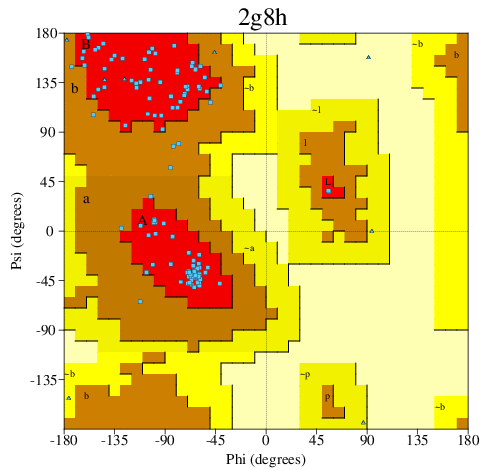
PDBsum entry 2g8h

|
|
|
|
|
|

|

|

|

|
|

|
|

|
|

|
|

|
|

|
|

|
|
|
 |

|

|
|
|
|
|
|
|
|
|
|
|
|
|
|
|
|
|
|
|
|
|
|
|
|
|
|
|
|
|
|
|
|
|
|
|
Hydrolase/RNA/DNA
|
PDB id
|
|
|
|
2g8h
|
|
|
|
|
|
|
|
|
|
|
|
|
|
|

|

|

|
|
|
|
|
|
|
|
 |
Contents |
 |
|
|
|
|
|
|
|
|
|
|
|
|
|
|
|
|
* Residue conservation analysis
|
|
|
|
|
|
|
|
|
|
|
Enzyme class:
|
|
E.C.3.1.26.4
- ribonuclease H.
|
|
|
|
|
|
|
Reaction:
|
|
Endonucleolytic cleavage to 5'-phosphomonoester.
|
|
|
|
|
|
|
|
|
|
|
|
|
|
|
|
|
|
 |
|
|
|
|
|
|
| |
|
DOI no:
|
EMBO J
25:1924-1933
(2006)
|
|
PubMed id:
|
|
|
|
|
|
| |
|
Stepwise analyses of metal ions in RNase H catalysis from substrate destabilization to product release.
|
|
M.Nowotny,
W.Yang.
|
|
|
|
|
| |
ABSTRACT
|
|
|
|
| |
|
|
In two-metal catalysis, metal ion A has been proposed to activate the
nucleophile and metal ion B to stabilize the transition state. We recently
reported crystal structures of RNase H-RNA/DNA substrate complexes obtained at
1.5-2.2 Angstroms. We have now determined and report here structures of reaction
intermediate and product complexes of RNase H at 1.65-1.85 Angstroms. The
movement of the two metal ions suggests how they may facilitate RNA hydrolysis
during the catalytic process. Firstly, metal ion A may assist nucleophilic
attack by moving towards metal ion B and bringing the nucleophile close to the
scissile phosphate. Secondly, metal ion B transforms from an irregular
coordination in the substrate complex to a more regular geometry in the product
complex. The exquisite sensitivity of Mg(2+) to the coordination environment
likely destabilizes the enzyme-substrate complex and reduces the energy barrier
to form product. Lastly, product release probably requires dissociation of metal
ion A, which is inhibited by either high concentrations of divalent cations or
mutation of an assisting protein residue.
|
|
|
|
|
|
| |
Selected figure(s)
|
|
|
|
| |
|
|

|
|

|
|
Figure 5.
Figure 5 Structure of the E188A Bh-RNase HC product complex. (A)
Stereo view of the active site superimposed with the 2F[o]-F[c]
map contoured at 0.9  .
The 5'-phosphate is shown as red and yellow ball-and-sticks,
Mg^2+ ions as purple spheres labeled with 'A' and 'B', and water
molecules as small red spheres. (B, C) Side-by-side comparison
of metal ion coordination in the substrate and product
complexes. The substrate complex (D192N, PDB: 1ZBL) is shown in
green with oxygen atoms in red and nitrogen atoms in blue, and
the product complex (E188A) is shown in orange. (D) Stereo view
of the superposition of substrate and product complexes. .
The 5'-phosphate is shown as red and yellow ball-and-sticks,
Mg^2+ ions as purple spheres labeled with 'A' and 'B', and water
molecules as small red spheres. (B, C) Side-by-side comparison
of metal ion coordination in the substrate and product
complexes. The substrate complex (D192N, PDB: 1ZBL) is shown in
green with oxygen atoms in red and nitrogen atoms in blue, and
the product complex (E188A) is shown in orange. (D) Stereo view
of the superposition of substrate and product complexes.
|
|
Figure 6.
Figure 6 Schematic representation of the reaction steps proposed
for RNase H. The substrate RNA is shown in pink and products in
purple. Coordination of metal ions is highlighted in dark blue,
and scissile phosphate in red. Selected hydrogen bonds are shown
as blue lines. Black circles represent water molecules. The
distance between the two metal ions is indicated in the
enzyme–substrate, enzyme–intermediate and enzyme–product
complexes.
|
|
|
|
|
|
| |
The above figures are
reprinted
by permission from Macmillan Publishers Ltd:
EMBO J
(2006,
25,
1924-1933)
copyright 2006.
|
|
| |
Figures were
selected
by an automated process.
|
|
|
|
|
|
|
|
|
|
|
|
|
|
|
|
 |
 |
 |
|
Literature references that cite this PDB file's key reference
|
|
|
| |
PubMed id
|
|
Reference
|
|
|
|
|
|
M.Ghosh-Kumar,
T.I.Alam,
B.Draper,
J.D.Stack,
and
V.B.Rao
(2011).
Regulation by interdomain communication of a headful packaging nuclease from bacteriophage T4.
|
| |
Nucleic Acids Res,
39,
2742-2755.
|
|
|
|
|
|
|
W.Yang
(2011).
Nucleases: diversity of structure, function and mechanism.
|
| |
Q Rev Biophys,
44,
1.
|
|
|
|
|
|
|
B.Elsässer,
and
G.Fels
(2010).
Atomistic details of the associative phosphodiester cleavage in human ribonuclease H.
|
| |
Phys Chem Chem Phys,
12,
11081-11088.
|
|
|
|
|
|
|
B.H.Schmidt,
A.B.Burgin,
J.E.Deweese,
N.Osheroff,
and
J.M.Berger
(2010).
A novel and unified two-metal mechanism for DNA cleavage by type II and IA topoisomerases.
|
| |
Nature,
465,
641-644.
|
|
|
PDB codes:
|
|
|
|
|
|
|
|
C.S.Adamson,
and
E.O.Freed
(2010).
Novel approaches to inhibiting HIV-1 replication.
|
| |
Antiviral Res,
85,
119-141.
|
|
|
|
|
|
|
E.Kanaya,
T.Sakabe,
N.T.Nguyen,
S.Koikeda,
Y.Koga,
K.Takano,
and
S.Kanaya
(2010).
Cloning of the RNase H genes from a metagenomic DNA library: identification of a new type 1 RNase H without a typical active-site motif.
|
| |
J Appl Microbiol,
109,
974-983.
|
|
|
|
|
|
|
H.P.Su,
Y.Yan,
G.S.Prasad,
R.F.Smith,
C.L.Daniels,
P.D.Abeywickrema,
J.C.Reid,
H.M.Loughran,
M.Kornienko,
S.Sharma,
J.A.Grobler,
B.Xu,
V.Sardana,
T.J.Allison,
P.D.Williams,
P.L.Darke,
D.J.Hazuda,
and
S.Munshi
(2010).
Structural basis for the inhibition of RNase H activity of HIV-1 reverse transcriptase by RNase H active site-directed inhibitors.
|
| |
J Virol,
84,
7625-7633.
|
|
|
PDB codes:
|
|
|
|
|
|
|
|
J.E.Deweese,
and
N.Osheroff
(2010).
The use of divalent metal ions by type II topoisomerases.
|
| |
Metallomics,
2,
450-459.
|
|
|
|
|
|
|
M.Nadal,
P.J.Mas,
P.J.Mas,
A.G.Blanco,
C.Arnan,
M.Solà,
D.J.Hart,
and
M.Coll
(2010).
Structure and inhibition of herpesvirus DNA packaging terminase nuclease domain.
|
| |
Proc Natl Acad Sci U S A,
107,
16078-16083.
|
|
|
PDB codes:
|
|
|
|
|
|
|
|
M.P.Rychlik,
H.Chon,
S.M.Cerritelli,
P.Klimek,
R.J.Crouch,
and
M.Nowotny
(2010).
Crystal structures of RNase H2 in complex with nucleic acid reveal the mechanism of RNA-DNA junction recognition and cleavage.
|
| |
Mol Cell,
40,
658-670.
|
|
|
PDB codes:
|
|
|
|
|
|
|
|
N.Jongruja,
D.J.You,
E.Kanaya,
Y.Koga,
K.Takano,
and
S.Kanaya
(2010).
The N-terminal hybrid binding domain of RNase HI from Thermotoga maritima is important for substrate binding and Mg2+-dependent activity.
|
| |
FEBS J,
277,
4474-4489.
|
|
|
|
|
|
|
E.Valkov,
S.S.Gupta,
S.Hare,
A.Helander,
P.Roversi,
M.McClure,
and
P.Cherepanov
(2009).
Functional and structural characterization of the integrase from the prototype foamy virus.
|
| |
Nucleic Acids Res,
37,
243-255.
|
|
|
PDB code:
|
|
|
|
|
|
|
|
F.Xie,
and
C.M.Dupureur
(2009).
Kinetic analysis of product release and metal ions in a metallonuclease.
|
| |
Arch Biochem Biophys,
483,
1-9.
|
|
|
|
|
|
|
G.A.Cisneros,
L.Perera,
R.M.Schaaper,
L.C.Pedersen,
R.E.London,
L.G.Pedersen,
and
T.A.Darden
(2009).
Reaction mechanism of the epsilon subunit of E. coli DNA polymerase III: insights into active site metal coordination and catalytically significant residues.
|
| |
J Am Chem Soc,
131,
1550-1556.
|
|
|
|
|
|
|
G.J.Grundy,
S.Ramón-Maiques,
E.K.Dimitriadis,
S.Kotova,
C.Biertümpfel,
J.B.Heymann,
A.C.Steven,
M.Gellert,
and
W.Yang
(2009).
Initial stages of V(D)J recombination: the organization of RAG1/2 and RSS DNA in the postcleavage complex.
|
| |
Mol Cell,
35,
217-227.
|
|
|
|
|
|
|
J.J.Champoux,
and
S.J.Schultz
(2009).
Ribonuclease H: properties, substrate specificity and roles in retroviral reverse transcription.
|
| |
FEBS J,
276,
1506-1516.
|
|
|
|
|
|
|
M.Jaskolski,
J.N.Alexandratos,
G.Bujacz,
and
A.Wlodawer
(2009).
Piecing together the structure of retroviral integrase, an important target in AIDS therapy.
|
| |
FEBS J,
276,
2926-2946.
|
|
|
|
|
|
|
M.Nowotny
(2009).
Retroviral integrase superfamily: the structural perspective.
|
| |
EMBO Rep,
10,
144-151.
|
|
|
|
|
|
|
N.D.Thomsen,
and
J.M.Berger
(2009).
Running in reverse: the structural basis for translocation polarity in hexameric helicases.
|
| |
Cell,
139,
523-534.
|
|
|
PDB code:
|
|
|
|
|
|
|
|
S.E.Butcher
(2009).
The spliceosome as ribozyme hypothesis takes a second step.
|
| |
Proc Natl Acad Sci U S A,
106,
12211-12212.
|
|
|
|
|
|
|
S.M.Cerritelli,
and
R.J.Crouch
(2009).
Ribonuclease H: the enzymes in eukaryotes.
|
| |
FEBS J,
276,
1494-1505.
|
|
|
|
|
|
|
T.Tadokoro,
and
S.Kanaya
(2009).
Ribonuclease H: molecular diversities, substrate binding domains, and catalytic mechanism of the prokaryotic enzymes.
|
| |
FEBS J,
276,
1482-1493.
|
|
|
|
|
|
|
C.Dash,
B.J.Scarth,
C.Badorrek,
M.Götte,
and
S.F.Le Grice
(2008).
Examining the ribonuclease H primer grip of HIV-1 reverse transcriptase by charge neutralization of RNA/DNA hybrids.
|
| |
Nucleic Acids Res,
36,
6363-6371.
|
|
|
|
|
|
|
J.Salon,
J.Jiang,
J.Sheng,
O.O.Gerlits,
and
Z.Huang
(2008).
Derivatization of DNAs with selenium at 6-position of guanine for function and crystal structure studies.
|
| |
Nucleic Acids Res,
36,
7009-7018.
|
|
|
|
|
|
|
M.De Vivo,
M.Dal Peraro,
and
M.L.Klein
(2008).
Phosphodiester cleavage in ribonuclease H occurs via an associative two-metal-aided catalytic mechanism.
|
| |
J Am Chem Soc,
130,
10955-10962.
|
|
|
|
|
|
|
M.L.Coté,
and
M.J.Roth
(2008).
Murine leukemia virus reverse transcriptase: structural comparison with HIV-1 reverse transcriptase.
|
| |
Virus Res,
134,
186-202.
|
|
|
|
|
|
|
M.Nowotny,
S.M.Cerritelli,
R.Ghirlando,
S.A.Gaidamakov,
R.J.Crouch,
and
W.Yang
(2008).
Specific recognition of RNA/DNA hybrid and enhancement of human RNase H1 activity by HBD.
|
| |
EMBO J,
27,
1172-1181.
|
|
|
PDB code:
|
|
|
|
|
|
|
|
S.J.Schultz,
and
J.J.Champoux
(2008).
RNase H activity: structure, specificity, and function in reverse transcription.
|
| |
Virus Res,
134,
86.
|
|
|
|
|
|
|
S.V.Lipchock,
and
S.A.Strobel
(2008).
A relaxed active site after exon ligation by the group I intron.
|
| |
Proc Natl Acad Sci U S A,
105,
5699-5704.
|
|
|
PDB codes:
|
|
|
|
|
|
|
|
U.D.Priyakumar,
and
A.D.Mackerell
(2008).
Atomic detail investigation of the structure and dynamics of DNA.RNA hybrids: a molecular dynamics study.
|
| |
J Phys Chem B,
112,
1515-1524.
|
|
|
|
|
|
|
V.Pena,
A.Rozov,
P.Fabrizio,
R.Lührmann,
and
M.C.Wahl
(2008).
Structure and function of an RNase H domain at the heart of the spliceosome.
|
| |
EMBO J,
27,
2929-2940.
|
|
|
PDB codes:
|
|
|
|
|
|
|
|
W.Yang
(2008).
An equivalent metal ion in one- and two-metal-ion catalysis.
|
| |
Nat Struct Mol Biol,
15,
1228-1231.
|
|
|
|
|
|
|
A.Savarino
(2007).
In-Silico docking of HIV-1 integrase inhibitors reveals a novel drug type acting on an enzyme/DNA reaction intermediate.
|
| |
Retrovirology,
4,
21.
|
|
|
|
|
|
|
C.R.Faehnle,
and
L.Joshua-Tor
(2007).
Argonautes confront new small RNAs.
|
| |
Curr Opin Chem Biol,
11,
569-577.
|
|
|
|
|
|
|
J.A.Worrall,
and
B.F.Luisi
(2007).
Information available at cut rates: structure and mechanism of ribonucleases.
|
| |
Curr Opin Struct Biol,
17,
128-137.
|
|
|
|
|
|
|
J.D.Ye,
C.D.Barth,
P.S.Anjaneyulu,
T.Tuschl,
and
J.A.Piccirilli
(2007).
Reactions of phosphate and phosphorothiolate diesters with nucleophiles: comparison of transition state structures.
|
| |
Org Biomol Chem,
5,
2491-2497.
|
|
|
|
|
|
|
L.Mones,
I.Simon,
and
M.Fuxreiter
(2007).
Metal-binding sites at the active site of restriction endonuclease BamHI can conform to a one-ion mechanism.
|
| |
Biol Chem,
388,
73-78.
|
|
|
|
|
|
|
M.Nowotny,
S.A.Gaidamakov,
R.Ghirlando,
S.M.Cerritelli,
R.J.Crouch,
and
W.Yang
(2007).
Structure of human RNase H1 complexed with an RNA/DNA hybrid: insight into HIV reverse transcription.
|
| |
Mol Cell,
28,
264-276.
|
|
|
PDB codes:
|
|
|
|
|
|
|
|
D.J.You,
H.Chon,
Y.Koga,
K.Takano,
and
S.Kanaya
(2006).
Crystallization and preliminary crystallographic analysis of type 1 RNase H from the hyperthermophilic archaeon Sulfolobus tokodaii 7.
|
| |
Acta Crystallogr Sect F Struct Biol Cryst Commun,
62,
781-784.
|
|
|
|
|
|
|
J.S.Parker,
and
D.Barford
(2006).
Argonaute: A scaffold for the function of short regulatory RNAs.
|
| |
Trends Biochem Sci,
31,
622-630.
|
|
|
|
|
|
|
T.L.Diamond,
and
F.D.Bushman
(2006).
Role of metal ions in catalysis by HIV integrase analyzed using a quantitative PCR disintegration assay.
|
| |
Nucleic Acids Res,
34,
6116-6125.
|
|
|
|
|
|
|
W.Yang,
J.Y.Lee,
and
M.Nowotny
(2006).
Making and breaking nucleic acids: two-Mg2+-ion catalysis and substrate specificity.
|
| |
Mol Cell,
22,
5.
|
|
|
|
|
|
The most recent references are shown first.
Citation data come partly from CiteXplore and partly
from an automated harvesting procedure. Note that this is likely to be
only a partial list as not all journals are covered by
either method. However, we are continually building up the citation data
so more and more references will be included with time.
Where a reference describes a PDB structure, the PDB
codes are
shown on the right.
|
|


 Links
Links