|
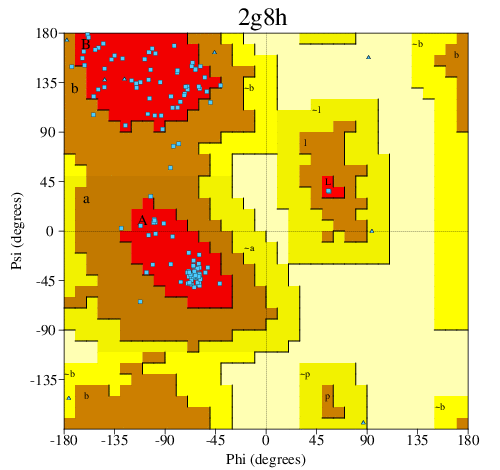
PDBsum entry 2g8h

|
|
|
|
|
|

|
|

|
|

|
|

|
|

|
|

|
|

|
|

|
|
|
 |

|

|
|
|
|
|
|
|
|
|
|
|
|
|
|
|
|
|
|
|
|
|
|
|
|
|
|
|
|
|
|
|
|
|
Hydrolase/RNA/DNA
|
PDB id
|
|
|
|
2g8h
|
|
|
|
|
|
|
|
|
|
|
|
|
|
|

|

|

|
|
|
|
|
|
References listed in PDB file
|
|
|
Key reference
|
|
|
Title
|
|
Stepwise analyses of metal ions in rnase h catalysis from substrate destabilization to product release.
|
|
|
Authors
|
|
M.Nowotny,
W.Yang.
|
|
|
Ref.
|
|
EMBO J, 2006,
25,
1924-1933.
[DOI no: ]
|
|
|
PubMed id
|
|
|
|
|
|
|
|
|
Abstract
|
|
|
In two-metal catalysis, metal ion A has been proposed to activate the
nucleophile and metal ion B to stabilize the transition state. We recently
reported crystal structures of RNase H-RNA/DNA substrate complexes obtained at
1.5-2.2 Angstroms. We have now determined and report here structures of reaction
intermediate and product complexes of RNase H at 1.65-1.85 Angstroms. The
movement of the two metal ions suggests how they may facilitate RNA hydrolysis
during the catalytic process. Firstly, metal ion A may assist nucleophilic
attack by moving towards metal ion B and bringing the nucleophile close to the
scissile phosphate. Secondly, metal ion B transforms from an irregular
coordination in the substrate complex to a more regular geometry in the product
complex. The exquisite sensitivity of Mg(2+) to the coordination environment
likely destabilizes the enzyme-substrate complex and reduces the energy barrier
to form product. Lastly, product release probably requires dissociation of metal
ion A, which is inhibited by either high concentrations of divalent cations or
mutation of an assisting protein residue.
|
|
|
|

|
|

|
|
Figure 5.
Figure 5 Structure of the E188A Bh-RNase HC product complex. (A)
Stereo view of the active site superimposed with the 2F[o]-F[c]
map contoured at 0.9  .
The 5'-phosphate is shown as red and yellow ball-and-sticks,
Mg^2+ ions as purple spheres labeled with 'A' and 'B', and water
molecules as small red spheres. (B, C) Side-by-side comparison
of metal ion coordination in the substrate and product
complexes. The substrate complex (D192N, PDB: 1ZBL) is shown in
green with oxygen atoms in red and nitrogen atoms in blue, and
the product complex (E188A) is shown in orange. (D) Stereo view
of the superposition of substrate and product complexes. .
The 5'-phosphate is shown as red and yellow ball-and-sticks,
Mg^2+ ions as purple spheres labeled with 'A' and 'B', and water
molecules as small red spheres. (B, C) Side-by-side comparison
of metal ion coordination in the substrate and product
complexes. The substrate complex (D192N, PDB: 1ZBL) is shown in
green with oxygen atoms in red and nitrogen atoms in blue, and
the product complex (E188A) is shown in orange. (D) Stereo view
of the superposition of substrate and product complexes.
|
|
Figure 6.
Figure 6 Schematic representation of the reaction steps proposed
for RNase H. The substrate RNA is shown in pink and products in
purple. Coordination of metal ions is highlighted in dark blue,
and scissile phosphate in red. Selected hydrogen bonds are shown
as blue lines. Black circles represent water molecules. The
distance between the two metal ions is indicated in the
enzyme–substrate, enzyme–intermediate and enzyme–product
complexes.
|
|
|
|
|
|
The above figures are
reprinted
by permission from Macmillan Publishers Ltd:
EMBO J
(2006,
25,
1924-1933)
copyright 2006.
|
|
|
|
|
|
|