 |
PDBsum entry 2faq

|
|
|
|
|
|

|

|

|

|
|

|
|

|
|

|
|

|
|

|
|

|
|

|
|
|
 |

|

|
|
|
|
|
|
|
|
|
|
|
|
|
|
|
|
|
|
|
|
|
|
|
|
|
|
|
|
|
|
|
|
|
|
|
|
Hydrolase/transferase
|
PDB id
|
|
|
|
2faq
|
|
|
|
|
|
|
|
|
|
|
|
|
|
|

|

|

|
|
|
|
|
|
|
|
 |
Contents |
 |
|
|
|
|
|
|
|
|
|
|
|
|
|
|
* Residue conservation analysis
|
|
|
|
|
|
PDB id:
|
|
|
|
| Name: |
|
Hydrolase/transferase
|
|
|
Title:
|
|
Crystal structure of pseudomonas aeruginosa ligd polymerase domain with atp and manganese
|
|
Structure:
|
|
Probable atp-dependent DNA ligase. Chain: a, b. Fragment: polymerase domain, residues 533-840. Engineered: yes
|
|
Source:
|
|
Pseudomonas aeruginosa. Organism_taxid: 287. Expressed in: escherichia coli. Expression_system_taxid: 562.
|
|
Resolution:
|
|
|
1.90Å
|
R-factor:
|
0.198
|
R-free:
|
0.226
|
|
|
Authors:
|
|
H.Zhu,J.Nandakumar,J.Aniukwu,L.K.Wang,M.S.Glickman,C.D.Lima,S.Shuman
|
Key ref:

|
|
H.Zhu
et al.
(2006).
Atomic structure and nonhomologous end-joining function of the polymerase component of bacterial DNA ligase D.
Proc Natl Acad Sci U S A,
103,
1711-1716.
PubMed id:
DOI:

|
|
|
Date:
|
|
|
07-Dec-05
|
Release date:
|
23-May-06
|
|
|
|
|
|
|
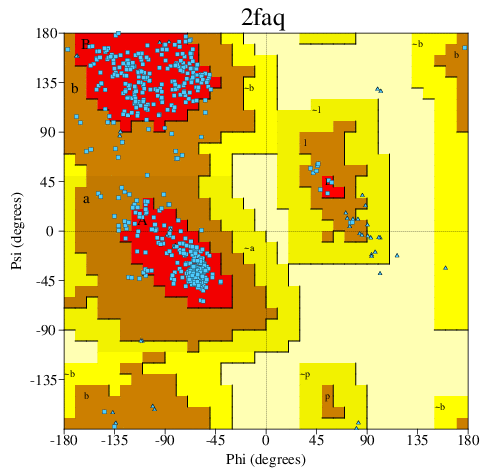
PROCHECK
|
|
|
|
|
|
Headers
|
|
|
|
References
|
|
|
|
|
|

|
|
Q9I1X7
(LIGD_PSEAE) -
Multifunctional non-homologous end joining protein LigD from Pseudomonas aeruginosa (strain ATCC 15692 / DSM 22644 / CIP 104116 / JCM 14847 / LMG 12228 / 1C / PRS 101 / PAO1)
|
|
|
|
Seq:
Struc:
|
|
|
|
840 a.a.
295 a.a.
|
|

|

|

|
|
|
|
|
|
|
|
|
|
|
Key: |
 |
PfamA domain |
|
|
 |
Secondary structure |
|
 |
CATH domain |
|
|
|
|
|
|
|
|
|
|
|
|
|
Enzyme class:
|
|
E.C.6.5.1.1
- Dna ligase (ATP).
|
|
|
|
|
|
|
Reaction:
|
|
ATP + (deoxyribonucleotide)n-3'-hydroxyl + 5'-phospho- (deoxyribonucleotide)m = (deoxyribonucleotide)n+m + AMP + diphosphate
|
|
|
|
|
|
ATP
Bound ligand (Het Group name = )
corresponds exactly
|
+
|
(deoxyribonucleotide)n-3'-hydroxyl
|
+
|
5'-phospho- (deoxyribonucleotide)m
|
=
|
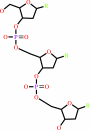 (deoxyribonucleotide)n+m
|
+
|
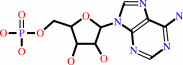 AMP
AMP
|
+
|
 diphosphate
|
|
|
|
|
|
|
|
|
|
|
|
|
Molecule diagrams generated from .mol files obtained from the
KEGG ftp site
|
|
|
|
|
|
|
|
|
|
|
|
|
|
 |
|
|
|
|
|
|
| |
|
|
| |
|
DOI no:
|
Proc Natl Acad Sci U S A
103:1711-1716
(2006)
|
|
PubMed id:
|
|
|
|
|
|
| |
|
Atomic structure and nonhomologous end-joining function of the polymerase component of bacterial DNA ligase D.
|
|
H.Zhu,
J.Nandakumar,
J.Aniukwu,
L.K.Wang,
M.S.Glickman,
C.D.Lima,
S.Shuman.
|
|
|
|
|
| |
ABSTRACT
|
|
|
|
| |
|
|
DNA ligase D (LigD) is a large polyfunctional protein that participates in a
recently discovered pathway of nonhomologous end-joining in bacteria. LigD
consists of an ATP-dependent ligase domain fused to a polymerase domain (Pol)
and a phosphoesterase module. The Pol activity is remarkable for its dependence
on manganese, its ability to perform templated and nontemplated primer extension
reactions, and its preference for adding ribonucleotides to blunt DNA ends. Here
we report the 1.5-A crystal structure of the Pol domain of Pseudomonas LigD and
its complexes with manganese and ATP/dATP substrates, which reveal a minimized
polymerase with a two-metal mechanism and a fold similar to that of archaeal DNA
primase. Mutational analysis highlights the functionally relevant atomic
contacts in the active site. Although distinct nucleoside conformations and
contacts for ATP versus dATP are observed in the cocrystals, the functional
analysis suggests that the ATP-binding mode is the productive conformation for
dNMP and rNMP incorporation. We find that a mutation of Mycobacterium LigD that
uniquely ablates the polymerase activity results in increased fidelity of
blunt-end double-strand break repair in vivo by virtue of eliminating nucleotide
insertions at the recombination junctions. Thus, LigD Pol is a direct catalyst
of mutagenic nonhomologous end-joining in vivo. Our studies underscore a
previously uncharacterized role for the primase-like polymerase family in DNA
repair.
|
|
|
|
|
|
| |
Selected figure(s)
|
|
|
|
| |
|
|

|
|

|
|
Figure 2.
Fig. 2. Structure of the LigD Pol domain. The overall fold
of the Pol domain of Pseudomonas LigD is depicted as a ribbon
diagram with  -helices colored
magenta and -helices colored
magenta and  -strands colored green.
The N and C termini are indicated. ATP is bound within a cleft
formed by two central -sheets; the cleft is
viewed from the side in A and from above in B. -strands colored green.
The N and C termini are indicated. ATP is bound within a cleft
formed by two central -sheets; the cleft is
viewed from the side in A and from above in B.
|
|
Figure 4.
Fig. 4. Active site of LigD Pol. Stereo views are shown of
the active site constituents of the apoenzyme (A), the Mn-ATP
cocrystal (B), and the Mn-dATP cocrystal (C). Potential
hydrogen-bonding interactions are denoted by dashed lines.
Manganese ions and waters are rendered as blue and red spheres,
respectively. Amino acids and sulfate (A), ATP (B), or dATP (C)
ligands are labeled and shown in stick representation.
|
|
|
|
| |
Figures were
selected
by an automated process.
|
|
|
|
|
|
|
|
|
|
|
|
|
|
|
|
 |
 |
 |
|
Literature references that cite this PDB file's key reference
|
|
|
| |
PubMed id
|
|
Reference
|
|
|
|
|
|
D.F.Warner,
and
V.Mizrahi
(2011).
Making ends meet in mycobacteria.
|
| |
Mol Microbiol,
79,
283-287.
|
|
|
|
|
|
|
P.Smith,
P.A.Nair,
U.Das,
H.Zhu,
and
S.Shuman
(2011).
Structures and activities of archaeal members of the LigD 3'-phosphoesterase DNA repair enzyme superfamily.
|
| |
Nucleic Acids Res,
39,
3310-3320.
|
|
|
PDB codes:
|
|
|
|
|
|
|
|
D.T.Kha,
G.Wang,
N.Natrajan,
L.Harrison,
and
K.M.Vasquez
(2010).
Pathways for double-strand break repair in genetically unstable Z-DNA-forming sequences.
|
| |
J Mol Biol,
398,
471-480.
|
|
|
|
|
|
|
H.Zhu,
and
S.Shuman
(2010).
Gap filling activities of Pseudomonas DNA ligase D (LigD) polymerase and functional interactions of LigD with the DNA end-binding Ku protein.
|
| |
J Biol Chem,
285,
4815-4825.
|
|
|
|
|
|
|
P.A.Nair,
P.Smith,
and
S.Shuman
(2010).
Structure of bacterial LigD 3'-phosphoesterase unveils a DNA repair superfamily.
|
| |
Proc Natl Acad Sci U S A,
107,
12822-12827.
|
|
|
PDB codes:
|
|
|
|
|
|
|
|
S.Geibel,
S.Banchenko,
M.Engel,
E.Lanka,
and
W.Saenger
(2009).
Structure and function of primase RepB' encoded by broad-host-range plasmid RSF1010 that replicates exclusively in leading-strand mode.
|
| |
Proc Natl Acad Sci U S A,
106,
7810-7815.
|
|
|
PDB codes:
|
|
|
|
|
|
|
|
H.Kobayashi,
L.A.Simmons,
D.S.Yuan,
W.J.Broughton,
and
G.C.Walker
(2008).
Multiple Ku orthologues mediate DNA non-homologous end-joining in the free-living form and during chronic infection of Sinorhizobium meliloti.
|
| |
Mol Microbiol,
67,
350-363.
|
|
|
|
|
|
|
H.Zhu,
and
S.Shuman
(2008).
Bacterial nonhomologous end joining ligases preferentially seal breaks with a 3'-OH monoribonucleotide.
|
| |
J Biol Chem,
283,
8331-8339.
|
|
|
|
|
|
|
J.Aniukwu,
M.S.Glickman,
and
S.Shuman
(2008).
The pathways and outcomes of mycobacterial NHEJ depend on the structure of the broken DNA ends.
|
| |
Genes Dev,
22,
512-527.
|
|
|
|
|
|
|
J.Gu,
and
M.R.Lieber
(2008).
Mechanistic flexibility as a conserved theme across 3 billion years of nonhomologous DNA end-joining.
|
| |
Genes Dev,
22,
411-415.
|
|
|
|
|
|
|
D.Liu,
J.Bischerour,
A.Siddique,
N.Buisine,
Y.Bigot,
and
R.Chalmers
(2007).
The human SETMAR protein preserves most of the activities of the ancestral Hsmar1 transposase.
|
| |
Mol Cell Biol,
27,
1125-1132.
|
|
|
|
|
|
|
H.Zhu,
and
S.Shuman
(2007).
Characterization of Agrobacterium tumefaciens DNA ligases C and D.
|
| |
Nucleic Acids Res,
35,
3631-3645.
|
|
|
|
|
|
|
N.C.Brissett,
R.S.Pitcher,
R.Juarez,
A.J.Picher,
A.J.Green,
T.R.Dafforn,
G.C.Fox,
L.Blanco,
and
A.J.Doherty
(2007).
Structure of a NHEJ polymerase-mediated DNA synaptic complex.
|
| |
Science,
318,
456-459.
|
|
|
PDB code:
|
|
|
|
|
|
|
|
N.C.Stephanou,
F.Gao,
P.Bongiorno,
S.Ehrt,
D.Schnappinger,
S.Shuman,
and
M.S.Glickman
(2007).
Mycobacterial nonhomologous end joining mediates mutagenic repair of chromosomal double-strand DNA breaks.
|
| |
J Bacteriol,
189,
5237-5246.
|
|
|
|
|
|
|
R.S.Pitcher,
N.C.Brissett,
and
A.J.Doherty
(2007).
Nonhomologous end-joining in bacteria: a microbial perspective.
|
| |
Annu Rev Microbiol,
61,
259-282.
|
|
|
|
|
|
|
S.Shuman,
and
M.S.Glickman
(2007).
Bacterial DNA repair by non-homologous end joining.
|
| |
Nat Rev Microbiol,
5,
852-861.
|
|
|
|
|
|
The most recent references are shown first.
Citation data come partly from CiteXplore and partly
from an automated harvesting procedure. Note that this is likely to be
only a partial list as not all journals are covered by
either method. However, we are continually building up the citation data
so more and more references will be included with time.
Where a reference describes a PDB structure, the PDB
codes are
shown on the right.
|
|


 Links
Links


