
|
|
|
|
|
 |
Contents |
 |
|
|
|
|
|
|
|
|
|
|
|

 476 a.a.
|
|
|
|
|
|
|
|
|
|
|

 522 a.a.
|
|
|
|
|
|
|
|
|
|
|

 289 a.a.
|
|
|
|
|
|
|
|
|
|
|
|
|
* Residue conservation analysis
|
|
|
|
|
|
PDB id:
|
|
|
|
| Name: |
|
Oxidoreductase
|
|
|
Title:
|
|
Crystal structure of nucleotide-free av2-av1 complex
|
|
Structure:
|
|
Nitrogenase molybdenum-iron protein. Chain: a, c. Synonym: nitrogenase component i, dinitrogenase. Other_details: alpha chain. Nitrogenase molybdenum-iron protein. Chain: b, d. Synonym: nitrogenase component i, dinitrogenase. Other_details: beta chain. Nitrogenase iron protein 1.
|
|
Source:
|
|
Azotobacter vinelandii. Organism_taxid: 354. Organism_taxid: 354
|
|
Biol. unit:
|
|
Hexamer (from
)
|
|
Resolution:
|
|
|
2.10Å
|
R-factor:
|
0.172
|
R-free:
|
0.221
|
|
|
Authors:
|
|
F.A.Tezcan,J.T.Kaiser,D.Mustafi,M.Y.Walton,J.B.Howard,D.C.Rees
|
Key ref:

|
|
F.A.Tezcan
et al.
(2005).
Nitrogenase complexes: multiple docking sites for a nucleotide switch protein.
Science,
309,
1377-1380.
PubMed id:
DOI:

|
|
|
Date:
|
|
|
25-Jul-05
|
Release date:
|
06-Sep-05
|
|
|
|
|
|
|
PROCHECK
|

|
|
|
|
|
Headers
|
|
|
|
References
|
|
|
|
|
|

|
|
P07328
(NIFD_AZOVI) -
Nitrogenase molybdenum-iron protein alpha chain from Azotobacter vinelandii
|
|
|
|
Seq:
Struc:
|
|
|
|
492 a.a.
476 a.a.
|
|

|

|

|
|
|
|
|
|
|
|
|
|
|
|
|
|
|
|
|
Enzyme class:
|
|
Chains A, B, C, D, E, F:
E.C.1.18.6.1
- nitrogenase.
|
|
|
|
|
|
|
Pathway:
|
|
Nitrogenase
|
|
|
|
|
|
Reaction:
|
|
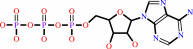
N2 + 8 reduced [2Fe-2S]-[ferredoxin] + 16 ATP + 16 H2O = H2 + 8 oxidized [2Fe-2S]-[ferredoxin] + 2 NH4+ + 16 ADP + 16 phosphate + 6 H+
|
|
|
|
|
|
 N2
N2
|
+
|
8
×
reduced [2Fe-2S]-[ferredoxin]
|
+
|
 16
×
ATP
16
×
ATP
|
+
|
16
×
H2O
|
=
|
H2
|
+
|
8
×
oxidized [2Fe-2S]-[ferredoxin]
|
+
|
2
×
NH4(+)
|
+
|
 16
×
ADP
16
×
ADP
|
+
|
 16
×
phosphate
16
×
phosphate
|
+
|
6
×
H(+)
|
|
|
|
|
|
|
|
|
|
Cofactor:
|
|
Iron-sulfur; Vanadium cation or Mo cation
|
|
|
|
|
|
 Iron-sulfur
|
Vanadium cation
|
or
|
Mo cation
|
|
|
|
|
|
|
Molecule diagrams generated from .mol files obtained from the
KEGG ftp site
|
|
|
|
|
|
|
|
|
|
|
|
|
|
 |
|
|
|
|
|
|
| |
|
|
| |
|
DOI no:
|
Science
309:1377-1380
(2005)
|
|
PubMed id:
|
|
|
|
|
|
| |
|
Nitrogenase complexes: multiple docking sites for a nucleotide switch protein.
|
|
F.A.Tezcan,
J.T.Kaiser,
D.Mustafi,
M.Y.Walton,
J.B.Howard,
D.C.Rees.
|
|
|
|
|
| |
ABSTRACT
|
|
|
|
| |
|
|
Adenosine triphosphate (ATP) hydrolysis in the nitrogenase complex controls the
cycle of association and dissociation between the electron donor adenosine
triphosphatase (ATPase) (Fe-protein) and its target catalytic protein
(MoFe-protein), driving the reduction of dinitrogen into ammonia. Crystal
structures in different nucleotide states have been determined that identify
conformational changes in the nitrogenase complex during ATP turnover. These
structures reveal distinct and mutually exclusive interaction sites on the
MoFe-protein surface that are selectively populated, depending on the Fe-protein
nucleotide state. A consequence of these different docking geometries is that
the distance between redox cofactors, a critical determinant of the
intermolecular electron transfer rate, is coupled to the nucleotide state. More
generally, stabilization of distinct docking geometries by different nucleotide
states, as seen for nitrogenase, could enable nucleotide hydrolysis to drive the
relative motion of protein partners in molecular motors and other systems.
|
|
|
|
|
|
| |
Selected figure(s)
|
|
|
|
| |
|
|

|
|

|
|
Figure 2.
Fig. 2. nf-, pcp-, adp-, and alf-[4Fe:4S]-cluster positions
relative to the P-cluster and FeMo-cofactor as viewed
perpendicular (A) and parallel (B) to the local two-fold axis
relating an  ß pair of
Av1 subunits. The approximate distances shown in the side-view
(A) are between the cluster centroids (see also Table 1). The
centroid distance between the P-cluster and the FeMo-cofactor is
19.3 Å. The corresponding edge-to-edge [4Fe:4S]-P-cluster
distances between the nearest pair of atoms in these structures
are ß pair of
Av1 subunits. The approximate distances shown in the side-view
(A) are between the cluster centroids (see also Table 1). The
centroid distance between the P-cluster and the FeMo-cofactor is
19.3 Å. The corresponding edge-to-edge [4Fe:4S]-P-cluster
distances between the nearest pair of atoms in these structures
are  5 Å shorter.
The outline of the Av1 surface is shown in coral. 5 Å shorter.
The outline of the Av1 surface is shown in coral.
|
|
Figure 3.
Fig. 3. Schematic representation of Av1-Av2 docking geometry at
different nucleotide states. The species representing the
pcp-conformer (dotted lines) is included in both cartoons to
illustrate the relative docking positions of Av2 molecules.
Taking a reference point near the "top" surface of Av2 (away
from the interface with Av1) that is positioned on the two-fold
axis at a distance of 35 Å from the [4Fe:4S] cluster of
each Av2 dimer (point A: pcp-Av2; point B: nf-Av2; point C,
adp-Av2), the displacement between pcp-Av2 and nf-Av2 is 19
Å, and that between pcp-Av2 and the four adp-conformers
ranges from 10 to 23 Å.
|
|
|
|
|
|
| |
The above figures are
reprinted
by permission from the AAAs:
Science
(2005,
309,
1377-1380)
copyright 2005.
|
|
| |
Figures were
selected
by an automated process.
|
|
|
|
|
|
|
|
|
|
|
|
|
|
|
|
 |
 |
 |
|
Literature references that cite this PDB file's key reference
|
|
|
| |
PubMed id
|
|
Reference
|
|
|
|
|
|
T.A.Clarke,
S.Fairhurst,
D.J.Lowe,
N.J.Watmough,
and
R.R.Eady
(2011).
Electron transfer and half-reactivity in nitrogenase.
|
| |
Biochem Soc Trans,
39,
201-206.
|
|
|
|
|
|
|
L.M.Lery,
M.Bitar,
M.G.Costa,
S.C.Rössle,
and
P.M.Bisch
(2010).
Unraveling the molecular mechanisms of nitrogenase conformational protection against oxygen in diazotrophic bacteria.
|
| |
BMC Genomics,
11,
S7.
|
|
|
|
|
|
|
Y.Hu,
and
M.W.Ribbe
(2010).
Decoding the nitrogenase mechanism: the homologue approach.
|
| |
Acc Chem Res,
43,
475-484.
|
|
|
|
|
|
|
D.Wätzlich,
M.J.Bröcker,
F.Uliczka,
M.Ribbe,
S.Virus,
D.Jahn,
and
J.Moser
(2009).
Chimeric nitrogenase-like enzymes of (bacterio)chlorophyll biosynthesis.
|
| |
J Biol Chem,
284,
15530-15540.
|
|
|
|
|
|
|
L.F.Huergo,
M.Merrick,
R.A.Monteiro,
L.S.Chubatsu,
M.B.Steffens,
F.O.Pedrosa,
and
E.M.Souza
(2009).
In vitro interactions between the PII proteins and the nitrogenase regulatory enzymes dinitrogenase reductase ADP-ribosyltransferase (DraT) and dinitrogenase reductase-activating glycohydrolase (DraG) in Azospirillum brasilense.
|
| |
J Biol Chem,
284,
6674-6682.
|
|
|
|
|
|
|
J.Petersen,
C.J.Mitchell,
K.Fisher,
and
D.J.Lowe
(2008).
Structural basis for VO(2+)-inhibition of nitrogenase activity: (B) pH-sensitive inner-sphere rearrangements in the 1H-environment of the metal coordination site of the nitrogenase Fe-protein identified by ENDOR spectroscopy.
|
| |
J Biol Inorg Chem,
13,
637-650.
|
|
|
|
|
|
|
J.Toepel,
E.Welsh,
T.C.Summerfield,
H.B.Pakrasi,
and
L.A.Sherman
(2008).
Differential transcriptional analysis of the cyanobacterium Cyanothece sp. strain ATCC 51142 during light-dark and continuous-light growth.
|
| |
J Bacteriol,
190,
3904-3913.
|
|
|
|
|
|
|
H.Sakurai,
and
H.Masukawa
(2007).
Promoting R & D in photobiological hydrogen production utilizing mariculture-raised cyanobacteria.
|
| |
Mar Biotechnol (NY),
9,
128-145.
|
|
|
|
|
|
|
J.Vela,
J.Cirera,
J.M.Smith,
R.J.Lachicotte,
C.J.Flaschenriem,
S.Alvarez,
and
P.L.Holland
(2007).
Quantitative geometric descriptions of the belt iron atoms of the iron-molybdenum cofactor of nitrogenase and synthetic iron(II) model complexes.
|
| |
Inorg Chem,
46,
60-71.
|
|
|
|
|
|
|
J.B.Howard,
and
D.C.Rees
(2006).
How many metals does it take to fix N2? A mechanistic overview of biological nitrogen fixation.
|
| |
Proc Natl Acad Sci U S A,
103,
17088-17093.
|
|
|
|
|
|
|
J.W.Peters,
and
R.K.Szilagyi
(2006).
Exploring new frontiers of nitrogenase structure and mechanism.
|
| |
Curr Opin Chem Biol,
10,
101-108.
|
|
|
|
|
|
|
K.A.Michie,
and
J.Löwe
(2006).
Dynamic filaments of the bacterial cytoskeleton.
|
| |
Annu Rev Biochem,
75,
467-492.
|
|
|
|
|
|
The most recent references are shown first.
Citation data come partly from CiteXplore and partly
from an automated harvesting procedure. Note that this is likely to be
only a partial list as not all journals are covered by
either method. However, we are continually building up the citation data
so more and more references will be included with time.
|
 |
|


 Links
Links


