
|
|
|
|
|
 |
Contents |
 |
|
|
|
|
|
|
|
|
|
|
|


 (+ 0 more)
245 a.a.
(+ 0 more)
245 a.a.
|
|
|
|
|
|
|
|
|
|
|

 11 a.a.
|
|
|
|
|
|
|
|
|
|
|

 13 a.a.
|
|
|
|
|
|
|
|
|
|
|
 12 a.a.
|
|
|
|
|
|
|
|
|
|
|
|
|
* Residue conservation analysis
|
|
|
|
|
|
PDB id:
|
|
|
|
| Name: |
|
Transferase
|
|
|
Title:
|
|
Crystal structure of pcna in complex with DNA polymerase kappa fragment
|
|
Structure:
|
|
Proliferating cell nuclear antigen. Chain: a, b, c, d, e, f. Synonym: pcna, cyclin. Engineered: yes. DNA polymerase kappa. Chain: u, v, w, x, y, z. Engineered: yes
|
|
Source:
|
|
Homo sapiens. Human. Organism_taxid: 9606. Gene: pcna. Expressed in: escherichia coli. Expression_system_taxid: 562. Synthetic: yes. Other_details: chemically synthesized peptide
|
|
Resolution:
|
|
|
2.50Å
|
R-factor:
|
0.229
|
R-free:
|
0.289
|
|
|
Authors:
|
|
A.Hishiki,H.Hashimoto,T.Hanafusa,K.Kamei,E.Ohashi,T.Shimizu,H.Ohmori, M.Sato
|
Key ref:

|
|
A.Hishiki
et al.
(2009).
Structural Basis for Novel Interactions between Human Translesion Synthesis Polymerases and Proliferating Cell Nuclear Antigen.
J Biol Chem,
284,
10552-10560.
PubMed id:
DOI:

|
|
|
Date:
|
|
|
11-Nov-08
|
Release date:
|
10-Feb-09
|
|
|
|
|
|
|
PROCHECK
|

|
|
|
|
|
Headers
|
|
|
|
References
|
|
|
|
|
|

|
|
P12004
(PCNA_HUMAN) -
Proliferating cell nuclear antigen from Homo sapiens
|
|
|
|
Seq:
Struc:
|
|
|
|
261 a.a.
245 a.a.
|
|

|

|
|
|
|
|
|
|
|
|
|
|
|
|

|
|
No UniProt id for this chain
|
|
|
|
|
|
|
|
|
|
|
|
|
|
|
|
|
|
|
|
|
Enzyme class:
|
|
Chains U, Z:
E.C.2.7.7.7
- DNA-directed Dna polymerase.
|
|
|
|
|
|
|
Reaction:
|
|
DNA(n) + a 2'-deoxyribonucleoside 5'-triphosphate = DNA(n+1) + diphosphate
|
|
|
|
|
|
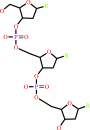 DNA(n)
|
+
|
2'-deoxyribonucleoside 5'-triphosphate
|
=
|
DNA(n+1)
|
+
|
 diphosphate
|
|
|
|
|
|
|
|
|
|
|
|
|
Molecule diagrams generated from .mol files obtained from the
KEGG ftp site
|
|
|
|
|
|
|
|
|
|
|
|
|
|
 |
|
|
|
|
|
|
| |
|
|
| |
|
DOI no:
|
J Biol Chem
284:10552-10560
(2009)
|
|
PubMed id:
|
|
|
|
|
|
| |
|
Structural Basis for Novel Interactions between Human Translesion Synthesis Polymerases and Proliferating Cell Nuclear Antigen.
|
|
A.Hishiki,
H.Hashimoto,
T.Hanafusa,
K.Kamei,
E.Ohashi,
T.Shimizu,
H.Ohmori,
M.Sato.
|
|
|
|
|
| |
ABSTRACT
|
|
|
|
| |
|
|
Translesion synthesis (TLS) is a DNA damage tolerance mechanism that allows
continued DNA synthesis, even in the presence of damaged DNA templates. Mammals
have multiple DNA polymerases specialized for TLS, including Poleta, Poliota,
and Polkappa. These enzymes show preferential bypass for different lesions.
Proliferating cell nuclear antigen (PCNA), which functions as a sliding clamp
for the replicative polymerase Poldelta, also interacts with the three TLS
polymerases. Although many PCNA-binding proteins have a highly conserved
sequence termed the PCNA-interacting protein box (PIP-box), Poleta, Poliota, and
Polkappa have a noncanonical PIP-box sequence. In response to DNA damage,
Lys-164 of PCNA undergoes ubiquitination by the RAD6-RAD18 complex, and the
ubiquitination is considered to facilitate TLS. Consistent with this, these
three TLS polymerases have one or two ubiquitin binding domains and are
recruited to replication forks via interactions with ubiquitinated PCNA
involving the noncanonical PIP-box and ubiquitin binding domain. However, it is
unclear how these TLS polymerases interact with PCNA. To address the structural
basis for interactions between different TLS polymerases and PCNA, we determined
crystal structures of PCNA bound to peptides containing the noncanonical PIP-box
of these polymerases. We show that the three PIP-box peptides interact with PCNA
in different ways, both from one another and from canonical PIP-box peptides.
Especially, the PIP-box of Poliota adopts a novel structure. Furthermore, these
structures enable us to speculate how these TLS polymerases interact with
Lys-164-monoubiquitinated PCNA. Our results will provide clues to understanding
the mechanism of preferential recruitment of TLS polymerases to the stalled
forks.
|
|
|
|
|
|
| |
Selected figure(s)
|
|
|
|
| |
|
|

|
|

|
|
Figure 3.
Hydrophobic plug-socket interaction of the Polη (A) or Polι
(B) peptide with PCNA and superimposition of PIP-box structures
bound to PCNA (C). A and B, PCNA is shown by a surface model,
and residues of PCNA that interact with the three-forked
hydrophobic plug are colored gray. PIP-box residues are shown by
stick models. Residues of PCNA that interact with the Met-701
(p1) residue of Polη in the Q-pocket are colored light pink. C,
structures of p21, Polη, Polκ, and Polι bound to PCNA are
shown in light blue, pink, green, and yellow, respectively.
PIP-box residues are shown by stick models, and only some
PIP-box residues of Polι are denoted.
|
|
Figure 5.
Proposed models of the interaction of
Lys-164-monoubiquitinated PCNA with Polη or Polκ (A) and Polι
(B). The ubiquitin moieties linked to Lys-164 are shown by
ellipsoids. N- and C-terminal sides of TLS polymerase fragments
are indicated by N and C, respectively.
|
|
|
|
|
|
| |
The above figures are
reprinted
by permission from the ASBMB:
J Biol Chem
(2009,
284,
10552-10560)
copyright 2009.
|
|
| |
Figures were
selected
by an automated process.
|
|
|
|
|
|
|
|
|
|
|
|
|
|
|
|
 |
 |
 |
|
Literature references that cite this PDB file's key reference
|
|
|
| |
PubMed id
|
|
Reference
|
|
|
|
|
|
A.A.Armstrong,
F.Mohideen,
and
C.D.Lima
(2012).
Recognition of SUMO-modified PCNA requires tandem receptor motifs in Srs2.
|
| |
Nature,
483,
59-63.
|
|
|
PDB codes:
|
|
|
|
|
|
|
|
A.Kawai,
H.Hashimoto,
S.Higuchi,
M.Tsunoda,
M.Sato,
K.T.Nakamura,
and
S.Miyamoto
(2011).
A novel heterotetrameric structure of the crenarchaeal PCNA2-PCNA3 complex.
|
| |
J Struct Biol,
174,
443-450.
|
|
|
PDB codes:
|
|
|
|
|
|
|
|
B.D.Freudenthal,
L.Gakhar,
S.Ramaswamy,
and
M.T.Washington
(2010).
Structure of monoubiquitinated PCNA and implications for translesion synthesis and DNA polymerase exchange.
|
| |
Nat Struct Mol Biol,
17,
479-484.
|
|
|
PDB codes:
|
|
|
|
|
|
|
|
J.D.Pata
(2010).
Structural diversity of the Y-family DNA polymerases.
|
| |
Biochim Biophys Acta,
1804,
1124-1135.
|
|
|
|
|
|
|
K.Hara,
H.Hashimoto,
Y.Murakumo,
S.Kobayashi,
T.Kogame,
S.Unzai,
S.Akashi,
S.Takeda,
T.Shimizu,
and
M.Sato
(2010).
Crystal structure of human REV7 in complex with a human REV3 fragment and structural implication of the interaction between DNA polymerase zeta and REV1.
|
| |
J Biol Chem,
285,
12299-12307.
|
|
|
PDB codes:
|
|
|
|
|
|
|
|
E.Morgunova,
F.C.Gray,
S.A.Macneill,
and
R.Ladenstein
(2009).
Structural insights into the adaptation of proliferating cell nuclear antigen (PCNA) from Haloferax volcanii to a high-salt environment.
|
| |
Acta Crystallogr D Biol Crystallogr,
65,
1081-1088.
|
|
|
PDB code:
|
|
|
|
|
|
|
|
T.Rolef Ben-Shahar,
A.G.Castillo,
M.J.Osborne,
K.L.Borden,
J.Kornblatt,
and
A.Verreault
(2009).
Two fundamentally distinct PCNA interaction peptides contribute to chromatin assembly factor 1 function.
|
| |
Mol Cell Biol,
29,
6353-6365.
|
|
|
|
|
|
The most recent references are shown first.
Citation data come partly from CiteXplore and partly
from an automated harvesting procedure. Note that this is likely to be
only a partial list as not all journals are covered by
either method. However, we are continually building up the citation data
so more and more references will be included with time.
Where a reference describes a PDB structure, the PDB
codes are
shown on the right.
|

| |


 Links
Links


