 |
PDBsum entry 2axd

|
|
|
|
|
 |
Contents |
 |
|
|
|
|
|
|
|
|
* Residue conservation analysis
|
|
|
|
|
|
|
|
|
|
|
Enzyme class:
|
|
E.C.2.7.7.7
- DNA-directed Dna polymerase.
|
|
|
|
|
|
|
Reaction:
|
|
DNA(n) + a 2'-deoxyribonucleoside 5'-triphosphate = DNA(n+1) + diphosphate
|
|
|
|
|
|
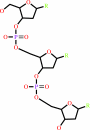 DNA(n)
|
+
|
2'-deoxyribonucleoside 5'-triphosphate
|
=
|
DNA(n+1)
|
+
|
 diphosphate
|
|
|
|
|
|
|
|
|
|
|
|
|
Molecule diagrams generated from .mol files obtained from the
KEGG ftp site
|
|
|
|
|
|
|
|
|
|
|
|
|
|
 |
|
|
|
|
|
|
| |
|
|
| |
|
|
J Bacteriol
188:4464-4473
(2006)
|
|
PubMed id:
|
|
|
|
|
|
| |
|
Structure of the theta subunit of Escherichia coli DNA polymerase III in complex with the epsilon subunit.
|
|
M.A.Keniry,
A.Y.Park,
E.A.Owen,
S.M.Hamdan,
G.Pintacuda,
G.Otting,
N.E.Dixon.
|
|
|
|
|
| |
ABSTRACT
|
|
|
|
| |
|
|
The catalytic core of Escherichia coli DNA polymerase III contains three tightly
associated subunits, the alpha, epsilon, and theta subunits. The theta subunit
is the smallest and least understood subunit. The three-dimensional structure of
theta in a complex with the unlabeled N-terminal domain of the epsilon subunit,
epsilon186, was determined by multidimensional nuclear magnetic resonance
spectroscopy. The structure was refined using pseudocontact shifts that resulted
from inserting a lanthanide ion (Dy3+, Er3+, or Ho3+) at the active site of
epsilon186. The structure determination revealed a three-helix bundle fold that
is similar to the solution structures of theta in a methanol-water buffer and of
the bacteriophage P1 homolog, HOT, in aqueous buffer. Conserved nuclear
Overhauser enhancement (NOE) patterns obtained for free and complexed theta show
that most of the structure changes little upon complex formation. Discrepancies
with respect to a previously published structure of free theta (Keniry et al.,
Protein Sci. 9:721-733, 2000) were attributed to errors in the latter structure.
The present structure satisfies the pseudocontact shifts better than either the
structure of theta in methanol-water buffer or the structure of HOT. satisfies
these shifts. The epitope of epsilon186 on theta was mapped by NOE difference
spectroscopy and was found to involve helix 1 and the C-terminal part of helix
3. The pseudocontact shifts indicated that the helices of theta are located
about 15 A or farther from the lanthanide ion in the active site of epsilon186,
in agreement with the extensive biochemical data for the theta-epsilon system.
|
|
|
|
|
|
|
|
|
|
|
|
|
|
|
|
|
|
 |
 |
 |
|
Literature references that cite this PDB file's key reference
|
|
|
| |
PubMed id
|
|
Reference
|
|
|
|
|
|
A.Y.Park,
and
C.V.Robinson
(2011).
Protein-nucleic acid complexes and the role of mass spectrometry in their structure determination.
|
| |
Crit Rev Biochem Mol Biol,
46,
152-164.
|
|
|
|
|
|
|
G.Otting
(2010).
Protein NMR using paramagnetic ions.
|
| |
Annu Rev Biophys,
39,
387-405.
|
|
|
|
|
|
|
J.Batra,
K.Xu,
S.Qin,
and
H.X.Zhou
(2009).
Effect of macromolecular crowding on protein binding stability: modest stabilization and significant biological consequences.
|
| |
Biophys J,
97,
906-911.
|
|
|
|
|
|
|
C.Schmitz,
M.J.Stanton-Cook,
X.C.Su,
G.Otting,
and
T.Huber
(2008).
Numbat: an interactive software tool for fitting Deltachi-tensors to molecular coordinates using pseudocontact shifts.
|
| |
J Biomol NMR,
41,
179-189.
|
|
|
|
|
|
|
K.Ozawa,
S.Jergic,
A.Y.Park,
N.E.Dixon,
and
G.Otting
(2008).
The proofreading exonuclease subunit epsilon of Escherichia coli DNA polymerase III is tethered to the polymerase subunit alpha via a flexible linker.
|
| |
Nucleic Acids Res,
36,
5074-5082.
|
|
|
|
|
|
|
M.John,
M.J.Headlam,
N.E.Dixon,
and
G.Otting
(2007).
Assignment of paramagnetic (15)N-HSQC spectra by heteronuclear exchange spectroscopy.
|
| |
J Biomol NMR,
37,
43-51.
|
|
|
|
|
|
|
T.W.Kirby,
S.Harvey,
E.F.DeRose,
S.Chalov,
A.K.Chikova,
F.W.Perrino,
R.M.Schaaper,
R.E.London,
and
L.C.Pedersen
(2006).
Structure of the Escherichia coli DNA polymerase III epsilon-HOT proofreading complex.
|
| |
J Biol Chem,
281,
38466-38471.
|
|
|
PDB code:
|
|
|
|
|
|
|
The most recent references are shown first.
Citation data come partly from CiteXplore and partly
from an automated harvesting procedure. Note that this is likely to be
only a partial list as not all journals are covered by
either method. However, we are continually building up the citation data
so more and more references will be included with time.
Where a reference describes a PDB structure, the PDB
code is
shown on the right.
|
|


 Links
Links


