|
|
|
|
|
 |
Contents |
 |
|
|
|
|
|
|
|
|
|
|
|
|
* Residue conservation analysis
|
|
|
|
|
|
|
|
|
|
Enzyme class:
|
|
Chains A, B:
E.C.2.4.1.255
- protein O-GlcNAc transferase.
|
|
|
|
|
|
|
Reaction:
|
|
|
1.
|
L-seryl-[protein] + UDP-N-acetyl-alpha-D-glucosamine = 3-O-(N-acetyl- beta-D-glucosaminyl)-L-seryl-[protein] + UDP + H+
|
|
2.
|
L-threonyl-[protein] + UDP-N-acetyl-alpha-D-glucosamine = 3-O- (N-acetyl-beta-D-glucosaminyl)-L-threonyl-[protein] + UDP + H+
|
|
|
|
|
|
|
L-seryl-[protein]
|
+
|
UDP-N-acetyl-alpha-D-glucosamine
|
=
|
3-O-(N-acetyl- beta-D-glucosaminyl)-L-seryl-[protein]
|
+
|
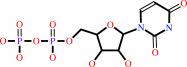 UDP
UDP
|
+
|
H(+)
|
|
|
|
|
|
|
L-threonyl-[protein]
|
+
|
UDP-N-acetyl-alpha-D-glucosamine
|
=
|
3-O- (N-acetyl-beta-D-glucosaminyl)-L-threonyl-[protein]
|
+
|
UDP
|
+
|
H(+)
|
|
|
|
|
|
|
|
|
|
|
|
|
Molecule diagrams generated from .mol files obtained from the
KEGG ftp site
|
|
|
|
|
|
|
|
|
|
|
|
|
|
 |
|
|
|
|
|
|
| |
|
|
| |
|
DOI no:
|
Nat Struct Mol Biol
11:1001-1007
(2004)
|
|
PubMed id:
|
|
|
|
|
|
| |
|
The superhelical TPR-repeat domain of O-linked GlcNAc transferase exhibits structural similarities to importin alpha.
|
|
M.Jínek,
J.Rehwinkel,
B.D.Lazarus,
E.Izaurralde,
J.A.Hanover,
E.Conti.
|
|
|
|
|
| |
ABSTRACT
|
|
|
|
| |
|
|
Addition of N-acetylglucosamine (GlcNAc) is a ubiquitous form of intracellular
glycosylation catalyzed by the conserved O-linked GlcNAc transferase (OGT). OGT
contains an N-terminal domain of tetratricopeptide (TPR) repeats that mediates
the recognition of a broad range of target proteins. Components of the nuclear
pore complex are major OGT targets, as OGT depletion by RNA interference (RNAi)
results in the loss of GlcNAc modification at the nuclear envelope. To gain
insight into the mechanism of target recognition, we solved the crystal
structure of the homodimeric TPR domain of human OGT, which contains 11.5 TPR
repeats. The repeats form an elongated superhelix. The concave surface of the
superhelix is lined by absolutely conserved asparagines, in a manner reminiscent
of the peptide-binding site of importin alpha. Based on this structural
similarity, we propose that OGT uses an analogous molecular mechanism to
recognize its targets.
|
|
|
|
|
|
| |
Selected figure(s)
|
|
|
|
| |
|
|

|
|

|
|
Figure 2.
Figure 2. Structure of the homodimeric TPR domain of human OGT.
The molecule is shown in two views related by a 90° rotation
about the pseudo two-fold axis. Chain 1 is yellow, chain 2 is
blue. Residues 320 -339 in chain 2 corresponding to TPR repeat
10 are disordered and are indicated with a dashed line. All
ribbon drawings were prepared using PyMOL (http://www.pymol.org).
|
|
Figure 5.
Figure 5. The inner surface of the TPR superhelix features a
ladder of asparagines. (a) Schematic of the inside face of
the superhelix, showing residues present at positions 6 (top
row) and 9 (bottom row) in the TPR repeats. Absolutely conserved
asparagines (Fig. 3a) are highlighted in red. TPR repeats 13 and
14, shaded in gray, are not present in the crystal structure.
(b) Stereo view of electron density around the conserved
asparagines of TPR repeats 3 and 4 in chain 2 with the final
model superimposed. The 2.85-Å electron density map is contoured
at 1.1  .
(c) Ribbon drawing of TPR repeats 2 -4 (helices A in yellow,
helices B in gray) with solvent-exposed residues highlighted.
The position in the TPR consensus sequence (Fig. 3a) of each
residue is indicated with circled numbers. .
(c) Ribbon drawing of TPR repeats 2 -4 (helices A in yellow,
helices B in gray) with solvent-exposed residues highlighted.
The position in the TPR consensus sequence (Fig. 3a) of each
residue is indicated with circled numbers.
|
|
|
|
|
|
| |
The above figures are
reprinted
by permission from Macmillan Publishers Ltd:
Nat Struct Mol Biol
(2004,
11,
1001-1007)
copyright 2004.
|
|
| |
Figures were
selected
by an automated process.
|
|
|
|
|
|
|
|
|
|
|
|
|
|
|
|
 |
 |
 |
|
Literature references that cite this PDB file's key reference
|
|
|
| |
PubMed id
|
|
Reference
|
|
|
|
|
|
C.Smet-Nocca,
M.Broncel,
J.M.Wieruszeski,
C.Tokarski,
X.Hanoulle,
A.Leroy,
I.Landrieu,
C.Rolando,
G.Lippens,
and
C.P.Hackenberger
(2011).
Identification of O-GlcNAc sites within peptides of the Tau protein and their impact on phosphorylation.
|
| |
Mol Biosyst,
7,
1420-1429.
|
|
|
|
|
|
|
F.Capotosti,
S.Guernier,
F.Lammers,
P.Waridel,
Y.Cai,
J.Jin,
J.W.Conaway,
R.C.Conaway,
and
W.Herr
(2011).
O-GlcNAc transferase catalyzes site-specific proteolysis of HCF-1.
|
| |
Cell,
144,
376-388.
|
|
|
|
|
|
|
I.H.Ryu,
and
S.I.Do
(2011).
Denitrosylation of S-nitrosylated OGT is triggered in LPS-stimulated innate immune response.
|
| |
Biochem Biophys Res Commun,
408,
52-57.
|
|
|
|
|
|
|
L.M.Gay,
X.Zheng,
and
D.M.van Aalten
(2011).
Molecular recognition: O-GlcNAc transfer: size matters.
|
| |
Nat Chem Biol,
7,
134-135.
|
|
|
|
|
|
|
M.B.Lazarus,
Y.Nam,
J.Jiang,
P.Sliz,
and
S.Walker
(2011).
Structure of human O-GlcNAc transferase and its complex with a peptide substrate.
|
| |
Nature,
469,
564-567.
|
|
|
PDB codes:
|
|
|
|
|
|
|
|
S.Daou,
N.Mashtalir,
I.Hammond-Martel,
H.Pak,
H.Yu,
G.Sui,
J.L.Vogel,
T.M.Kristie,
and
e.l. .B.Affar
(2011).
Crosstalk between O-GlcNAcylation and proteolytic cleavage regulates the host cell factor-1 maturation pathway.
|
| |
Proc Natl Acad Sci U S A,
108,
2747-2752.
|
|
|
|
|
|
|
A.L.Cortajarena,
J.Wang,
and
L.Regan
(2010).
Crystal structure of a designed tetratricopeptide repeat module in complex with its peptide ligand.
|
| |
FEBS J,
277,
1058-1066.
|
|
|
PDB code:
|
|
|
|
|
|
|
|
C.Butkinaree,
K.Park,
and
G.W.Hart
(2010).
O-linked beta-N-acetylglucosamine (O-GlcNAc): Extensive crosstalk with phosphorylation to regulate signaling and transcription in response to nutrients and stress.
|
| |
Biochim Biophys Acta,
1800,
96.
|
|
|
|
|
|
|
C.L.Keiski,
M.Harwich,
S.Jain,
A.M.Neculai,
P.Yip,
H.Robinson,
J.C.Whitney,
L.Riley,
L.L.Burrows,
D.E.Ohman,
and
P.L.Howell
(2010).
AlgK is a TPR-containing protein and the periplasmic component of a novel exopolysaccharide secretin.
|
| |
Structure,
18,
265-273.
|
|
|
PDB code:
|
|
|
|
|
|
|
|
J.A.Hanover,
M.W.Krause,
and
D.C.Love
(2010).
The hexosamine signaling pathway: O-GlcNAc cycling in feast or famine.
|
| |
Biochim Biophys Acta,
1800,
80-95.
|
|
|
|
|
|
|
J.Tao,
K.Petrova,
D.Ron,
and
B.Sha
(2010).
Crystal structure of P58(IPK) TPR fragment reveals the mechanism for its molecular chaperone activity in UPR.
|
| |
J Mol Biol,
397,
1307-1315.
|
|
|
PDB code:
|
|
|
|
|
|
|
|
K.J.Choi,
S.Grass,
S.Paek,
J.W.St Geme,
and
H.J.Yeo
(2010).
The Actinobacillus pleuropneumoniae HMW1C-like glycosyltransferase mediates N-linked glycosylation of the Haemophilus influenzae HMW1 adhesin.
|
| |
PLoS One,
5,
e15888.
|
|
|
|
|
|
|
T.M.Gloster,
and
D.J.Vocadlo
(2010).
Mechanism, Structure, and Inhibition of O-GlcNAc Processing Enzymes.
|
| |
Curr Signal Transduct Ther,
5,
74-91.
|
|
|
|
|
|
|
Z.Zhang,
K.Kulkarni,
S.J.Hanrahan,
A.J.Thompson,
and
D.Barford
(2010).
The APC/C subunit Cdc16/Cut9 is a contiguous tetratricopeptide repeat superhelix with a homo-dimer interface similar to Cdc27.
|
| |
EMBO J,
29,
3733-3744.
|
|
|
PDB code:
|
|
|
|
|
|
|
|
B.D.Lazarus,
D.C.Love,
and
J.A.Hanover
(2009).
O-GlcNAc cycling: implications for neurodegenerative disorders.
|
| |
Int J Biochem Cell Biol,
41,
2134-2146.
|
|
|
|
|
|
|
D.Han,
K.Kim,
Y.Kim,
Y.Kang,
J.Y.Lee,
and
Y.Kim
(2009).
Crystal structure of the N-terminal domain of anaphase-promoting complex subunit 7.
|
| |
J Biol Chem,
284,
15137-15146.
|
|
|
PDB code:
|
|
|
|
|
|
|
|
L.J.Terry,
and
S.R.Wente
(2009).
Flexible gates: dynamic topologies and functions for FG nucleoporins in nucleocytoplasmic transport.
|
| |
Eukaryot Cell,
8,
1814-1827.
|
|
|
|
|
|
|
V.V.Lima,
C.S.Rigsby,
D.M.Hardy,
R.C.Webb,
and
R.C.Tostes
(2009).
O-GlcNAcylation: a novel post-translational mechanism to alter vascular cellular signaling in health and disease: focus on hypertension.
|
| |
J Am Soc Hypertens,
3,
374-387.
|
|
|
|
|
|
|
A.Golks,
and
D.Guerini
(2008).
The O-linked N-acetylglucosamine modification in cellular signalling and the immune system. 'Protein modifications: beyond the usual suspects' review series.
|
| |
EMBO Rep,
9,
748-753.
|
|
|
|
|
|
|
A.J.Clarke,
R.Hurtado-Guerrero,
S.Pathak,
A.W.Schüttelkopf,
V.Borodkin,
S.M.Shepherd,
A.F.Ibrahim,
and
D.M.van Aalten
(2008).
Structural insights into mechanism and specificity of O-GlcNAc transferase.
|
| |
EMBO J,
27,
2780-2788.
|
|
|
PDB codes:
|
|
|
|
|
|
|
|
C.Martinez-Fleites,
M.S.Macauley,
Y.He,
D.L.Shen,
D.J.Vocadlo,
and
G.J.Davies
(2008).
Structure of an O-GlcNAc transferase homolog provides insight into intracellular glycosylation.
|
| |
Nat Struct Mol Biol,
15,
764-765.
|
|
|
PDB code:
|
|
|
|
|
|
|
|
C.Slawson,
T.Lakshmanan,
S.Knapp,
and
G.W.Hart
(2008).
A mitotic GlcNAcylation/phosphorylation signaling complex alters the posttranslational state of the cytoskeletal protein vimentin.
|
| |
Mol Biol Cell,
19,
4130-4140.
|
|
|
|
|
|
|
D.Han,
K.Kim,
J.Oh,
J.Park,
and
Y.Kim
(2008).
TPR domain of NrfG mediates complex formation between heme lyase and formate-dependent nitrite reductase in Escherichia coli O157:H7.
|
| |
Proteins,
70,
900-914.
|
|
|
PDB code:
|
|
|
|
|
|
|
|
J.E.Rexach,
P.M.Clark,
and
L.C.Hsieh-Wilson
(2008).
Chemical approaches to understanding O-GlcNAc glycosylation in the brain.
|
| |
Nat Chem Biol,
4,
97.
|
|
|
|
|
|
|
J.Koo,
S.Tammam,
S.Y.Ku,
L.M.Sampaleanu,
L.L.Burrows,
and
P.L.Howell
(2008).
PilF is an outer membrane lipoprotein required for multimerization and localization of the Pseudomonas aeruginosa Type IV pilus secretin.
|
| |
J Bacteriol,
190,
6961-6969.
|
|
|
PDB code:
|
|
|
|
|
|
|
|
J.W.Hammond,
K.Griffin,
G.T.Jih,
J.Stuckey,
and
K.J.Verhey
(2008).
Co-operative versus independent transport of different cargoes by Kinesin-1.
|
| |
Traffic,
9,
725-741.
|
|
|
|
|
|
|
M.Jinek,
A.Eulalio,
A.Lingel,
S.Helms,
E.Conti,
and
E.Izaurralde
(2008).
The C-terminal region of Ge-1 presents conserved structural features required for P-body localization.
|
| |
RNA,
14,
1991-1998.
|
|
|
PDB code:
|
|
|
|
|
|
|
|
M.Palaiomylitou,
A.Tartas,
D.Vlachakis,
D.Tzamarias,
and
M.Vlassi
(2008).
Investigating the structural stability of the Tup1-interaction domain of Ssn6: evidence for a conformational change on the complex.
|
| |
Proteins,
70,
72-82.
|
|
|
|
|
|
|
R.Hurtado-Guerrero,
H.C.Dorfmueller,
and
D.M.van Aalten
(2008).
Molecular mechanisms of O-GlcNAcylation.
|
| |
Curr Opin Struct Biol,
18,
551-557.
|
|
|
|
|
|
|
S.A.Whelan,
M.D.Lane,
and
G.W.Hart
(2008).
Regulation of the O-linked beta-N-acetylglucosamine transferase by insulin signaling.
|
| |
J Biol Chem,
283,
21411-21417.
|
|
|
|
|
|
|
W.D.Cheung,
K.Sakabe,
M.P.Housley,
W.B.Dias,
and
G.W.Hart
(2008).
O-Linked {beta}-N-Acetylglucosaminyltransferase Substrate Specificity Is Regulated by Myosin Phosphatase Targeting and Other Interacting Proteins.
|
| |
J Biol Chem,
283,
33935-33941.
|
|
|
|
|
|
|
Y.Itoh,
J.D.Rice,
C.Goller,
A.Pannuri,
J.Taylor,
J.Meisner,
T.J.Beveridge,
J.F.Preston,
and
T.Romeo
(2008).
Roles of pgaABCD genes in synthesis, modification, and export of the Escherichia coli biofilm adhesin poly-beta-1,6-N-acetyl-D-glucosamine.
|
| |
J Bacteriol,
190,
3670-3680.
|
|
|
|
|
|
|
N.Declerck,
L.Bouillaut,
D.Chaix,
N.Rugani,
L.Slamti,
F.Hoh,
D.Lereclus,
and
S.T.Arold
(2007).
Structure of PlcR: Insights into virulence regulation and evolution of quorum sensing in Gram-positive bacteria.
|
| |
Proc Natl Acad Sci U S A,
104,
18490-18495.
|
|
|
PDB code:
|
|
|
|
|
|
|
|
W.B.Dias,
and
G.W.Hart
(2007).
O-GlcNAc modification in diabetes and Alzheimer's disease.
|
| |
Mol Biosyst,
3,
766-772.
|
|
|
|
|
|
|
Y.Bai,
T.C.Auperin,
C.Y.Chou,
G.G.Chang,
J.L.Manley,
and
L.Tong
(2007).
Crystal structure of murine CstF-77: dimeric association and implications for polyadenylation of mRNA precursors.
|
| |
Mol Cell,
25,
863-875.
|
|
|
PDB codes:
|
|
|
|
|
|
|
|
A.J.Perry,
J.M.Hulett,
V.A.Likić,
T.Lithgow,
and
P.R.Gooley
(2006).
Convergent evolution of receptors for protein import into mitochondria.
|
| |
Curr Biol,
16,
221-229.
|
|
|
PDB code:
|
|
|
|
|
|
|
|
C.Slawson,
M.P.Housley,
and
G.W.Hart
(2006).
O-GlcNAc cycling: how a single sugar post-translational modification is changing the way we think about signaling networks.
|
| |
J Cell Biochem,
97,
71-83.
|
|
|
|
|
|
|
G.Jékely,
and
D.Arendt
(2006).
Evolution of intraflagellar transport from coated vesicles and autogenous origin of the eukaryotic cilium.
|
| |
Bioessays,
28,
191-198.
|
|
|
|
|
|
|
J.E.Kudlow
(2006).
Post-translational modification by O-GlcNAc: another way to change protein function.
|
| |
J Cell Biochem,
98,
1062-1075.
|
|
|
|
|
|
|
P.März,
J.Stetefeld,
K.Bendfeldt,
C.Nitsch,
J.Reinstein,
R.L.Shoeman,
B.Dimitriades-Schmutz,
M.Schwager,
D.Leiser,
S.Ozcan,
U.Otten,
and
S.Ozbek
(2006).
Ataxin-10 interacts with O-linked beta-N-acetylglucosamine transferase in the brain.
|
| |
J Biol Chem,
281,
20263-20270.
|
|
|
|
|
|
|
R.J.Dennis,
E.J.Taylor,
M.S.Macauley,
K.A.Stubbs,
J.P.Turkenburg,
S.J.Hart,
G.N.Black,
D.J.Vocadlo,
and
G.J.Davies
(2006).
Structure and mechanism of a bacterial beta-glucosaminidase having O-GlcNAcase activity.
|
| |
Nat Struct Mol Biol,
13,
365-371.
|
|
|
PDB codes:
|
|
|
|
|
|
|
|
S.Schornack,
A.Meyer,
P.Römer,
T.Jordan,
and
T.Lahaye
(2006).
Gene-for-gene-mediated recognition of nuclear-targeted AvrBs3-like bacterial effector proteins.
|
| |
J Plant Physiol,
163,
256-272.
|
|
|
|
|
|
|
Y.Wu,
and
B.Sha
(2006).
Crystal structure of yeast mitochondrial outer membrane translocon member Tom70p.
|
| |
Nat Struct Mol Biol,
13,
589-593.
|
|
|
PDB code:
|
|
|
|
|
|
|
|
A.Krupa,
and
N.Srinivasan
(2005).
Diversity in domain architectures of Ser/Thr kinases and their homologues in prokaryotes.
|
| |
BMC Genomics,
6,
129.
|
|
|
|
|
|
|
B.D.Lazarus,
M.D.Roos,
and
J.A.Hanover
(2005).
Mutational analysis of the catalytic domain of O-linked N-acetylglucosaminyl transferase.
|
| |
J Biol Chem,
280,
35537-35544.
|
|
|
|
|
|
|
J.A.Hanover,
M.E.Forsythe,
P.T.Hennessey,
T.M.Brodigan,
D.C.Love,
G.Ashwell,
and
M.Krause
(2005).
A Caenorhabditis elegans model of insulin resistance: altered macronutrient storage and dauer formation in an OGT-1 knockout.
|
| |
Proc Natl Acad Sci U S A,
102,
11266-11271.
|
|
|
|
|
|
|
J.Kim,
S.Sitaraman,
A.Hierro,
B.M.Beach,
G.Odorizzi,
and
J.H.Hurley
(2005).
Structural basis for endosomal targeting by the Bro1 domain.
|
| |
Dev Cell,
8,
937-947.
|
|
|
PDB code:
|
|
|
|
|
|
|
|
J.Yang,
S.M.Roe,
M.J.Cliff,
M.A.Williams,
J.E.Ladbury,
P.T.Cohen,
and
D.Barford
(2005).
Molecular basis for TPR domain-mediated regulation of protein phosphatase 5.
|
| |
EMBO J,
24,
1.
|
|
|
PDB code:
|
|
|
|
|
|
|
|
L.A.Passmore,
C.R.Booth,
C.Vénien-Bryan,
S.J.Ludtke,
C.Fioretto,
L.N.Johnson,
W.Chiu,
and
D.Barford
(2005).
Structural analysis of the anaphase-promoting complex reveals multiple active sites and insights into polyubiquitylation.
|
| |
Mol Cell,
20,
855-866.
|
|
|
|
|
|
The most recent references are shown first.
Citation data come partly from CiteXplore and partly
from an automated harvesting procedure. Note that this is likely to be
only a partial list as not all journals are covered by
either method. However, we are continually building up the citation data
so more and more references will be included with time.
Where a reference describes a PDB structure, the PDB
codes are
shown on the right.
|
 |


 Links
Links