
|
|
|
|
|
 |
Contents |
 |
|
|
|
|
|
|
|
|
|
|
|

 308 a.a.
|
|
|
|
|
|
|
|
|
|
|
 321 a.a.
|
|
|
|
|
|
|
|
|
|
|
 278 a.a.
|
|
|
|
|
|
|
|
|
|
|
* Residue conservation analysis
|
|
|
|
|
|
PDB id:
|
|
|
|
| Name: |
|
Protein binding
|
|
|
Title:
|
|
Crystal structure of the core fh2 domain of mouse mdia1
|
|
Structure:
|
|
Diaphanous protein homolog 1. Chain: a, b, c, d. Fragment: core fh2 domain. Synonym: diaphanous-related formin 1, drf1, mdia1, p140mdia. Engineered: yes
|
|
Source:
|
|
Mus musculus. House mouse. Organism_taxid: 10090. Expressed in: escherichia coli. Expression_system_taxid: 562.
|
|
Biol. unit:
|
|
Tetramer (from
)
|
|
Resolution:
|
|
|
2.60Å
|
R-factor:
|
0.236
|
R-free:
|
0.267
|
|
|
Authors:
|
|
A.Shimada,M.Nyitrai,I.R.Vetter,D.Kuhlmann,B.Bugyi,S.Narumiya, M.A.Geeves,A.Wittinghofer
|
Key ref:

|
|
A.Shimada
et al.
(2004).
The core FH2 domain of diaphanous-related formins is an elongated actin binding protein that inhibits polymerization.
Mol Cell,
13,
511-522.
PubMed id:
DOI:

|
|
|
Date:
|
|
|
24-Jan-04
|
Release date:
|
09-Mar-04
|
|
|
|
|
|
|
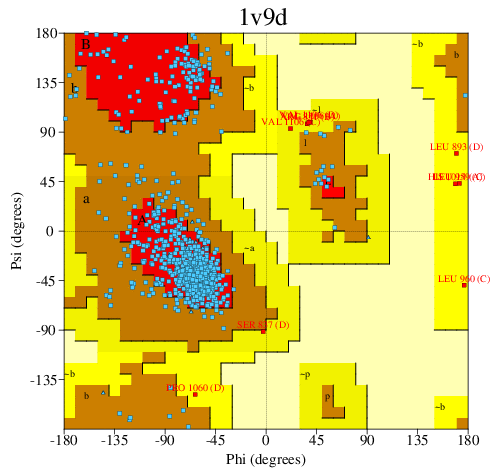
PROCHECK
|
|
|
|
|
|
Headers
|
|
|
|
References
|
|
|
|
|
|

|
|
O08808
(DIAP1_MOUSE) -
Protein diaphanous homolog 1 from Mus musculus
|
|
|
|
Seq:
Struc:
|
|
|
|
1255 a.a.
308 a.a.
|
|

|

|
|
|
|
|
|
|
|
|
|
|
|
|
|
|
|
|
|
|
|
|
|
 |
|
|
|
|
|
|
| |
|
DOI no:
|
Mol Cell
13:511-522
(2004)
|
|
PubMed id:
|
|
|
|
|
|
| |
|
The core FH2 domain of diaphanous-related formins is an elongated actin binding protein that inhibits polymerization.
|
|
A.Shimada,
M.Nyitrai,
I.R.Vetter,
D.Kühlmann,
B.Bugyi,
S.Narumiya,
M.A.Geeves,
A.Wittinghofer.
|
|
|
|
|
| |
ABSTRACT
|
|
|
|
| |
|
|
Diaphanous-related formins (Drf) are activated by Rho GTP binding proteins and
induce polymerization of unbranched actin filaments. They contain three formin
homology domains. Evidence as to the effect of formins on actin polymerization
were obtained using FH2/FH1 constructs of various length from different Drfs.
Here we define the core FH2 domain as a proteolytically stable domain of
approximately 338 residues. The monomeric FH2 domains from mDia1 and mDia3
inhibit polymerization of actin and can bind in a 1:1 complex with F-actin at
micromolar concentrations. The X-ray structure analysis of the domain shows an
elongated, crescent-shaped molecule consisting of three helical subdomains. The
most highly conserved regions of the domain span a distance of 75 A and are both
required for barbed-end inhibition. A construct containing an additional 72
residue linker has dramatically different properties: It oligomerizes and
induces actin polymerization at subnanomolar concentration.
|
|
|
|
|
|
| |
Selected figure(s)
|
|
|
|
| |
|
|

|
|

|
|
Figure 3.
Figure 3. X-Ray Structure Solution of the Core FH2 Domain
from mDia1(A) Stereo view of the asymmetric unit. Molecules A,
B, C, and D of the asymmetric unit are colored red, green, blue,
and yellow, respectively, with NH[2] and COOH termini labeled
correspondingly.(B) A representative stereo electron density
map. An 2F[o] − F[c] electron density map, contoured at 1.2σ,
of the interface between α13 and surrounding helices α9 and
3^10. The residues involved in the interaction are labeled.
|
|
Figure 4.
Figure 4. Structural Analysis of the mDia1 Core FH2
Domain(A) Ribbon diagram of the core FH2 domain. The
NH[2]-terminal, three-helix-bundle, and FH2 motif subdomains are
colored red, blue, and green, respectively. The region
corresponding to the highly conserved ^967GNXMN^971 motif is
colored purple. The NH[2] and COOH termini of the molecule are
indicated by N and C, respectively. Secondary structures are
numbered consecutively. Ile845, Met970, Lys989, Lys994, Lys999,
Arg919, and Asp1067 are shown as ball-and-stick
representation. Distance between Ile845 and Met970 and
approximate locations of the FH1 domain, linker, and DAD in
mDia1 are indicated.(B) A buried salt bridge. A salt bridge
between Arg919 and Asp1067 is shown as ball-and-stick
representation together with surrounding hydrophobic residues,
as indicated.(C) Superimposition of the four molecules in the
asymmetric unit. Molecules A, B, C, and D, colored in red,
green, blue, and yellow, respectively, were superimposed on the
three-helix-bundle subdomains, and are oriented as in (A). Note
that the FH2 subdomain exhibited the highest conformational
differences.(D) Conserved residues. Surface representation of
the mDia1-FH2 core domain with residues conserved in the six
formin family proteins colored orange and those conserved in
five of six colored yellow. Residues mentioned in the text are
indicated. Left and right: orientation as in Figure 3B and
rotated 180°, respectively.
|
|
|
|
|
|
| |
The above figures are
reprinted
by permission from Cell Press:
Mol Cell
(2004,
13,
511-522)
copyright 2004.
|
|
| |
Figures were
selected
by an automated process.
|
|
|
|
|
|
|
|
|
|
|
|
|
|
|
|
 |
 |
 |
|
Literature references that cite this PDB file's key reference
|
|
|
| |
PubMed id
|
|
Reference
|
|
|
|
|
|
M.E.Thompson,
E.G.Heimsath,
T.J.Gauvin,
H.N.Higgs,
and
F.J.Kull
(2013).
FMNL3 FH2-actin structure gives insight into formin-mediated actin nucleation and elongation.
|
| |
Nat Struct Mol Biol,
20,
111-118.
|
|
|
PDB code:
|
|
|
|
|
|
|
|
A.Nezami,
F.Poy,
A.Toms,
W.Zheng,
and
M.J.Eck
(2010).
Crystal structure of a complex between amino and carboxy terminal fragments of mDia1: insights into autoinhibition of diaphanous-related formins.
|
| |
PLoS One,
5,
0.
|
|
|
PDB code:
|
|
|
|
|
|
|
|
H.G.Mannherz,
A.J.Mazur,
and
B.Jockusch
(2010).
Repolymerization of actin from actin:thymosin beta4 complex induced by diaphanous related formins and gelsolin.
|
| |
Ann N Y Acad Sci,
1194,
36-43.
|
|
|
|
|
|
|
K.G.Campellone,
and
M.D.Welch
(2010).
A nucleator arms race: cellular control of actin assembly.
|
| |
Nat Rev Mol Cell Biol,
11,
237-251.
|
|
|
|
|
|
|
S.Barkó,
B.Bugyi,
M.F.Carlier,
R.Gombos,
T.Matusek,
J.Mihály,
and
M.Nyitrai
(2010).
Characterization of the biochemical properties and biological function of the formin homology domains of Drosophila DAAM.
|
| |
J Biol Chem,
285,
13154-13169.
|
|
|
|
|
|
|
T.Iskratsch,
S.Lange,
J.Dwyer,
A.L.Kho,
C.dos Remedios,
and
E.Ehler
(2010).
Formin follows function: a muscle-specific isoform of FHOD3 is regulated by CK2 phosphorylation and promotes myofibril maintenance.
|
| |
J Cell Biol,
191,
1159-1172.
|
|
|
|
|
|
|
T.Otomo,
D.R.Tomchick,
C.Otomo,
M.Machius,
and
M.K.Rosen
(2010).
Crystal structure of the Formin mDia1 in autoinhibited conformation.
|
| |
PLoS One,
5,
0.
|
|
|
PDB code:
|
|
|
|
|
|
|
|
Z.Ujfalusi,
S.Barkó,
G.Hild,
and
M.Nyitrai
(2010).
The effects of formins on the conformation of subdomain 1 in actin filaments.
|
| |
J Photochem Photobiol B,
98,
7.
|
|
|
|
|
|
|
A.S.Paul,
and
T.D.Pollard
(2009).
Energetic Requirements for Processive Elongation of Actin Filaments by FH1FH2-formins.
|
| |
J Biol Chem,
284,
12533-12540.
|
|
|
|
|
|
|
T.Kupi,
P.Gróf,
M.Nyitrai,
and
J.Belágyi
(2009).
The uncoupling of the effects of formins on the local and global dynamics of actin filaments.
|
| |
Biophys J,
96,
2901-2911.
|
|
|
|
|
|
|
Z.Ujfalusi,
A.Vig,
G.Hild,
and
M.Nyitrai
(2009).
Effect of tropomyosin on formin-bound actin filaments.
|
| |
Biophys J,
96,
162-168.
|
|
|
|
|
|
|
A.Schulte,
B.Stolp,
A.Schönichen,
O.Pylypenko,
A.Rak,
O.T.Fackler,
and
M.Geyer
(2008).
The human formin FHOD1 contains a bipartite structure of FH3 and GTPase-binding domains required for activation.
|
| |
Structure,
16,
1313-1323.
|
|
|
PDB code:
|
|
|
|
|
|
|
|
D.Chalkia,
N.Nikolaidis,
W.Makalowski,
J.Klein,
and
M.Nei
(2008).
Origins and evolution of the formin multigene family that is involved in the formation of actin filaments.
|
| |
Mol Biol Evol,
25,
2717-2733.
|
|
|
|
|
|
|
F.Bartolini,
J.B.Moseley,
J.Schmoranzer,
L.Cassimeris,
B.L.Goode,
and
G.G.Gundersen
(2008).
The formin mDia2 stabilizes microtubules independently of its actin nucleation activity.
|
| |
J Cell Biol,
181,
523-536.
|
|
|
|
|
|
|
M.Dettenhofer,
F.Zhou,
and
P.Leder
(2008).
Formin 1-isoform IV deficient cells exhibit defects in cell spreading and focal adhesion formation.
|
| |
PLoS ONE,
3,
e2497.
|
|
|
|
|
|
|
M.Lammers,
S.Meyer,
D.Kühlmann,
and
A.Wittinghofer
(2008).
Specificity of Interactions between mDia Isoforms and Rho Proteins.
|
| |
J Biol Chem,
283,
35236-35246.
|
|
|
PDB code:
|
|
|
|
|
|
|
|
S.L.Lai,
T.H.Chan,
M.J.Lin,
W.P.Huang,
S.W.Lou,
and
S.J.Lee
(2008).
Diaphanous-related formin 2 and profilin I are required for gastrulation cell movements.
|
| |
PLoS ONE,
3,
e3439.
|
|
|
|
|
|
|
A.Dorfmann,
B.A.Trimmer,
and
W.A.Woods
(2007).
A constitutive model for muscle properties in a soft-bodied arthropod.
|
| |
J R Soc Interface,
4,
257-269.
|
|
|
|
|
|
|
B.L.Goode,
and
M.J.Eck
(2007).
Mechanism and function of formins in the control of actin assembly.
|
| |
Annu Rev Biochem,
76,
593-627.
|
|
|
|
|
|
|
J.Lu,
W.Meng,
F.Poy,
S.Maiti,
B.L.Goode,
and
M.J.Eck
(2007).
Structure of the FH2 domain of Daam1: implications for formin regulation of actin assembly.
|
| |
J Mol Biol,
369,
1258-1269.
|
|
|
PDB code:
|
|
|
|
|
|
|
|
M.Yamashita,
T.Higashi,
S.Suetsugu,
Y.Sato,
T.Ikeda,
R.Shirakawa,
T.Kita,
T.Takenawa,
H.Horiuchi,
S.Fukai,
and
O.Nureki
(2007).
Crystal structure of human DAAM1 formin homology 2 domain.
|
| |
Genes Cells,
12,
1255-1265.
|
|
|
PDB code:
|
|
|
|
|
|
|
|
S.Romero,
D.Didry,
E.Larquet,
N.Boisset,
D.Pantaloni,
and
M.F.Carlier
(2007).
How ATP hydrolysis controls filament assembly from profilin-actin: implication for formin processivity.
|
| |
J Biol Chem,
282,
8435-8445.
|
|
|
|
|
|
|
T.M.Kitzing,
A.S.Sahadevan,
D.T.Brandt,
H.Knieling,
S.Hannemann,
O.T.Fackler,
J.Grosshans,
and
R.Grosse
(2007).
Positive feedback between Dia1, LARG, and RhoA regulates cell morphology and invasion.
|
| |
Genes Dev,
21,
1478-1483.
|
|
|
|
|
|
|
A.Schönichen,
M.Alexander,
J.E.Gasteier,
F.E.Cuesta,
O.T.Fackler,
and
M.Geyer
(2006).
Biochemical characterization of the diaphanous autoregulatory interaction in the formin homology protein FHOD1.
|
| |
J Biol Chem,
281,
5084-5093.
|
|
|
|
|
|
|
B.Bugyi,
G.Papp,
G.Hild,
D.Lõrinczy,
E.M.Nevalainen,
P.Lappalainen,
B.Somogyi,
and
M.Nyitrai
(2006).
Formins regulate actin filament flexibility through long range allosteric interactions.
|
| |
J Biol Chem,
281,
10727-10736.
|
|
|
|
|
|
|
B.J.Wallar,
B.N.Stropich,
J.A.Schoenherr,
H.A.Holman,
S.M.Kitchen,
and
A.S.Alberts
(2006).
The basic region of the diaphanous-autoregulatory domain (DAD) is required for autoregulatory interactions with the diaphanous-related formin inhibitory domain.
|
| |
J Biol Chem,
281,
4300-4307.
|
|
|
|
|
|
|
E.S.Harris,
I.Rouiller,
D.Hanein,
and
H.N.Higgs
(2006).
Mechanistic differences in actin bundling activity of two mammalian formins, FRL1 and mDia2.
|
| |
J Biol Chem,
281,
14383-14392.
|
|
|
|
|
|
|
G.Papp,
B.Bugyi,
Z.Ujfalusi,
S.Barkó,
G.Hild,
B.Somogyi,
and
M.Nyitrai
(2006).
Conformational changes in actin filaments induced by formin binding to the barbed end.
|
| |
Biophys J,
91,
2564-2572.
|
|
|
|
|
|
|
H.P.Schmitz,
A.Kaufmann,
M.Köhli,
P.P.Laissue,
and
P.Philippsen
(2006).
From function to shape: a novel role of a formin in morphogenesis of the fungus Ashbya gossypii.
|
| |
Mol Biol Cell,
17,
130-145.
|
|
|
|
|
|
|
J.B.Moseley,
and
B.L.Goode
(2006).
The yeast actin cytoskeleton: from cellular function to biochemical mechanism.
|
| |
Microbiol Mol Biol Rev,
70,
605-645.
|
|
|
|
|
|
|
A.Piekny,
M.Werner,
and
M.Glotzer
(2005).
Cytokinesis: welcome to the Rho zone.
|
| |
Trends Cell Biol,
15,
651-658.
|
|
|
|
|
|
|
A.Schirenbeck,
T.Bretschneider,
R.Arasada,
M.Schleicher,
and
J.Faix
(2005).
The Diaphanous-related formin dDia2 is required for the formation and maintenance of filopodia.
|
| |
Nat Cell Biol,
7,
619-625.
|
|
|
|
|
|
|
F.Li,
and
H.N.Higgs
(2005).
Dissecting requirements for auto-inhibition of actin nucleation by the formin, mDia1.
|
| |
J Biol Chem,
280,
6986-6992.
|
|
|
|
|
|
|
F.Rivero,
T.Muramoto,
A.K.Meyer,
H.Urushihara,
T.Q.Uyeda,
and
C.Kitayama
(2005).
A comparative sequence analysis reveals a common GBD/FH3-FH1-FH2-DAD architecture in formins from Dictyostelium, fungi and metazoa.
|
| |
BMC Genomics,
6,
28.
|
|
|
|
|
|
|
H.N.Higgs,
K.J.Peterson,
and
K.J.Peterson
(2005).
Phylogenetic analysis of the formin homology 2 domain.
|
| |
Mol Biol Cell,
16,
1.
|
|
|
|
|
|
|
H.N.Higgs
(2005).
Formin proteins: a domain-based approach.
|
| |
Trends Biochem Sci,
30,
342-353.
|
|
|
|
|
|
|
K.Kurokawa,
and
M.Matsuda
(2005).
Localized RhoA activation as a requirement for the induction of membrane ruffling.
|
| |
Mol Biol Cell,
16,
4294-4303.
|
|
|
|
|
|
|
M.Ingouff,
J.N.Fitz Gerald,
C.Guérin,
H.Robert,
M.B.Sørensen,
D.Van Damme,
D.Geelen,
L.Blanchoin,
and
F.Berger
(2005).
Plant formin AtFH5 is an evolutionarily conserved actin nucleator involved in cytokinesis.
|
| |
Nat Cell Biol,
7,
374-380.
|
|
|
|
|
|
|
M.Lammers,
R.Rose,
A.Scrima,
and
A.Wittinghofer
(2005).
The regulation of mDia1 by autoinhibition and its release by Rho*GTP.
|
| |
EMBO J,
24,
4176-4187.
|
|
|
PDB code:
|
|
|
|
|
|
|
|
R.Rose,
A.Wittinghofer,
and
M.Weyand
(2005).
The purification and crystallization of mDia1 in complex with RhoC.
|
| |
Acta Crystallogr Sect F Struct Biol Cryst Commun,
61,
225-227.
|
|
|
|
|
|
|
R.Rose,
M.Weyand,
M.Lammers,
T.Ishizaki,
M.R.Ahmadian,
and
A.Wittinghofer
(2005).
Structural and mechanistic insights into the interaction between Rho and mammalian Dia.
|
| |
Nature,
435,
513-518.
|
|
|
PDB codes:
|
|
|
|
|
|
|
|
T.Otomo,
D.R.Tomchick,
C.Otomo,
S.C.Panchal,
M.Machius,
and
M.K.Rosen
(2005).
Structural basis of actin filament nucleation and processive capping by a formin homology 2 domain.
|
| |
Nature,
433,
488-494.
|
|
|
PDB code:
|
|
|
|
|
|
|
|
F.Cvrcková,
M.Novotný,
D.Pícková,
and
V.Zárský
(2004).
Formin homology 2 domains occur in multiple contexts in angiosperms.
|
| |
BMC Genomics,
5,
44.
|
|
|
|
|
|
|
J.W.Copeland,
S.J.Copeland,
and
R.Treisman
(2004).
Homo-oligomerization is essential for F-actin assembly by the formin family FH2 domain.
|
| |
J Biol Chem,
279,
50250-50256.
|
|
|
|
|
|
|
L.Blumenstein,
and
M.R.Ahmadian
(2004).
Models of the cooperative mechanism for Rho effector recognition: implications for RhoA-mediated effector activation.
|
| |
J Biol Chem,
279,
53419-53426.
|
|
|
|
|
|
|
M.M.Kozlov,
and
A.D.Bershadsky
(2004).
Processive capping by formin suggests a force-driven mechanism of actin polymerization.
|
| |
J Cell Biol,
167,
1011-1017.
|
|
|
|
|
|
|
S.Romero,
C.Le Clainche,
D.Didry,
C.Egile,
D.Pantaloni,
and
M.F.Carlier
(2004).
Formin is a processive motor that requires profilin to accelerate actin assembly and associated ATP hydrolysis.
|
| |
Cell,
119,
419-429.
|
|
|
|
|
|
The most recent references are shown first.
Citation data come partly from CiteXplore and partly
from an automated harvesting procedure. Note that this is likely to be
only a partial list as not all journals are covered by
either method. However, we are continually building up the citation data
so more and more references will be included with time.
Where a reference describes a PDB structure, the PDB
code is
shown on the right.
|
 |
|


 Links
Links










