 |
PDBsum entry 1ucn

|
|
|
|
|
 |
Contents |
 |
|
|
|
|
|
|
|
|
|
|
|
|
|
|
* Residue conservation analysis
|
|
|
|
|
|
PDB id:
|
|
|
|
| Name: |
|
Transferase
|
|
|
Title:
|
|
X-ray structure of human nucleoside diphosphate kinase a complexed with adp at 2 a resolution
|
|
Structure:
|
|
Nucleoside diphosphate kinase a. Chain: a, b, c. Engineered: yes. Mutation: yes
|
|
Source:
|
|
Homo sapiens. Human. Organism_taxid: 9606. Expressed in: escherichia coli. Expression_system_taxid: 562.
|
|
Biol. unit:
|
|
 Hexamer (from PDB file)
|
|
Resolution:
|
|
|
2.00Å
|
R-factor:
|
0.237
|
R-free:
|
0.282
|
|
|
Authors:
|
|
Y.Chen,S.Gallois-Montbrun,B.Schneider,M.Veron,S.Morera,D.Deville- Bonne,J.Janin
|
Key ref:

|
|
Y.Chen
et al.
(2003).
Nucleotide binding to nucleoside diphosphate kinases: X-ray structure of human NDPK-A in complex with ADP and comparison to protein kinases.
J Mol Biol,
332,
915-926.
PubMed id:
DOI:

|
|
|
Date:
|
|
|
16-Apr-03
|
Release date:
|
30-Sep-03
|
|
|
|
|
|
|
PROCHECK
|

|
|
|
|
|
Headers
|
|
|
|
References
|
|
|
|
|
|

|
|
P15531
(NDKA_HUMAN) -
Nucleoside diphosphate kinase A from Homo sapiens
|
|
|
|
Seq:
Struc:
|
|
|
|
152 a.a.
151 a.a.*
|
|

|

|
|
|
|
|
|
|
|
|
|
|
|
Key: |
 |
PfamA domain |
|
|
 |
Secondary structure |
|
 |
CATH domain |
|
|
*
PDB and UniProt seqs differ
at 2 residue positions (black
crosses)
|
|
|
|
|
|
|
|
|
|
|
|
|
Enzyme class:
|
|
E.C.2.7.4.6
- nucleoside-diphosphate kinase.
|
|
|
|
|
|
|
Reaction:
|
|
|
1.
|
a ribonucleoside 5'-diphosphate + ATP = a ribonucleoside 5'-triphosphate + ADP
|
|
2.
|
a 2'-deoxyribonucleoside 5'-diphosphate + ATP = a 2'-deoxyribonucleoside 5'-triphosphate + ADP
|
|
|
|
|
|
|
ribonucleoside 5'-diphosphate
|
+
|
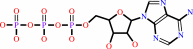 ATP
ATP
|
=
|
ribonucleoside 5'-triphosphate
|
+
|
ADP
Bound ligand (Het Group name = )
corresponds exactly
|
|
|
|
|
|
|
2'-deoxyribonucleoside 5'-diphosphate
|
+
|
ATP
|
=
|
2'-deoxyribonucleoside 5'-triphosphate
|
+
|
ADP
Bound ligand (Het Group name = )
corresponds exactly
|
|
|
|
|
|
|
|
|
|
|
|
|
Molecule diagrams generated from .mol files obtained from the
KEGG ftp site
|
|
|
|
|
|
|
|
|
|
|
|
|
|
 |
|
|
|
|
|
|
| |
|
|
| |
|
DOI no:
|
J Mol Biol
332:915-926
(2003)
|
|
PubMed id:
|
|
|
|
|
|
| |
|
Nucleotide binding to nucleoside diphosphate kinases: X-ray structure of human NDPK-A in complex with ADP and comparison to protein kinases.
|
|
Y.Chen,
S.Gallois-Montbrun,
B.Schneider,
M.Véron,
S.Moréra,
D.Deville-Bonne,
J.Janin.
|
|
|
|
|
| |
ABSTRACT
|
|
|
|
| |
|
|
NDPK-A, product of the nm23-H1 gene, is one of the two major isoforms of human
nucleoside diphosphate kinase. We analyzed the binding of its nucleotide
substrates by fluorometric methods. The binding of nucleoside triphosphate (NTP)
substrates was detected by following changes of the intrinsic fluorescence of
the H118G/F60W variant, a mutant protein engineered for that purpose. Nucleoside
diphosphate (NDP) substrate binding was measured by competition with a
fluorescent derivative of ADP, following the fluorescence anisotropy of the
derivative. We also determined an X-ray structure at 2.0A resolution of the
variant NDPK-A in complex with ADP, Ca(2+) and inorganic phosphate, products of
ATP hydrolysis. We compared the conformation of the bound nucleotide seen in
this complex and the interactions it makes with the protein, with those of the
nucleotide substrates, substrate analogues or inhibitors present in other NDP
kinase structures. We also compared NDP kinase-bound nucleotides to ATP bound to
protein kinases, and showed that the nucleoside monophosphate moieties have
nearly identical conformations in spite of the very different protein
environments. However, the beta and gamma-phosphate groups are differently
positioned and oriented in the two types of kinases, and they bind metal ions
with opposite chiralities. Thus, it should be possible to design nucleotide
analogues that are good substrates of one type of kinase, and poor substrates or
inhibitors of the other kind.
|
|
|
|
|
|
| |
Selected figure(s)
|
|
|
|
| |
|
|

|
|

|
|
Figure 4.
Figure 4. The nucleotide binding site of human NDPK-A. (A)
ADP, Ca^2+ and inorganic phosphate bound to subunit A of
H118G/F60W variant NDPK-A; the 2.0 Å resolution
F[o]−F[c] electron density is contoured at 3σ. (B) Comparison
of ADP-Pi-Ca^2+ in the variant NDPK-A (yellow bonds) with
GDP-Mg^2+ bound to NDPK-B (green bonds). The two human NDP
kinases are identical at their active site except for the H118G
and F60W substitutions engineered in the variant. ADP and GDP
interact with the same set of residues.
|
|
Figure 8.
Figure 8. The NTP environment and conformation in
cAMP-dependent protein kinase and NDP kinase. ATP bound to cAPK
(cAMP-dependent protein kinase,[46.] PDB entry 1ATP) is drawn in
orange bonds. The triphosphate moiety interacts with the
main-chain NH of residues 53-55, the side-chains of Lys72 and
Lys168, and two Mn2+ labelled M1 and M2. ADP bound to the
variant NDPK-A (yellow bonds) and R[p]-a-borano AZT triphosphate
bound to a variant Dictyostelium NDP kinase[15.] (blue bonds,
PDB entry 1MN7), are superimposed on ATP in cAPK. The AZT
derivative binds the variant NDP kinase like the natural
substrate dTTP; it carries a borano (BH[3]^ -) group in R[p]
position of the a-phosphate. Mg2+ (blue ball) ligates the oxygen
in the S[p] position, and the b and g-phosphate groups.
|
|
|
|
|
|
| |
The above figures are
reprinted
by permission from Elsevier:
J Mol Biol
(2003,
332,
915-926)
copyright 2003.
|
|
| |
Figures were
selected
by an automated process.
|
|
|
|
|
|
|
|
|
|
|
|
|
|
|
|
 |
 |
 |
|
Literature references that cite this PDB file's key reference
|
|
|
| |
PubMed id
|
|
Reference
|
|
|
|
|
|
A.Bilitou,
J.Watson,
A.Gartner,
and
S.Ohnuma
(2009).
The NM23 family in development.
|
| |
Mol Cell Biochem,
329,
17-33.
|
|
|
|
|
|
|
M.Boissan,
S.Dabernat,
E.Peuchant,
U.Schlattner,
I.Lascu,
and
M.L.Lacombe
(2009).
The mammalian Nm23/NDPK family: from metastasis control to cilia movement.
|
| |
Mol Cell Biochem,
329,
51-62.
|
|
|
|
|
|
|
M.Kandeel,
T.Miyamoto,
and
Y.Kitade
(2009).
Bioinformatics, enzymologic properties, and comprehensive tracking of Plasmodium falciparum nucleoside diphosphate kinase.
|
| |
Biol Pharm Bull,
32,
1321-1327.
|
|
|
|
|
|
|
T.S.Dexheimer,
S.S.Carey,
S.Zuohe,
V.M.Gokhale,
X.Hu,
L.B.Murata,
E.M.Maes,
A.Weichsel,
D.Sun,
E.J.Meuillet,
W.R.Montfort,
and
L.H.Hurley
(2009).
NM23-H2 may play an indirect role in transcriptional activation of c-myc gene expression but does not cleave the nuclease hypersensitive element III1.
|
| |
Mol Cancer Ther,
8,
1363-1377.
|
|
|
PDB codes:
|
|
|
|
|
|
|
|
D.Topalis,
H.Kumamoto,
M.F.Amaya Velasco,
L.Dugué,
A.Haouz,
J.A.Alexandre,
S.Gallois-Montbrun,
P.M.Alzari,
S.Pochet,
L.A.Agrofoglio,
and
D.Deville-Bonne
(2007).
Nucleotide binding to human UMP-CMP kinase using fluorescent derivatives -- a screening based on affinity for the UMP-CMP binding site.
|
| |
FEBS J,
274,
3704-3714.
|
|
|
|
|
|
|
J.A.Alexandre,
B.Roy,
D.Topalis,
S.Pochet,
C.Périgaud,
and
D.Deville-Bonne
(2007).
Enantioselectivity of human AMP, dTMP and UMP-CMP kinases.
|
| |
Nucleic Acids Res,
35,
4895-4904.
|
|
|
|
|
|
|
M.A.Boudreau,
and
J.C.Vederas
(2007).
Synthesis and biological evaluation of nucleoside dicarboxylates as potential mimics of nucleoside diphosphates.
|
| |
Org Biomol Chem,
5,
627-635.
|
|
|
|
|
|
|
M.F.Giraud,
F.Georgescauld,
I.Lascu,
and
A.Dautant
(2006).
Crystal structures of S120G mutant and wild type of human nucleoside diphosphate kinase A in complex with ADP.
|
| |
J Bioenerg Biomembr,
38,
261-264.
|
|
|
PDB codes:
|
|
|
|
|
|
|
|
D.Topalis,
B.Collinet,
C.Gasse,
L.Dugué,
J.Balzarini,
S.Pochet,
and
D.Deville-Bonne
(2005).
Substrate specificity of vaccinia virus thymidylate kinase.
|
| |
FEBS J,
272,
6254-6265.
|
|
|
|
|
|
|
Y.Shen,
J.I.Kim,
and
P.S.Song
(2005).
NDPK2 as a signal transducer in the phytochrome-mediated light signaling.
|
| |
J Biol Chem,
280,
5740-5749.
|
|
|
|
|
|
The most recent references are shown first.
Citation data come partly from CiteXplore and partly
from an automated harvesting procedure. Note that this is likely to be
only a partial list as not all journals are covered by
either method. However, we are continually building up the citation data
so more and more references will be included with time.
Where a reference describes a PDB structure, the PDB
codes are
shown on the right.
|
|


 Links
Links


