 |
PDBsum entry 1soo

|
|
|
|
|
 |
Contents |
 |
|
|
|
|
|
|
|
|
|
|
|
|
|
|
* Residue conservation analysis
|
|
|
|
|
|
|
|
|
|
|
Enzyme class:
|
|
E.C.6.3.4.4
- adenylosuccinate synthase.
|
|
|
|
|
|
|
Pathway:
|
|
AMP and GMP Biosynthesis
|
|
|
|
|
|
Reaction:
|
|
IMP + L-aspartate + GTP = N6-(1,2-dicarboxyethyl)-AMP + GDP + phosphate + 2 H+
|
|
|
|
|
|
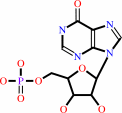 IMP
IMP
|
+
|
L-aspartate
Bound ligand (Het Group name = )
matches with 68.00% similarity
|
+
|
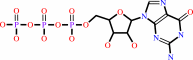 GTP
GTP
|
=
|
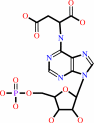 N(6)-(1,2-dicarboxyethyl)-AMP
|
+
|
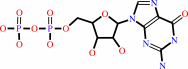 GDP
GDP
|
+
|
 phosphate
|
+
|
2
×
H(+)
|
|
|
|
|
|
|
|
|
|
|
|
|
Molecule diagrams generated from .mol files obtained from the
KEGG ftp site
|
|
|
|
|
|
|
|
|
|
|
|
|
|
 |
|
|
|
|
|
|
| |
|
|
| |
|
|
Proc Natl Acad Sci U S A
93:9431-9436
(1996)
|
|
PubMed id:
|
|
|
|
|
|
| |
|
The mode of action and the structure of a herbicide in complex with its target: binding of activated hydantocidin to the feedback regulation site of adenylosuccinate synthetase.
|
|
R.Fonné-Pfister,
P.Chemla,
E.Ward,
M.Girardet,
K.E.Kreuz,
R.B.Honzatko,
H.J.Fromm,
H.P.Schär,
M.G.Grütter,
S.W.Cowan-Jacob.
|
|
|
|
|
| |
ABSTRACT
|
|
|
|
| |
|
|
(+)-Hydantocidin, a recently discovered natural spironucleoside with potent
herbicidal activity, is shown to be a proherbicide that, after phosphorylation
at the 5' position, inhibits adenylosuccinate synthetase, an enzyme involved in
de novo purine synthesis. The mode of binding of hydantocidin 5'-monophosphate
to the target enzyme was analyzed by determining the crystal structure of the
enzyme-inhibitor complex at 2.6-A resolution. It was found that adenylosuccinate
synthetase binds the phosphorylated compound in the same fashion as it does
adenosine 5'-monophosphate, the natural feedback regulator of this enzyme. This
work provides the first crystal structure of a herbicide-target complex reported
to date.
|
|
|
|
|
|
|
|
|
|
|
|
|
|
|
|
|
|
 |
 |
 |
|
Literature references that cite this PDB file's key reference
|
|
|
| |
PubMed id
|
|
Reference
|
|
|
|
|
|
S.O.Duke
(2007).
The emergence of grass root chemical ecology.
|
| |
Proc Natl Acad Sci U S A,
104,
16729-16730.
|
|
|
|
|
|
|
R.Zrenner,
M.Stitt,
U.Sonnewald,
and
R.Boldt
(2006).
Pyrimidine and purine biosynthesis and degradation in plants.
|
| |
Annu Rev Plant Biol,
57,
805-836.
|
|
|
|
|
|
|
R.Boldt,
and
R.Zrenner
(2003).
Purine and pyrimidine biosynthesis in higher plants.
|
| |
Physiol Plant,
117,
297-304.
|
|
|
|
|
|
|
D.Guyer,
A.Tuttle,
S.Rouse,
S.Volrath,
M.Johnson,
S.Potter,
J.Görlach,
S.Goff,
L.Crossland,
and
E.Ward
(1998).
Activation of latent transgenes in Arabidopsis using a hybrid transcription factor.
|
| |
Genetics,
149,
633-639.
|
|
|
|
|
|
|
M.Gregoriou,
M.E.Noble,
K.A.Watson,
E.F.Garman,
T.M.Krulle,
C.de la Fuente,
G.W.Fleet,
N.G.Oikonomakos,
and
L.N.Johnson
(1998).
The structure of a glycogen phosphorylase glucopyranose spirohydantoin complex at 1.8 A resolution and 100 K: the role of the water structure and its contribution to binding.
|
| |
Protein Sci,
7,
915-927.
|
|
|
PDB codes:
|
|
|
|
|
|
|
The most recent references are shown first.
Citation data come partly from CiteXplore and partly
from an automated harvesting procedure. Note that this is likely to be
only a partial list as not all journals are covered by
either method. However, we are continually building up the citation data
so more and more references will be included with time.
Where a reference describes a PDB structure, the PDB
codes are
shown on the right.
|
|


 Links
Links


