 |
PDBsum entry 1soi

|
|
|
|
|
 |
Contents |
 |
|
|
|
|
|
|
|
|
|
|
|
|
* Residue conservation analysis
|
|
|
|
|
|
PDB id:
|
|
|
|
| Name: |
|
Hydrolase
|
|
|
Title:
|
|
Crystal structure of nudix hydrolase dr1025 in complex with sm+3
|
|
Structure:
|
|
Mutt/nudix family protein. Chain: a. Engineered: yes
|
|
Source:
|
|
Deinococcus radiodurans. Organism_taxid: 1299. Gene: dr1025. Expressed in: escherichia coli. Expression_system_taxid: 562.
|
|
Biol. unit:
|
|
 Dimer (from PDB file)
|
|
Resolution:
|
|
|
1.80Å
|
R-factor:
|
0.218
|
R-free:
|
0.251
|
|
|
Authors:
|
|
W.Ranatunga,E.E.Hill,J.L.Mooster,E.L.Holbrook,U.Schulze-Gahmen,W.Xu, M.J.Bessman,S.E.Brenner,S.R.Holbrook,Berkeley Structural Genomics Center (Bsgc)
|
Key ref:

|
|
W.Ranatunga
et al.
(2004).
Structural studies of the Nudix hydrolase DR1025 from Deinococcus radiodurans and its ligand complexes.
J Mol Biol,
339,
103-116.
PubMed id:
DOI:

|
|
|
Date:
|
|
|
15-Mar-04
|
Release date:
|
11-May-04
|
|
|
|
|
|
|
PROCHECK
|

|
|
|
|
|
Headers
|
|
|
|
References
|
|
|
|
|
|

|
|
Q9RVK2
(Q9RVK2_DEIRA) -
Nudix hydrolase DR_1025 from Deinococcus radiodurans (strain ATCC 13939 / DSM 20539 / JCM 16871 / CCUG 27074 / LMG 4051 / NBRC 15346 / NCIMB 9279 / VKM B-1422 / R1)
|
|
|
|
Seq:
Struc:
|
|
|
|
159 a.a.
156 a.a.
|
|

|

|
|
|
|
|
|
|
|
|
|
|
|
Key: |
 |
PfamA domain |
|
|
 |
Secondary structure |
|
 |
CATH domain |
|
|
|
|
|
|
|
|
|
|
|
|
|
Enzyme class 2:
|
|
E.C.3.6.1.61
- diadenosine hexaphosphate hydrolase (ATP-forming).
|
|
|
|
|
|
|
Reaction:
|
|
|
1.
|
P1,P6-bis(5'-adenosyl) hexaphosphate + H2O = 2 ATP + 2 H+
|
|
2.
|
P1,P5-bis(5'-adenosyl) pentaphosphate + H2O = ADP + ATP + 2 H+
|
|
3.
|
P1,P4-bis(5'-adenosyl) tetraphosphate + H2O = AMP + ATP + 2 H+
|
|
|
|
|
|
|
P(1),P(6)-bis(5'-adenosyl) hexaphosphate
|
+
|
H2O
|
=
|
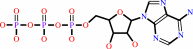 2
×
ATP
2
×
ATP
|
+
|
2
×
H(+)
|
|
|
|
|
|
|
P(1),P(5)-bis(5'-adenosyl) pentaphosphate
|
+
|
H2O
|
=
|
 ADP
ADP
|
+
|
ATP
|
+
|
2
×
H(+)
|
|
|
|
|
|
|
P(1),P(4)-bis(5'-adenosyl) tetraphosphate
|
+
|
H2O
|
=
|
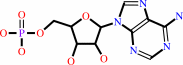 AMP
AMP
|
+
|
ATP
|
+
|
2
×
H(+)
|
|
|
|
|
|
|
|
|
|
Cofactor:
|
|
Divalent cation
|
|
|
|
|
|
Enzyme class 3:
|
|
E.C.3.6.1.69
- 8-oxo-(d)GTP phosphatase.
|
|
|
|
|
|
|
Reaction:
|
|
|
1.
|
8-oxo-GTP + H2O = 8-oxo-GDP + phosphate + H+
|
|
2.
|
8-oxo-dGTP + H2O = 8-oxo-dGDP + phosphate + H+
|
|
|
|
|
|
|
8-oxo-GTP
|
+
|
H2O
|
=
|
2
×
8-oxo-GDP
|
+
|
 2
×
phosphate
2
×
phosphate
|
+
|
H(+)
|
|
|
|
|
|
|
8-oxo-dGTP
|
+
|
H2O
|
=
|
8-oxo-dGDP
|
+
|
phosphate
|
+
|
2
×
H(+)
|
|
|
|
|
|
|
|
|
|
|
|
|
Note, where more than one E.C. class is given (as above), each may
correspond to a different protein domain or, in the case of polyprotein
precursors, to a different mature protein.
|
|
|
|
Molecule diagrams generated from .mol files obtained from the
KEGG ftp site
|
|
|
|
|
|
|
|
|
|
|
|
|
|
 |
|
|
|
|
|
|
| |
|
|
| |
|
DOI no:
|
J Mol Biol
339:103-116
(2004)
|
|
PubMed id:
|
|
|
|
|
|
| |
|
Structural studies of the Nudix hydrolase DR1025 from Deinococcus radiodurans and its ligand complexes.
|
|
W.Ranatunga,
E.E.Hill,
J.L.Mooster,
E.L.Holbrook,
U.Schulze-Gahmen,
W.Xu,
M.J.Bessman,
S.E.Brenner,
S.R.Holbrook.
|
|
|
|
|
| |
ABSTRACT
|
|
|
|
| |
|
|
We have determined the crystal structure, at 1.4A, of the Nudix hydrolase DR1025
from the extremely radiation resistant bacterium Deinococcus radiodurans. The
protein forms an intertwined homodimer by exchanging N-terminal segments between
chains. We have identified additional conserved elements of the Nudix fold,
including the metal-binding motif, a kinked beta-strand characterized by a
proline two positions upstream of the Nudix consensus sequence, and
participation of the N-terminal extension in the formation of the
substrate-binding pocket. Crystal structures were also solved of DR1025
crystallized in the presence of magnesium and either a GTP analog or Ap(4)A
(both at 1.6A resolution). In the Ap(4)A co-crystal, the electron density
indicated that the product of asymmetric hydrolysis, ATP, was bound to the
enzyme. The GTP analog bound structure showed that GTP was bound almost
identically as ATP. Neither nucleoside triphosphate was further cleaved.
|
|
|
|
|
|
| |
Selected figure(s)
|
|
|
|
| |
|
|

|
|

|
|
Figure 1.
Figure 1. The structure of the DR1025 dimer as observed in
the crystal. The Nudix box is colored in blue. Secondary
structure elements are labeled. The b strands are colored
yellow. The other a helices are in pink and the samarium bound
to the Nudix helix (Sm1) is in orange. The intertwining
N-terminal extension is in red. The proteins sit on a
crystallographic 2-fold axis that relates the monomer to the
dimer. Only one samarium of one monomer (Sm1) is shown.
|
|
Figure 3.
Figure 3. Electrostatic potential surface of the DR1025
dimer as calculated by the GRASP program.[32.] The areas of high
negative charge are shaded red, while the positively charged
regions are shaded blue.
|
|
|
|
|
|
| |
The above figures are
reprinted
by permission from Elsevier:
J Mol Biol
(2004,
339,
103-116)
copyright 2004.
|
|
| |
Figures were
selected
by an automated process.
|
|
|
|
|
|
|
|
|
|
|
|
|
|
|
|
 |
 |
 |
|
Literature references that cite this PDB file's key reference
|
|
|
| |
PubMed id
|
|
Reference
|
|
|
|
|
|
T.Nakamura,
S.Meshitsuka,
S.Kitagawa,
N.Abe,
J.Yamada,
T.Ishino,
H.Nakano,
T.Tsuzuki,
T.Doi,
Y.Kobayashi,
S.Fujii,
M.Sekiguchi,
and
Y.Yamagata
(2010).
Structural and dynamic features of the MutT protein in the recognition of nucleotides with the mutagenic 8-oxoguanine base.
|
| |
J Biol Chem,
285,
444-452.
|
|
|
PDB codes:
|
|
|
|
|
|
|
|
G.W.Buchko,
O.Litvinova,
H.Robinson,
A.F.Yakunin,
and
M.A.Kennedy
(2008).
Functional and structural characterization of DR_0079 from Deinococcus radiodurans, a novel Nudix hydrolase with a preference for cytosine (deoxy)ribonucleoside 5'-Di- and triphosphates.
|
| |
Biochemistry,
47,
6571-6582.
|
|
|
PDB code:
|
|
|
|
|
|
|
|
M.Coseno,
G.Martin,
C.Berger,
G.Gilmartin,
W.Keller,
and
S.Doublié
(2008).
Crystal structure of the 25 kDa subunit of human cleavage factor Im.
|
| |
Nucleic Acids Res,
36,
3474-3483.
|
|
|
PDB codes:
|
|
|
|
|
|
|
|
V.Anantharaman,
and
L.Aravind
(2008).
Analysis of DBC1 and its homologs suggests a potential mechanism for regulation of sirtuin domain deacetylases by NAD metabolites.
|
| |
Cell Cycle,
7,
1467-1472.
|
|
|
|
|
|
|
D.I.Fisher,
J.L.Cartwright,
and
A.G.McLennan
(2006).
Characterization of the Mn2+-stimulated (di)adenosine polyphosphate hydrolase encoded by the Deinococcus radiodurans DR2356 nudix gene.
|
| |
Arch Microbiol,
186,
415-424.
|
|
|
|
|
|
|
J.D.Swarbrick,
S.Buyya,
D.Gunawardana,
K.R.Gayler,
A.G.McLennan,
and
P.R.Gooley
(2005).
Structure and substrate-binding mechanism of human Ap4A hydrolase.
|
| |
J Biol Chem,
280,
8471-8481.
|
|
|
PDB codes:
|
|
|
|
|
|
|
The most recent references are shown first.
Citation data come partly from CiteXplore and partly
from an automated harvesting procedure. Note that this is likely to be
only a partial list as not all journals are covered by
either method. However, we are continually building up the citation data
so more and more references will be included with time.
Where a reference describes a PDB structure, the PDB
codes are
shown on the right.
|
|


 Links
Links


