 |
PDBsum entry 1qqm

|
|
|
|
|
 |
Contents |
 |
|
|
|
|
|
|
|
|
|
|
|
|
|
|
* Residue conservation analysis
|
|
|
|
|
|
|
|
|
|
|
Enzyme class:
|
|
E.C.3.6.4.10
- non-chaperonin molecular chaperone ATPase.
|
|
|
|
|
|
|
Reaction:
|
|
ATP + H2O = ADP + phosphate + H+
|
|
|
|
|
|
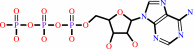 ATP
ATP
|
+
|
H2O
|
=
|
ADP
Bound ligand (Het Group name = )
corresponds exactly
|
+
|
 phosphate
|
+
|
H(+)
Bound ligand (Het Group name = )
corresponds exactly
|
|
|
|
|
|
|
|
|
|
|
|
|
Molecule diagrams generated from .mol files obtained from the
KEGG ftp site
|
|
|
|
|
|
|
|
|
|
|
|
|
|
 |
|
|
|
|
|
|
| |
|
|
| |
|
DOI no:
|
Biochemistry
38:10823-10830
(1999)
|
|
PubMed id:
|
|
|
|
|
|
| |
|
Mapping the role of active site residues for transducing an ATP-induced conformational change in the bovine 70-kDa heat shock cognate protein.
|
|
E.R.Johnson,
D.B.McKay.
|
|
|
|
|
| |
ABSTRACT
|
|
|
|
| |
|
|
ATP binding induces a conformational change in 70-kDa heat shock proteins
(Hsp70s) that facilitates release of bound polypeptides. Using the bovine heat
shock cognate protein (Hsc70) as a representative of the Hsp70 family, we have
characterized the effect of mutations on the coupling between ATP binding and
the nucleotide-induced conformational change. Steady-state solution small-angle
X-ray scattering and kinetic fluorescence measurements on a 60-kDa fragment of
Hsc70 show that point mutations K71M, E175S, D199S, and D206S in the nucleotide
binding cleft impair the ability of ATP to induce a conformational change. A
secondary mutation in the peptide binding domain, E543K, "rescues" the
ATP-induced transition for three of these mutations (E175S/E543K, D199S/E543K,
and D206S/E543K) but not for K71M/E543K. Analysis of kinetics of the ATPase
cycle confirm that these effects do not result from unexpectedly rapid ATP
hydrolysis or slow ATP binding. Crystallographic structures of E175S, D199S, and
D206S mutant ATPase fragment proteins show that the mutations do not perturb the
tertiary structure of the protein but do significantly alter the protein-ligand
interactions, due in part to an apparent charge compensation effect whereby
mutating a (probably) negatively charged carboxyl group to a neutral serine
displaces a K+ ion from the nucleotide binding cleft in two out of three cases
(E175S and D199S but not D206S).
|
|
|
|
|
|
|
|
|
|
|
|
|
|
|
|
|
|
 |
 |
 |
|
Literature references that cite this PDB file's key reference
|
|
|
| |
PubMed id
|
|
Reference
|
|
|
|
|
|
C.Leidig,
G.Bange,
J.Kopp,
S.Amlacher,
A.Aravind,
S.Wickles,
G.Witte,
E.Hurt,
R.Beckmann,
and
I.Sinning
(2013).
Structural characterization of a eukaryotic chaperone-the ribosome-associated complex.
|
| |
Nat Struct Mol Biol,
20,
23-28.
|
|
|
PDB codes:
|
|
|
|
|
|
|
|
A.Zhuravleva,
and
L.M.Gierasch
(2011).
Allosteric signal transmission in the nucleotide-binding domain of 70-kDa heat shock protein (Hsp70) molecular chaperones.
|
| |
Proc Natl Acad Sci U S A,
108,
6987-6992.
|
|
|
|
|
|
|
W.Yang
(2011).
Nucleases: diversity of structure, function and mechanism.
|
| |
Q Rev Biophys,
44,
1.
|
|
|
|
|
|
|
R.G.Smock,
O.Rivoire,
W.P.Russ,
J.F.Swain,
S.Leibler,
R.Ranganathan,
and
L.M.Gierasch
(2010).
An interdomain sector mediating allostery in Hsp70 molecular chaperones.
|
| |
Mol Syst Biol,
6,
414.
|
|
|
|
|
|
|
Y.Liu,
and
I.Bahar
(2010).
Toward understanding allosteric signaling mechanisms in the ATPase domain of molecular chaperones.
|
| |
Pac Symp Biocomput,
(),
269-280.
|
|
|
|
|
|
|
H.J.Woo,
J.Jiang,
E.M.Lafer,
and
R.Sousa
(2009).
ATP-induced conformational changes in Hsp70: molecular dynamics and experimental validation of an in silico predicted conformation.
|
| |
Biochemistry,
48,
11470-11477.
|
|
|
|
|
|
|
R.Perera,
M.Khaliq,
and
R.J.Kuhn
(2008).
Closing the door on flaviviruses: entry as a target for antiviral drug design.
|
| |
Antiviral Res,
80,
11-22.
|
|
|
|
|
|
|
J.Jiang,
E.G.Maes,
A.B.Taylor,
L.Wang,
A.P.Hinck,
E.M.Lafer,
and
R.Sousa
(2007).
Structural basis of J cochaperone binding and regulation of Hsp70.
|
| |
Mol Cell,
28,
422-433.
|
|
|
PDB codes:
|
|
|
|
|
|
|
|
Q.Liu,
and
W.A.Hendrickson
(2007).
Insights into Hsp70 chaperone activity from a crystal structure of the yeast Hsp110 Sse1.
|
| |
Cell,
131,
106-120.
|
|
|
PDB code:
|
|
|
|
|
|
|
|
B.S.Hong,
M.K.Yun,
Y.M.Zhang,
S.Chohnan,
C.O.Rock,
S.W.White,
S.Jackowski,
H.W.Park,
and
R.Leonardi
(2006).
Prokaryotic type II and type III pantothenate kinases: The same monomer fold creates dimers with distinct catalytic properties.
|
| |
Structure,
14,
1251-1261.
|
|
|
PDB codes:
|
|
|
|
|
|
|
|
M.Vogel,
B.Bukau,
and
M.P.Mayer
(2006).
Allosteric regulation of Hsp70 chaperones by a proline switch.
|
| |
Mol Cell,
21,
359-367.
|
|
|
|
|
|
|
M.Vogel,
M.P.Mayer,
and
B.Bukau
(2006).
Allosteric regulation of Hsp70 chaperones involves a conserved interdomain linker.
|
| |
J Biol Chem,
281,
38705-38711.
|
|
|
|
|
|
|
J.Jiang,
K.Prasad,
E.M.Lafer,
and
R.Sousa
(2005).
Structural basis of interdomain communication in the Hsc70 chaperone.
|
| |
Mol Cell,
20,
513-524.
|
|
|
PDB code:
|
|
|
|
|
|
|
|
K.P.Kauppinen,
F.Duan,
J.I.Wels,
and
D.Manor
(2005).
Regulation of the Dbl proto-oncogene by heat shock cognate protein 70 (Hsc70).
|
| |
J Biol Chem,
280,
21638-21644.
|
|
|
|
|
|
|
J.M.Gruschus,
L.E.Greene,
E.Eisenberg,
and
J.A.Ferretti
(2004).
Experimentally biased model structure of the Hsc70/auxilin complex: substrate transfer and interdomain structural change.
|
| |
Protein Sci,
13,
2029-2044.
|
|
|
|
|
|
|
C.Harrison
(2003).
GrpE, a nucleotide exchange factor for DnaK.
|
| |
Cell Stress Chaperones,
8,
218-224.
|
|
|
|
|
|
|
B.A.Owen,
W.P.Sullivan,
S.J.Felts,
and
D.O.Toft
(2002).
Regulation of heat shock protein 90 ATPase activity by sequences in the carboxyl terminus.
|
| |
J Biol Chem,
277,
7086-7091.
|
|
|
|
|
|
|
P.C.Angeletti,
D.Walker,
and
A.T.Panganiban
(2002).
Small glutamine-rich protein/viral protein U-binding protein is a novel cochaperone that affects heat shock protein 70 activity.
|
| |
Cell Stress Chaperones,
7,
258-268.
|
|
|
|
|
|
|
S.L.Newmyer,
and
S.L.Schmid
(2001).
Dominant-interfering Hsc70 mutants disrupt multiple stages of the clathrin-coated vesicle cycle in vivo.
|
| |
J Cell Biol,
152,
607-620.
|
|
|
|
|
|
|
T.K.Barthel,
J.Zhang,
and
G.C.Walker
(2001).
ATPase-defective derivatives of Escherichia coli DnaK that behave differently with respect to ATP-induced conformational change and peptide release.
|
| |
J Bacteriol,
183,
5482-5490.
|
|
|
|
|
|
|
S.Kimmins,
and
T.H.MacRae
(2000).
Maturation of steroid receptors: an example of functional cooperation among molecular chaperones and their associated proteins.
|
| |
Cell Stress Chaperones,
5,
76-86.
|
|
|
|
|
|
The most recent references are shown first.
Citation data come partly from CiteXplore and partly
from an automated harvesting procedure. Note that this is likely to be
only a partial list as not all journals are covered by
either method. However, we are continually building up the citation data
so more and more references will be included with time.
Where a reference describes a PDB structure, the PDB
codes are
shown on the right.
|
|


 Links
Links


